 LEAP26
 AI
AI Saudi Arabia
 UAE
UAE Egypt
EgyptFrom Prompt to Production: How Websparks Lets You Build Full-Stack Apps Without Coding

6 min
Full-stack building remains “slow, fragmented, and unforgiving” despite better frameworks and abundant AI tools.
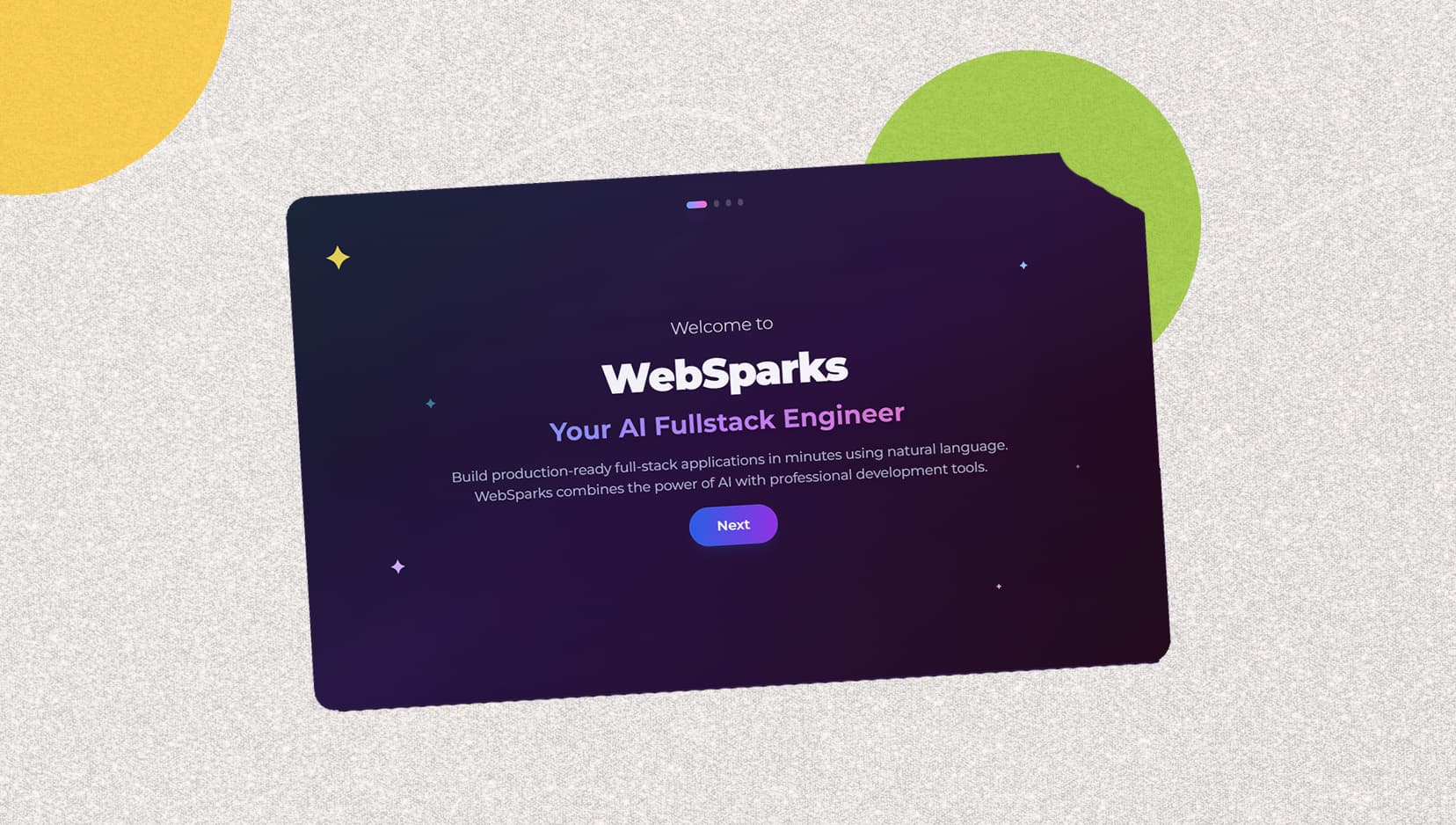
Websparks targets setup pain, acting as an “AI Full-Stack Engineer” from prompt to production.
One prompt generates frontend, backend, integrations, and deployment-ready infrastructure.
Unlike no-code tools, it keeps “real, editable code” and modern frameworks.
The aim is simple: collapse the gap between idea and shipping.
For years, full-stack development has followed the same exhausting pattern.
An idea turns into wireframes.
Wireframes turn into tickets.
Tickets turn into weeks of setup, configuration, integrations, and infrastructure decisions—long before a real user ever touches the product.
Frameworks improved. Tooling exploded. AI entered the picture.
Yet somehow, the process is still slow, fragmented, and unforgiving—especially for founders and teams who just want to ship.
That gap is exactly where Websparks positions itself: not as another coding assistant, but as something more ambitious—an AI Full-Stack Engineer that takes a single prompt and turns it into a production-ready application.
This article breaks down why full-stack development still feels broken, what Websparks actually does differently, and why prompt-to-production may be the most important shift in how software gets built.
Why Full-Stack Development Is Still Broken
Despite all the progress in frameworks and cloud platforms, building a full-stack app remains unnecessarily complex.
Tool Sprawl Became the Default
Modern apps are rarely built with one tool or one stack. Even the simplest product now requires:
- A frontend framework
- A backend or API layer
- Authentication
- Database setup
- Hosting and deployment
- Analytics and SEO
- Payments or integrations
Each decision introduces friction. Each tool has its own configuration, edge cases, and learning curve. What should take hours often turns into weeks—not because the idea is complex, but because the setup is.
Boilerplate Is Still Wasted Time
Developers spend an enormous amount of time recreating the same foundations: auth flows, CRUD logic, environment configs, deployment pipelines.
For non-technical founders, this becomes a hard stop. For developers, it’s quiet burnout. Either way, it slows experimentation—and experimentation is how good products are found.
AI Tools Help… But Only Partially
AI coding tools can generate snippets, components, or isolated functions. They’re helpful—but they don’t think in systems.
They don’t decide:
- How the frontend and backend should evolve together
- How integrations fit into the architecture
- How SEO, security, and deployment are handled coherently
That gap between “generated code” and “working product” is still very real.
What Is Websparks?
Websparks is an AI-powered full-stack app builder designed around a simple but bold idea:
One prompt in → whole app out.
Instead of helping you write code, Websparks helps you build systems.
You describe what you want in natural language—what the app does, who it’s for, and how it should behave. Websparks then generates:
- A complete frontend
- A structured backend
- Integrations and services
- Deployment-ready infrastructure
Not a demo. Not a mockup. A real application you can edit, deploy, and scale.
The positioning is intentional: Websparks acts like an AI Full-Stack Engineer, not a no-code toy or a code snippet generator.
How Websparks Builds Apps From a Single Prompt
The real shift Websparks introduces isn’t just speed—it’s workflow simplification.
Step 1: Prompt the Product, Not the Code
Instead of thinking in components or endpoints, you start by describing the product:
“Build a SaaS dashboard for freelancers to track invoices, payments, and monthly revenue, with authentication and Stripe payments.”
That’s enough context for Websparks to understand intent—not just syntax.
Step 2: Full-Stack Generation
From that prompt, Websparks generates:
- Frontend UI using modern frameworks (React, Next.js, Vue, Svelte)
- Backend logic and APIs
- Authentication flows
- Database structure
- Third-party integrations
The output is structured, readable, and framework-native—not locked into a black box.
Step 3: Visual Editing With Real Code Underneath
You’re not forced into raw code or locked visuals.
Websparks gives you:
- A visual editor for layout and UI changes
- Access to real, editable code underneath
This matters because it keeps the product flexible as it grows.
Step 4: One-Click Deployment
Hosting, deployment, and publishing aren’t afterthoughts.
Websparks connects directly with platforms like Vercel, Netlify, and cloud services, letting you go live without assembling a DevOps puzzle.
Features That Make Websparks Production-Ready
Most builders claim speed. Websparks focuses on completeness.
Full-Stack, Not Partial Generation
Websparks doesn’t stop at UI or logic. It generates the entire system—frontend, backend, and integrations—designed to work together.
Modern Framework Support
You’re not forced into a proprietary stack. Websparks supports popular frameworks like:
- React
- Next.js
- Vue
- Svelte
This keeps projects future-proof and developer-friendly.
Built-In Integrations
Instead of manual setup, Websparks integrates directly with:
- GitHub
- Supabase
- Stripe
- OpenAI
- Vercel & Netlify
What usually takes days of configuration happens automatically.
SEO, Analytics, and Security by Default
These are typically postponed until “later”—and then forgotten.
Websparks includes:
- SEO-ready structure
- Analytics setup
- Security features like authentication and role-based access
From day one, the app behaves like a real product, not a prototype.
Who Websparks Is Built For
Websparks isn’t trying to replace developers. It’s trying to remove unnecessary friction.
Startup Founders & Solo Builders
If you’re validating ideas or launching MVPs, Websparks lets you test faster—without waiting for a full engineering team.
Product Managers & Growth Teams
You can prototype real flows, not slides. That shortens feedback loops and improves alignment.
Agencies Handling Multiple Clients
Repetitive setup disappears. Teams focus on customization and value instead of rebuilding foundations.
Marketers & Campaign Builders
Landing pages, microsites, and experiments can go live without engineering bottlenecks.
Students & New Builders
Websparks lowers the barrier without lowering the ceiling. You learn by building real systems, not toy examples.
Real-World Use Cases We See Repeatedly
- Launching an MVP in days instead of weeks
- Delivering client apps at scale without duplicated effort
- Building internal dashboards quickly
- Creating campaign-specific apps without engineering debt
These aren’t edge cases. They’re everyday product needs that don’t justify months of setup.
Why Websparks Beats Traditional and No-Code Tools
No-code tools prioritize ease, but sacrifice flexibility.
Traditional development prioritizes control, but sacrifices speed.
Websparks sits in between—without forcing a compromise.
- Faster than traditional development
- More flexible than no-code platforms
- More complete than AI coding assistants
Most importantly, it treats production readiness as the default, not an upgrade.
Start Building With Websparks Today
The real promise of AI in software development isn’t replacing engineers. It’s removing wasted effort.
Websparks doesn’t ask you to learn a new paradigm or abandon real code. It simply collapses the distance between idea and execution.
If you’ve ever thought:
- “This should be easier.”
- “Why does setup take longer than validation?”
- “I just want to ship and learn.”






Websparks was built for that moment.
Try Websparks for free. No credit card required.
Type one prompt—and let the app build itself.