 GITEX Dubai
 Ai Everything
 LEAP26
 AI
AI Saudi Arabia
 UAE
UAE Egypt
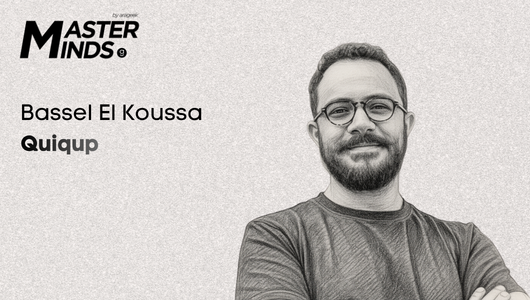
EgyptI am Bassel El Koussa. I backed same-day delivery, and raised the bar

8 min
Bassel El Koussa does not tell the story of Quiqup as a clean arc from idea to success. The defining move, he says, was a painful one: leaving the UK, moving to the UAE, and shifting from a consumer business to a B2B model at the same time. That decision did more than change geography. It forced the company to rethink what kind of business it was trying to become.
What stands out in his account is not just the scale of the pivot, but the cost of executing it. There was culture to preserve, colleagues to part with, and a market to enter from scratch. For El Koussa, this was the moment that mattered because it tested whether the business could survive contact with reality, not just whether the original plan had merit.
Why move markets at all?
When asked about the move from London to Dubai, El Koussa is blunt about the trade-off. In London, he says, Quiqup was operating in a hyper-competitive market where winning depended heavily on raising large amounts of capital while tolerating weak unit economics for too long. That was not the kind of business he wanted to keep building.
The UAE offered something different: the chance to build with a stronger moat and a more durable model. That mattered commercially, but also intellectually. El Koussa says the business they have now is more aligned with the type of technology and service he believes can have a positive effect on the wider economy. The move was not simply opportunistic. It was a recalibration of ambition, from chasing scale in one market to building something more resilient in another.
What bigger players missed in ecommerce logistics
When the conversation turns to the logistics gap Quiqup spotted early, El Koussa points to a weakness that was obvious once you looked beyond the largest platforms. If a merchant was not shipping through Amazon or Noon, he says, the customer experience in the UAE was often simply not good enough. Independent brands were left trying to compete with a structurally worse delivery offer.
Quiqup responded from two directions. The first was speed. El Koussa says the company brought delivery times down from three to five days to same-day service, setting a new regional standard in the process. The second was customer experience. Rather than treating delivery as a backend cost centre, the business was designed from the customer backwards.
That distinction still matters in how he explains the company today. The point was never just to move parcels more cheaply. It was to make independent merchants competitive by closing the experience gap that larger incumbents had opened up.
What it means to build around the end customer
Asked to reflect on Quiqup's biggest success, El Koussa does not reach first for a revenue figure or expansion milestone. He points to reputation. The company, he says, is now recognised in the market as the gold standard for delivery experience, and he sees validation in the brands that trust it with their customers.
That standard, in his telling, came from a fairly strict operating principle: put the client's customer at the centre of both operational design and technical design. If end customers were happy, the commercial result tended to follow. "As long as we could make our clients' clients really happy, we were always able to win more business," he says, and the sentence captures the logic neatly.
There is nothing abstract about that approach. It is a view of logistics as part of the brand promise, not a hidden layer behind it.
How do you scale without becoming rigid?
On the question of scaling across more than 3,500 brands in the UAE and KSA, El Koussa identifies a familiar trap: mistaking what once worked for what will keep working. The hardest part, he says, has been staying genuinely close to the market as customer expectations keep changing.
He is clear that the standard for parcel delivery in 2018 is not the standard now. Competition has sharpened. New entrants have raised the bar. Customers themselves have become more demanding. In that environment, scale can easily turn into complacency.
His answer is flexibility, but not as a slogan. He means staying close enough to the ground to listen, adapt and reinvent the model before it hardens into dogma. The underlying point is that service businesses do not protect standards by freezing them. They protect them by updating them faster than the market shifts.
The founder lesson that still stings
Pressed on failure, El Koussa resists the term. He says he tends to see setbacks as opportunities to learn. Still, one lesson clearly carries weight: he believes Quiqup took too long to pivot.
The caution felt responsible at the time. There was deliberation, planning, and an understandable reluctance to move too abruptly. But looking back, he thinks that delay drained the business in three ways at once. It dragged the company through an old model that no longer fit, consumed leadership attention, and absorbed capital that could have been invested in the future business.
That is why his sharpest lesson is about timing. Once you know a direction is changing, he argues, cutting losses quickly matters more than trying to engineer a perfectly managed transition. The cost of waiting is not just financial. It also sits in lost focus.
The worst decision was making the business his identity
When asked for the worst decision he has made in business, El Koussa gives an answer that is less operational and more personal. It was making the business his life and identity.
He says there was a period when he was not investing enough in himself outside the company, and that eventually fed back into the business itself. The argument is not about work-life balance in the bland corporate sense. It is about judgement. A more well-rounded leader, he says, is better able to see the bigger picture, connect disparate ideas and make better decisions.
That same idea reappears later when he talks about habits. Physical exercise matters. So do hobbies, interests and curiosity outside work. In a tough industry, he argues, effectiveness depends in part on whether you remain in touch with the world beyond the company.
How he thinks about leadership under pressure
When the conversation shifts to leadership, El Koussa describes a style built on space and standards in equal measure. He wants people to have room to realise their own potential and bring their own flavour to the business. He sees diversity of opinion and approach as a practical advantage, not a cultural add-on.
But the freedom is not loose. He pairs it with high expectations on thought process and approach. That combination matters to him because he believes genuine accountability works better when it is internal rather than imposed. Give people space, and they become accountable to themselves and each other. Rely too heavily on top-down pressure, and output may rise in the short term, but in a way he sees as unsustainable.
It is a useful distinction. He is not describing a soft culture. He is describing one where standards are high, but ownership is expected to come from within the team.
What he hires for, and what he cannot teach
Asked about hiring, El Koussa is refreshingly unpolished on the subject. He says it is hard, and that he is still learning how to do it better. The clearest conclusion he has reached is to hire for values.
For him, that does not mean hiring people who think the same way or resemble each other. He wants diversity in personality and approach. What matters is alignment on fundamentals: what people believe in, how they want to show up professionally, what they are ambitious about, and whether those instincts fit the values the company is trying to uphold.
The reasoning is straightforward. Skills can be developed. Values are much harder to install after the fact.
His advice to anyone entering logistics now
Asked to advise someone building in ecommerce infrastructure today, El Koussa's answer is direct: build something different. He sees an industry still too reliant on small iterations of existing models when what is really required is reinvention.

That view is consistent with the rest of his story. He did not end up believing in incremental improvement as a sufficient strategy, not after changing market, model and operating assumptions himself. The lesson from Quiqup is not that founders should pivot for the sake of it. It is that they should be honest about whether the existing model deserves to survive.
For El Koussa, the deeper pattern is clear. Better businesses are often built when founders stop defending the version they started with, move faster than their caution tells them to, and keep enough of themselves outside the company to make sharper decisions inside it.