 GITEX Dubai
 Ai Everything
 LEAP26
 AI
AI Saudi Arabia
 UAE
UAE Egypt
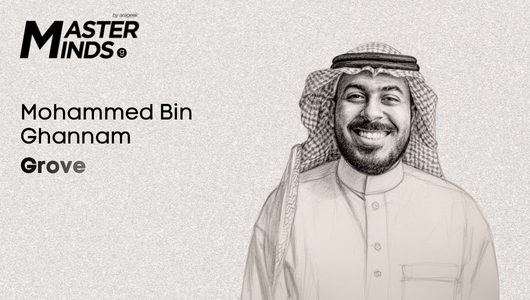
EgyptI am Mohammed Bin Ghannam. I moved from product roles to full ownership.

6 min
Mohammed Bin Ghannam on thinking like an operator, not a function
Mohammed Bin Ghannam has spent his career moving deliberately away from labels. Engineering, product, growth, executive leadership, each phase expanded his scope, but none fully defined how he sees his work now. When asked to introduce himself today, he lands simply on cofounder of Grove, not as a title, but as the natural outcome of a long progression from building software to carrying full business responsibility. The throughline is not discipline, but judgement.
How his professional identity moved from builder to owner
When asked about his professional evolution, Bin Ghannam frames it as an accumulation rather than a series of pivots. He began as a software engineering student, moved into product development, then steadily absorbed marketing, growth, and executive responsibilities. Each step added a layer of accountability. By the time he co-founded Grove, introducing himself any other way would have felt incomplete. Ownership, rather than craft, had become the defining feature of his work.
Why mindset is shaped slowly, not by defining moments
Pressed on the experiences that shaped his mindset, he resists the urge to point to a single formative chapter. In his view, mindset is not forged in moments of intensity alone, but in the years of reflection that follow. Exposure compounds gradually. Even periods that feel transformative at the time only reveal their full impact later, once decisions and outcomes can be properly examined.
How he thinks about the relationship between product and growth
When the conversation turns to product versus growth, Bin Ghannam is precise. He sees growth not as a function, but as a way of working in environments where roles are still fluid. Growth, in his framing, is the search for the highest order-of-magnitude problem holding the business back, whether that problem sits in operations, distribution, product, or commercial structure.
Product skills remain essential, even when the bottleneck is elsewhere. For product leaders, growth becomes a bridge, a way to extend their thinking from user problems to business constraints without abandoning rigour.
What actually triggered change at Mrsool
Asked about his time at Mrsool, Bin Ghannam is careful to correct the usual narrative. The shift towards data-driven, user-centric decision making was not driven by resistance or internal politics. It was driven by scale arriving far earlier than organisational maturity.
He joined just after the company hit product-market fit. Growth was explosive, largely organic, pushing Mrsool to revenue volumes typically seen years later. The challenge was not convincing people to change, but building decision infrastructure while the company continued to grow at speed. There was no middle management to resist. The difficulty lay in adjusting the plane mid-flight.
The hardest decisions in building a product organisation
When asked about building the product team at Mrsool, he points to a structural tension that many scaling companies underestimate. The organisation had to fight fires daily, dealing with technical debt and scalability issues, while simultaneously holding a long-term roadmap and vision.
These demands require fundamentally different types of people. Balancing both without creating redundancy or bureaucracy was the real challenge. Alignment, hiring, and culture mattered, but the deeper question was how to let opposing modes of work coexist without paralysing the organisation.
The real product-market-fit question at Sary
On the question of Sary, a two-sided marketplace serving micro and small businesses, Bin Ghannam reduces the problem to a single, uncomfortable question. If price is removed from the equation, what else convinces a small grocery operator to change behaviour and order through an app?
Everything else followed from answering that. Until that question was resolved, scaling was secondary.
Why he calls growth an engineering problem
Pressed on his description of growth as an engineering problem, he is direct. The idea is meant to push back against the myth of growth as hacking. There is nothing random about it.
Growth, as he defines it, is the methodical identification of the largest real problem preventing consistent usage. The problem space is effectively infinite, resources are not. Guesswork does not scale. An engineering mindset, exhaustive, structured, and constraint-aware, is the only viable approach.
How he balanced experimentation and stability at scale
Asked to reflect on experimentation at Sary, Bin Ghannam emphasises coordination over cleverness. Experiments were designed within existing operational limits, with constant communication across teams. Early tests were intentionally non-disruptive. Once a signal appeared, commercialisation and scaling plans were socialised quickly, so experiments did not become isolated successes that the organisation could not absorb.
The bottleneck startups underestimate most
When the conversation shifts to scalability bottlenecks, his answer avoids technology entirely. Culture, he argues, is the hardest thing to accelerate.
Money can buy tools and people, but it cannot buy shared values or judgement under pressure. Culture takes time to form and constant reinforcement to preserve. If the wrong behaviours are allowed to persist early, they scale just as efficiently as the business does.
How he forces teams to focus on the right problem
Asked about keeping teams from defaulting to feature delivery, Bin Ghannam points to written communication. Writing slows thinking. It exposes weak logic and defuses urgency driven by fear of missing out.
He expects teams to present a clear chain of reasoning, one that links the proposed work directly to the agreed problem for that period. If the logic cannot be defended in writing, the work is not ready.
His rule for avoiding overbuilding
On the question of simplicity, his answer is characteristically unsentimental. Ship it. If it works, users will make it obvious what comes next. If it does not, no amount of theorising would have saved it.
Why he chose agriculture and fresh produce
When asked about founding Grove, Bin Ghannam splits his motivation cleanly. Personally, his connection to nature and time spent on farms made the sector familiar. Professionally, agriculture offered something more compelling: a large market with problems that cannot be easily copied away by competitors.
Attempting to improve an age-old system in Saudi Arabia felt both ambitious and grounded.
What working backwards from demand really changes
On Grove’s demand-led approach, he avoids grand claims. The supply chain itself remains intact. What changes is value capture. By creating a direct path between farmers and optimal demand for each grade of produce, value shifts back to those who create it.
The best produce goes direct to consumers. The rest continues through wholesale markets. The outcome is economically positive for farmers without pretending to reinvent an entire system.
The hardest transition from software to supply chains
Asked about moving from pure tech into a physical, asset-heavy industry, Bin Ghannam is clear that technology is not the hard part. Adoption is.
The long-term goal is to avoid operating heavy assets. That only happens if the market adopts the platform at scale. Building the solution is solvable. Changing behaviour is the real work.
The skill that will still matter in ten years


To close, he returns to fundamentals. Product management, in his view, does not require a new mindset for the next decade. Communication remains the core skill.
Listening well, articulating clearly, and adjusting your message across audiences, from internal teams to millions of users, determines effectiveness. The scale changes. The requirement does not.