 LEAP26
 AI
AI Saudi Arabia
 UAE
UAE Egypt
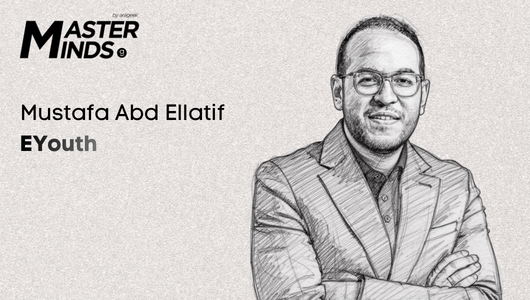
EgyptI am Mustafa Abd Ellatif. I chased opportunity gaps, which shaped EYouth

8 min
A system that fails until someone decides to fix it
When asked about where his thinking on education first took shape, Mustafa Abd Ellatif does not point to a company, but to a gap. As an engineering student at Assiut University, he watched capable peers move through years of study only to graduate without confidence or direction. The problem, as he saw it, was not intelligence or effort. It was translation. Knowledge was not turning into skills, and skills were not turning into opportunity.
That question, why education fails to convert potential into outcomes, stayed with him. Later exposure to entrepreneurship in the United States reframed the issue. There, education did not sit apart from the economy. It fed directly into it. Universities acted as engines for ideas, and students were expected to shape their own paths. In Switzerland, a different lesson emerged, this time about structure and discipline. Systems worked because they were designed to last and to scale.
Taken together, those experiences formed a clear position. Education is not an academic exercise. It is an economic gateway, and it must be run with the same seriousness as any enterprise.
The moment the problem became personal
When the conversation turns to the moment that pushed him from observation to action, he recalls a small training programme in a village in Upper Egypt. Resources were limited, the setting modest, but the insight was sharp. In an open discussion after the sessions, one participant cut through the usual narrative around aid and support.
They did not want help. They wanted a chance.
That distinction shifted the problem. It was not simply about equipping people with skills. It was about building pathways that connect those skills to fair opportunities. The idea of impact became more concrete, and more demanding. Changing one life was proof of concept. Scaling that change became the ambition.
What different systems taught him about youth potential
Asked to reflect on how studying across three countries shaped his understanding, Abd Ellatif separates what each environment revealed. In Egypt, he saw raw, underutilised potential. Talent was not scarce. Opportunity was.
In the United States, he saw how ideas move quickly from concept to company, and how education systems actively support that transition. In Switzerland, he saw the value of long-term thinking, where institutions are built with sustainability in mind, not short-term output.
The conclusion is not to replicate one model, but to combine strengths. Energy and ambition from Arab youth, paired with relevant technical education, aligned with real market demand, and executed with discipline. That combination sits at the core of what he set out to build.
Proving the idea before anyone else believes it
Pressed on the early challenges, he returns to a familiar theme for first-time founders. Credibility. Starting young, without capital or strong networks, meant that belief in the idea had to be earned through results, not promises.
Doubt came from multiple directions. Financial pressure was constant. At times, continuation itself was uncertain. What sustained the effort was not a single breakthrough, but a combination of conviction, team alignment, and a willingness to learn quickly from mistakes.
Failure was not treated as a setback, but as input.
Starting small, building trust the hard way
When asked how EYouth began in practice, the answer is deliberately simple. The first problem they tackled was access. How do you reach young people outside major cities?
The solution was direct. Travel across governorates, run workshops, work long hours with minimal resources. The early phase was less about scale and more about trust. Trust from participants, and trust from partners who needed to see tangible outcomes.
The first meaningful signal came when thousands of participants began to translate training into real opportunities. At that point, the model proved it could work beyond theory.
Scaling from programmes to millions
On the question of how EYouth reached millions of learners across multiple countries, Abd Ellatif avoids any single explanation. Instead, he points to three consistent choices.
First, start with the market, not the curriculum. Identify what jobs exist, what skills are missing, and design programmes accordingly. Second, build partnerships early, across governments, private sector, and international organisations. Scale does not happen in isolation. Third, invest in technology as infrastructure, not as an add-on. Without a flexible platform, expansion across countries would not have been possible.
Technology, in this case, is what turned a series of workshops into a system.
Linking learning directly to earning
When asked how EYouth translated training into over 500,000 job opportunities, he describes a model that rejects the idea of education as an endpoint. The framework is simple in concept, harder in execution. Training must lead somewhere measurable.
Programmes are designed based on company needs, not academic assumptions. Candidates are then directly connected to opportunities. The same logic extends to entrepreneurship, where support goes beyond training into actually enabling the creation of startups.
The underlying principle is clear. Certificates do not matter unless they lead to outcomes.
The moment it became a regional mission
Asked to identify a turning point, Abd Ellatif distinguishes between emotional and strategic milestones. On a personal level, seeing the first cohort secure jobs validated the effort. It proved that the model could change individual lives.
At an organisational level, expansion beyond Egypt marked a different kind of shift. Entering markets like Saudi Arabia and the UAE turned the initiative into a regional mission. The problem they were addressing was not local. The demand for solutions was shared.
Why EdTech in the region remains unfinished
When the conversation moves to the broader sector, his assessment is direct. EdTech in the Arab world is still early, and the gaps are structural. High-quality Arabic content remains limited. The disconnect between education and employment persists. Infrastructure varies widely across countries. Funding often favours more traditional sectors.
Yet the constraints point to opportunity. A young population, combined with digital transformation, creates conditions for rapid growth if the right models are built.
Building around outcomes, not content
Asked how EYouth approached these challenges, Abd Ellatif outlines three priorities. Develop strong Arabic content that meets global standards. Build technology that can scale across different learning environments. Most importantly, ensure every programme leads to a tangible outcome, whether employment, a project, or measurable progress.
The emphasis is consistent. Output over activity.
The role of AI in reshaping education
When asked about what will define the next phase of EdTech, he points to artificial intelligence as a structural shift. Not as a feature, but as a foundation.
AI has the potential to personalise learning, reduce time to competence, and improve how talent is matched with opportunity. It can also introduce more consistent and fair evaluation systems. Those who integrate it early will not just improve efficiency, they will redefine expectations.
Choosing where to expand, and why it matters
On the question of expansion into Saudi Arabia and the UAE, the rationale is tied to momentum. Both markets are actively investing in youth, education, and economic transformation. Demand is not theoretical. It is backed by policy and capital.
Future expansion follows a similar logic. Markets are selected based on youth demographics, unemployment levels, technological readiness, and the presence of strong local partners. Without alignment across these factors, scale becomes harder to sustain.
Building towards a larger target
Asked about the next five years, Abd Ellatif frames the goal in terms of reach and function. Growth is not just about becoming the largest platform. It is about becoming the most effective bridge between learning and earning.
The target of reaching 15 million young people by 2027 reflects both ambition and urgency. The region’s digital economy will depend on how quickly talent can be prepared and deployed.
Leadership shaped by pressure and pace
When asked which leadership skills mattered most, he narrows it down to two. Adaptability and decisiveness. The ability to respond to changing conditions, and the willingness to make decisions without perfect information.
He adds a quieter point. Leadership also requires listening. Not as a principle, but as a practice that improves judgement over time.
A direct message to those still waiting




Asked what he would say to young people in the region, his answer is stripped of abstraction. Waiting for perfect conditions is a mistake. They do not exist.
Progress comes from starting with what is available, learning through action, and treating mistakes as part of the process. Opportunity is not always visible, but it exists for those who actively look for it.