 Ai Everything
 LEAP26
 AI
AI Saudi Arabia
 UAE
UAE Egypt
EgyptI am Naief Jobsen. I refused specialisation, and it shaped how I build companies

7 min
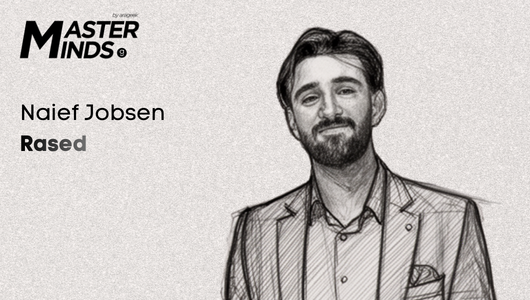
Naief Jobsen does not separate thinking from execution. When asked to reflect on the arc of his career, he comes back to a single idea that runs through everything he has done, context matters more than function. It is a view shaped early, tested repeatedly, and now applied deliberately as he builds ventures designed to scale, survive scrutiny, and eventually be acquired.
Why he refused to choose between being technical and leading
When asked about his professional journey, Jobsen starts with an early contradiction. He began as a junior front end engineer after studying in Sweden, but his interests were never confined to code. Markets and trading were already familiar territory, rooted in family exposure, and he was drawn to understanding how decisions connected across the whole system.
That instinct hardened when a senior director told him he had to choose between staying technical or moving into management. Jobsen rejected the premise. He saw the separation as artificial, and he treated proving that wrong as a personal challenge.
Startups became the natural environment. Problems arrived without job descriptions, and titles carried little protection. Over time, he worked across more than 50 projects and 15 companies spanning the US, UK, Scandinavia, the UAE, Saudi Arabia, and Syria. What emerged was not a hybrid role on paper, but a way of operating that linked technology, business, psychology, and execution in practice.
How cross industry work changed how he evaluates problems
On the question of working across such varied industries, Jobsen is blunt about what actually transfers. Patterns repeat. Once you understand how technology, product, and business reinforce or undermine each other, the specific domain matters far less than most people assume.
This perspective removes intimidation from new markets. He does not develop loyalty to sectors or labels. His loyalty is to outcomes, and to identifying what genuinely creates success rather than what sounds impressive within a given industry.
Why ego quietly destroys otherwise strong businesses
Asked to unpack his belief that ego is the biggest threat to sustainability, Jobsen frames it as a listening problem. Ego surfaces when someone repeats an idea you already had or challenges something on your roadmap. The instinct is to disengage because it feels redundant.
He argues that this is precisely the moment to listen more carefully. The value may sit in timing, framing, or execution detail rather than originality. Businesses are ultimately judged on numbers, KPIs, and outcomes, not on who thought of what first. His focus is on being the engine that delivers results, not the hero who claims credit.
What building an acquirable company actually requires
When the conversation turns to his idea of building ventures to make them acquirable, Jobsen grounds it in removing friction. The first step is defining and targeting the Ideal Customer Profile with precision. From there, everything must signal fit, from product design and messaging to onboarding and customer success.
At the same time, the business needs to surface expansion paths early, including cross sell opportunities, vertical depth, and even future venture creation. Having worked with more than 50 investors through both family and startup channels, he has seen how often healthy businesses fail to meet investment readiness standards. Bridging that gap, he says, is a discipline of its own.
How he creates autonomy without chaos
Pressed on culture, Jobsen reduces it to three components, trust, measurement, and bonds. Strong human relationships matter, but so does clarity. Everything that can be tracked should be tracked.
Autonomy without measurement drifts into chaos. Measurement without trust creates fear. When both are present, teams move quickly, learn faster, and take responsibility for outcomes rather than hiding behind process.
His approach to stakeholder management under pressure
Asked about stakeholder management, Jobsen emphasises preparation and empathy over performance. He puts himself in the stakeholder’s position, recognising that a department head, a C suite executive, and a regulator operate under very different pressures.
He plans several steps ahead, sets clear soft and hard deadlines, and leaves margin for error. When things go wrong, he stays transparent. Bluffing is not an option. Consistency, trust, and honesty are non negotiable because credibility compounds over time.
The lessons that only scaling pain teaches
When asked which experiences taught him the most about scaling, Jobsen points to loss. Losing money accelerates learning. Learning from others’ losses can do the same without the cost, which is where mentors and trusted networks become critical.
He is clear eyed about the limits of tools. AI can simulate much of advisory thinking on paper, but markets still hold secrets that only surface through genuine relationships. Cultural fluency matters too. Approaches that work with American stakeholders, such as directness and structured confrontation, can fail elsewhere. Understanding these differences can change outcomes dramatically.
Why Rasēd fit his personal criteria
Asked what drew him to Rasēd, Jobsen points to its specificity. He is motivated by niche, high impact ventures, especially those operating where risk, regulation, and technology intersect.
Rasēd’s work is structural and mission critical rather than theoretical. That reality, and the weight of responsibility that comes with it, is what makes the challenge worthwhile for him.
How he explains Rasēd to institutions
On the question of Rasēd’s value proposition, Jobsen keeps it deliberately plain. The company reduces risk, friction, and fragmentation while staying aligned with regulatory reality and operational constraints. Clarity and execution matter more than ambition dressed up in language.
The commercial problems Rasēd is tackling
When pressed on the company’s commercial and growth challenges, Jobsen does not dress them up. They are exactly as they appear. The work is about execution, not storytelling, and the difficulty is part of the point.
Balancing Rasēd with Ghaith Ventures
Asked how his role at Ghaith Ventures complements his work at Rasēd, Jobsen frames it as responsibility. Ghaith Ventures is a vehicle for giving back to Syria, applying the same discipline of growth, governance, and communication, but toward a deeper social purpose.
He hints at initiatives in motion without expanding on them, choosing restraint over promotion.
Why strategic communication still decides outcomes
On the importance of PR and communication, Jobsen highlights word of mouth. Ambiguity is expensive. Poor signals spread faster than good ones, and repairing them costs more than getting it right initially.
Strategic communication, in his view, is about precision rather than volume. Saying less, but saying it clearly.
The principle he relies on when pressure peaks
Asked to name the leadership principle that guides him most under pressure, Jobsen does not hesitate. Radical honesty, starting with himself, then extending outward.
The trend he believes actually matters in digital transformation
When asked about trends, Jobsen dismisses surface level narratives. What excites him are people who close gaps across domains. Sales and marketing, for example, no longer function well as silos. Governed together, they can produce outsized results.
The deeper trend is automation paired with deliberate replaceability. He designs systems to remove dependency on himself, viewing that as a strength rather than a threat.
His advice to founders building for scale and acquisition
Asked to offer advice, Jobsen returns to the same idea. Make yourself replaceable. A company that cannot operate without its founder cannot scale and will not be trusted.
He closes by acknowledging the work of his brothers, Daniel Chahin, Peder Remman, and Arnold Jobsen, who are building an AI diagnostics copilot. His role has been advisory, and he credits their execution rather than his involvement.



Closing
Asked to reflect more broadly, Jobsen sums himself up without softening the edges. The harder the challenge, the more engaged he becomes. He describes himself as both humble and competitive, driven to challenge systems, assumptions, and inertia to get things done.