 LEAP26
 AI
AI Saudi Arabia
 UAE
UAE Egypt
EgyptCNTXT AI Launches Munsit Edge: A Major Leap in On-Device Arabic Transcription

4 min
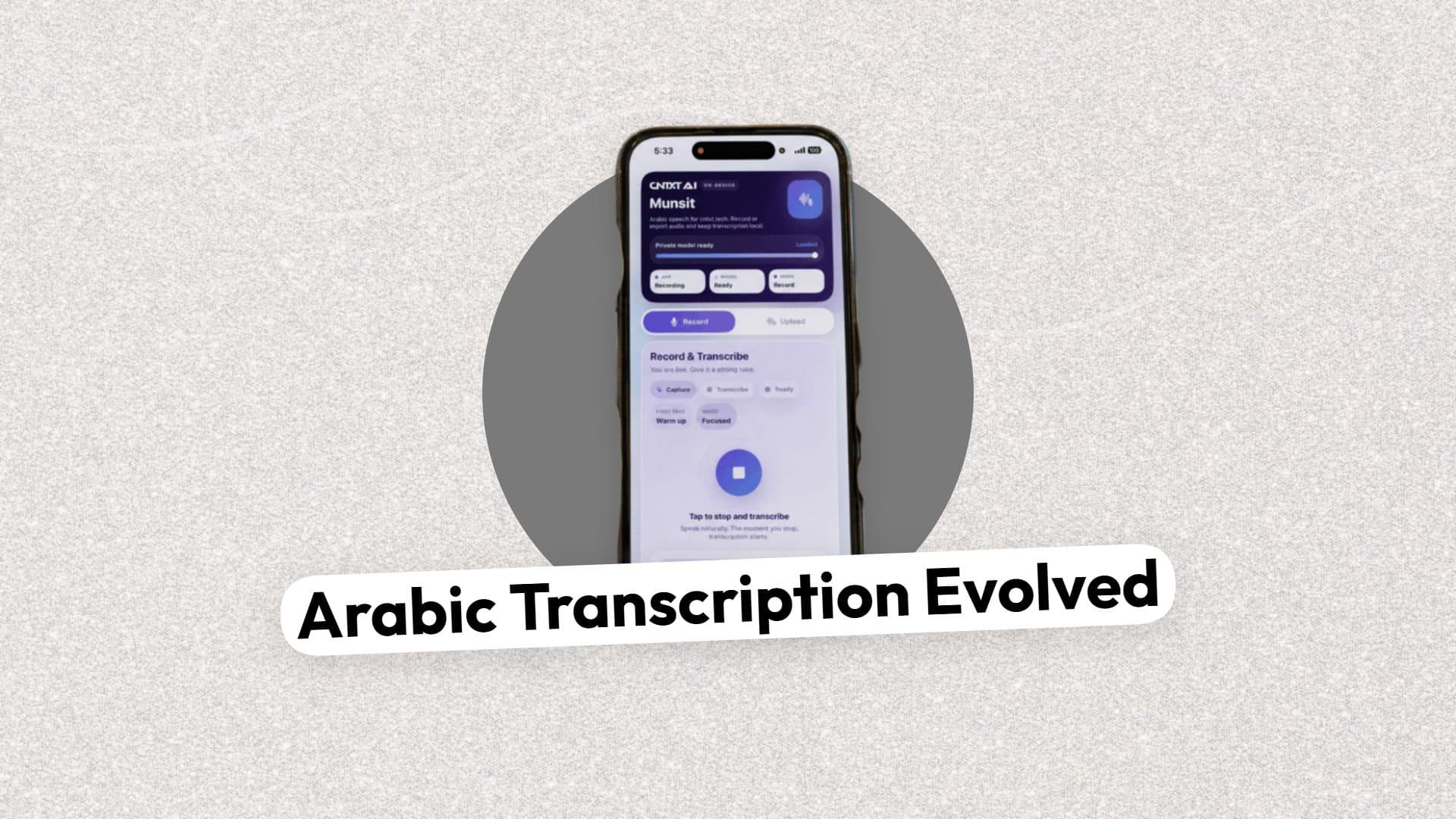
CNTXT AI launched Munsit Edge, an on-device Arabic speech-to-text system.
It delivers real-time transcription without sending audio to the cloud.
The shift boosts privacy, “sovereignty” and lower latency for sensitive sectors.
Built for phones, cars and IoT, it supports broad hardware.
Accuracy across dialects will determine its regional impact.
CNTXT AI has unveiled what it describes as one of the first fully on‑device Arabic speech‑to‑text systems, marking a notable shift in how voice technology could be deployed across the region. The new product, called Munsit Edge, was announced from Abu Dhabi on 13 May 2026, and it brings real-time Arabic transcription directly onto consumer hardware, without relying on the cloud.
In simple terms, this means the audio never leaves your phone, car system or laptop. The company says the system can deliver transcription at around 150 milliseconds on a standard iPhone. That’s fast enough to feel instant in everyday use, whether someone is speaking on a call in Riyadh, dictating notes in Dubai, or interacting with a smart car system in Cairo.
For years, Arabic speech recognition has largely depended on cloud processing. Audio would be streamed to remote servers, handled by heavy GPU infrastructure, and then sent back to the device as text. It works, of course, but it comes with latency, ongoing infrastructure costs and, perhaps most sensitive of all, questions around data privacy. In a region where data sovereignty is becoming a serious talking point, that model can be a bit of a faff.
Mohammad Abu Sheikh, CEO of CNTXT AI, said the launch builds on the company’s earlier Munsit Arabic ASR model, which had already aimed to outperform more generic, non-Arabic-first systems in transcription accuracy. He noted that with Munsit Edge, the company has shifted the processing from distant data centres to users’ own devices, enabling real-time understanding of Arabic without sending any audio to third-party cloud providers.
That last part is crucial. As Abu Sheikh pointed out, sovereignty is not only about where the data is stored, but where it is processed. For banks, government helplines or contact centres handling sensitive calls, having speech recognition operate entirely within their own infrastructure could be a game changer.
Arabic, as many founders in the AI space will tell you, is not easy territory. The language carries rich dialect diversity, frequent code-switching with English, and often challenging real-world audio conditions. Getting high accuracy is one thing; doing it on-device, with limited processing power, is another story altogether. I’ve seen startups struggle with this for years, promising big and delivering… well, not quite spot on. So if the performance claims hold up, this is definately one to watch.
CNTXT AI says Munsit Edge runs across iPhone and Android devices, MacBooks, Windows and Linux PCs, in-car infotainment systems, smart home devices and embedded IoT hardware. The on-device model is supported by runtime optimisation tailored for everyday consumer hardware, rather than server-grade machines.
At the same time, the wider Munsit platform remains available via secure cloud API, a web workspace and a mobile app. In practice, this gives organisations flexibility to combine edge and cloud deployments depending on their needs around latency, compliance or infrastructure.
From my perspective at Arageek, where we constantly meet founders trying to crack the Arabic AI puzzle, this announcement feels like part of a broader regional shift. There’s growing ambition to build “Arabic-first” technology rather than adapting global systems as an afterthought. And believe it or not, that mindset change can ripple far beyond tech, into education, banking, mobility and even how families interact with devices at home.
CNTXT AI positions itself as a UAE-based data and AI company focused on helping organisations build and scale sovereign AI solutions while maintaining control over their data. Alongside its proprietary products like Munsit, it also provides training data, labelling and custom AI integration services for enterprises and AI labs.
On the flip side, the real test will be adoption. Enterprise clients will want proof that accuracy, especially across Gulf, Levantine and North African dialects, stands up under everyday pressure. If it does, Munsit Edge could well shift expectations for Arabic voice AI, moving it from the cloud and placing it firmly, and privately, into the hands of users across the region.
🚀 Got exciting news to share?
If you're a startup founder, VC, or PR agency with big updates—funding rounds, product launches 📢, or company milestones 🎉 — AraGeek English wants to hear from you!
✉️ Send Us Your Story 👇