 GITEX Dubai
 Ai Everything
 LEAP26
 AI
 Saudi Arabia
 UAE
 Egypt
CostLoop Turns SaaS Sprawl Into a Budget Small Businesses Can Control!

10 min
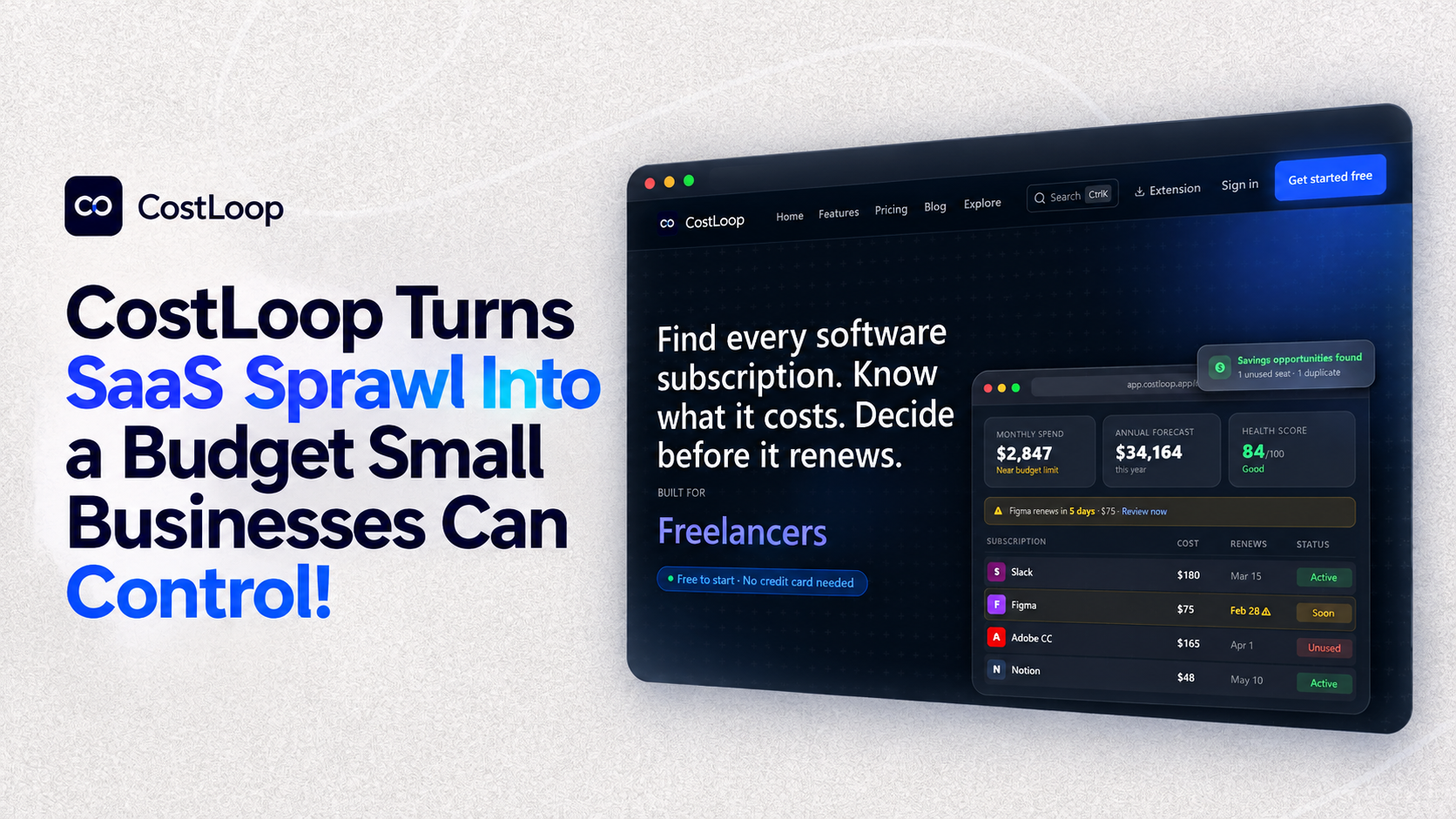
CostLoop gives smaller firms a clear view of “recurring software costs” and renewals.
It finds subscriptions through manual entry, CSV bank imports, or email-scanning extensions.
The platform flags “unused seats”, overlaps and price rises before they vanish into budgets.
Approval workflows help stop shadow spending by checking new tools before purchase.
It suits teams outgrowing spreadsheets, not full enterprise asset or cloud-cost management.
Software subscriptions rarely become a financial burden through one dramatic purchase. The problem usually develops quietly: one team adopts a new collaboration platform, another experiments with several AI tools, and a former employee’s licences continue renewing long after their departure.
Every individual charge may appear reasonable. Collectively, however, they can leave a company paying for unused seats, overlapping products and subscriptions that nobody clearly owns.
Large enterprises can address this problem with procurement departments and specialised software asset management platforms. Smaller organisations often rely on spreadsheets, bank statements and calendar reminders instead. CostLoop wants to close that gap by giving small and medium-sized businesses an accessible command centre for recurring software costs.
A clearer view of recurring spending
CostLoop is a subscription tracking and SaaS spend management platform designed for small businesses, agencies, freelancers and growing teams. Rather than functioning as another accounting application, it concentrates on the operational questions surrounding recurring software expenses:
- What services is the company paying for?
- How much will they cost over a full year?
- When will each subscription renew?
- Who owns and uses each product?
- Are there unused licences or overlapping tools?
- Which subscriptions should be reviewed before the next payment?
Each subscription record can include its vendor, price, currency, billing cycle, category, renewal date, owner, department and number of purchased seats. Teams can also attach invoice and contract links, save cancellation URLs and add notes that may become important during a renewal discussion.
This centralisation matters because SaaS information is normally scattered across employee inboxes, company cards and departmental spreadsheets. When everything is brought together, recurring costs become visible as a portfolio rather than a collection of isolated transactions.
The dashboard then converts those records into monthly spending, projected annual costs, upcoming renewals and department-level breakdowns. CostLoop also supports more than 40 currencies and applies daily exchange-rate conversions, allowing international teams to view subscriptions in a common home currency without manually recalculating every invoice. CostLoop’s feature overview provides further details about its tracking and reporting capabilities.
Three ways to find subscriptions
A subscription management tool is only useful if businesses can build an accurate inventory without spending days entering data. CostLoop therefore offers three methods for bringing subscriptions into the platform.
The first is manual entry, which gives a team direct control over every field. This is suitable for businesses with a small number of tools or those creating a carefully reviewed inventory.
The second is bank-statement import. Users can upload a CSV export rather than connect CostLoop directly to their bank. The platform analyses transactions, identifies charges that appear to recur and suggests them as possible subscriptions. Users can review, edit or reject every suggestion before adding it to their account.
The third option is an email-scanning browser extension for Gmail and Outlook. It looks for billing messages, invoices, payment confirmations and renewal notices that may reveal subscriptions missing from the company’s records.
CostLoop’s current privacy policy says the scanner initially examines fields such as the sender, subject, date and message ID. When it identifies a likely billing email, it may process the message’s text or HTML content to extract subscription details. According to the company, raw email content is not uploaded to CostLoop: only derived information—such as the service name, estimated cost, currency, billing cycle and renewal date—is transmitted when the user confirms an import.
CostLoop also acknowledges that this detection is heuristic. The extension may miss certain billing messages or incorrectly identify an ordinary email as a subscription, so users remain responsible for reviewing the results. That qualification is important: automation can accelerate discovery, but it should not be mistaken for a perfect financial audit.
Catching price increases before they disappear into the budget
Finding a subscription is only the beginning. Prices can change while a service remains active, especially when a discounted introductory period ends or a vendor raises its standard rates.
CostLoop says its connected-inbox feature checks for relevant price-change notices and can show the previous price, new price and percentage increase. This gives teams an opportunity to update their budget or reconsider the service rather than noticing the difference months later.
The platform also sends reminders before renewals. This changes the timing of the decision. A charge on a bank statement tells the finance team what has already happened; a renewal alert creates a window in which the company can cancel, renegotiate or move to a different plan.
Renewal records can contain the subscription owner, seat information, supporting documents and a direct cancellation link. As a result, the person reviewing a renewal does not have to search several systems before making a decision.
From tracking expenses to identifying waste
CostLoop attempts to go beyond maintaining a digital list by evaluating how well the company’s subscription portfolio is managed.
Its Health Score is a rating from zero to 100 based on factors such as unused seats, subscriptions without owners, possible tool duplication and overdue or approaching renewals. The score updates as the team resolves the underlying issues.
A score cannot decide whether a product genuinely creates value, but it can reveal where a human review is most urgently needed. A subscription with no owner is not automatically wasteful, for example, but the absence of accountability makes it easier for that cost to continue without scrutiny.
CostLoop’s savings panel translates several of these signals into estimated financial opportunities. It compares purchased seats with assigned users, flags products in the same category as possible duplicates and highlights spending that exceeds defined budgets.
If a business pays for ten licences but records only seven active users, CostLoop can present the remaining three seats as a possible saving. Similarly, if two departments independently subscribe to tools serving the same function, the platform can surface the overlap for review.
The company is careful to frame these as opportunities rather than automatic cancellation decisions. Two tools in the same category may support very different workflows, and an unassigned licence may be reserved for an incoming employee. The real value lies in directing attention toward costs that would otherwise remain invisible.
Controlling new software before it becomes shadow spending
Subscription waste is easier to prevent than to clean up. CostLoop’s Business plan therefore includes a request-and-approval workflow for teams.
Instead of independently purchasing a product, an employee can submit the proposed tool, vendor, expected monthly cost, department and business reason. Administrators receive a notification and can approve or decline the request. Approval automatically creates a subscription record, reducing duplicate data entry and ensuring the cost enters the company inventory from the beginning.
This workflow connects procurement with visibility. The finance or operations team can check whether the organisation already pays for an equivalent product, whether the department has sufficient budget and who will be responsible for the new subscription.
It is a relatively lightweight form of governance, but that may be precisely what a growing company needs. Small teams often do not require a complex procurement suite; they need a consistent checkpoint before another monthly charge begins. CostLoop explains the complete process in its help centre.
Integrating subscription data with other systems
For organisations that need subscription information outside CostLoop, the Business plan includes a REST API and webhooks.
The API can be used to pull current subscription and spending data into an internal dashboard or reporting system. Webhooks can notify another application when a subscription is created, updated or deleted, or when the status of a request changes. CostLoop says these webhook payloads are protected with HMAC signatures so receiving systems can verify their authenticity.
This makes the product more than an isolated dashboard. A company could, for example, include subscription totals in a wider finance report or trigger an internal workflow when a software request receives approval.
CSV import and export also provide a simpler route for organisations that do not need a technical integration. More importantly, export functionality gives customers a way to retrieve their information instead of permanently locking it inside the platform.
Security and privacy considerations
CostLoop says account and subscription information is stored using Supabase infrastructure hosted in the European Union, with encryption in transit and at rest. Payments are processed by Stripe, meaning CostLoop does not directly store customers’ card numbers or security codes.
The service does not ask users to connect their bank accounts or provide online banking credentials. Bank-statement discovery instead works through a CSV file supplied by the user.
For email integrations, CostLoop uses read-only authorisation and states that raw message text is not retained as part of an imported subscription. Users can disconnect Gmail or Outlook, revoke access and delete stored integration credentials. The company also states that Google account data is not used to train general-purpose AI or machine-learning models.
These are company-published practices, not a substitute for an organisation’s own security assessment. Businesses handling sensitive financial or contractual information should review the platform’s security documentation and privacy policy, particularly before connecting a corporate inbox or uploading transaction records.
Pricing aimed at smaller teams
CostLoop uses a relatively simple pricing structure.
The Free plan supports up to five subscriptions and includes basic tracking, dashboard analytics and renewal reminders. It offers a practical way for freelancers or very small teams to test the product.
The Pro plan is listed at $9 per month for one user and removes the subscription limit. It adds capabilities such as the Health Score, savings opportunities, renewal calendar, CSV import and export, bank-statement import, advanced reminders and the browser extension.
The Business plan is listed at $39 per month and introduces workspaces, team members, subscription requests, approval controls, administrative reporting, API access and webhooks. CostLoop also advertises a seven-day Business trial without requiring a payment card and a discount for annual billing.
Unlike many business platforms, the listed price does not increase according to the number of subscriptions being monitored. Pro remains intended for an individual user, while Business is the team-oriented option. Current details should still be confirmed on the official pricing page before purchasing.
What CostLoop is—and what it is not
CostLoop’s strongest use case is providing straightforward oversight of everyday SaaS subscriptions. It is particularly relevant to companies that have outgrown a spreadsheet but do not need an enterprise-scale software asset management system.
It should not be confused with a complete IT asset management platform. CostLoop is not primarily designed to track employee laptops, reconcile complex enterprise software entitlements or analyse usage telemetry from specialised licence servers. Nor is it a cloud infrastructure cost-optimisation system for analysing resources across AWS, Microsoft Azure or Google Cloud.
Its focus is narrower: recurring software costs, ownership, seats, renewals and purchasing accountability.
That focus may be an advantage for its intended audience. Enterprise platforms can demand lengthy implementation projects and specialised administrators. CostLoop is designed to let a smaller business assemble its inventory, identify obvious waste and establish basic controls without building an entire procurement department.
Making recurring costs accountable
Subscription creep is ultimately an information problem. When nobody can see all the company’s tools, owners, seats and renewal dates in one place, unnecessary spending can continue without attracting attention.
CostLoop responds by turning fragmented recurring charges into structured operational data. Discovery tools help build the inventory, renewal reminders create time to act, savings signals guide reviews, and approval workflows reduce the chance that new purchases will remain invisible.






The platform cannot determine whether every subscription is strategically valuable. That decision still belongs to the people who understand how a tool is used. What CostLoop can do is ensure that the decision is made deliberately—before another automatic renewal turns uncertainty into another year of spending.
For small and growing businesses, that shift from passive payment to active review may be the most important feature of all.