 Ai Everything
 LEAP26
 AI
AI Saudi Arabia
 UAE
UAE Egypt
EgyptI am Ahmed Mahmoud. I bet on dialects, not demos, and won enterprises.

6 min
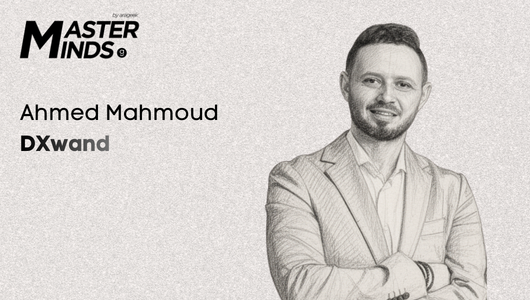
Ahmed Mahmoud does not describe DXwand as an experiment in emerging technology. He talks about it as a response to a structural gap, one that had been obvious to him long before AI became fashionable in the region. After more than two decades in technology, including years working on data analytics and artificial intelligence at Microsoft Egypt, he saw how unevenly progress was distributed. Silicon Valley was accelerating, while the Middle East was largely consuming tools built elsewhere, often poorly adapted to local realities.
That imbalance became the starting point.
Why Arabic AI could not be an afterthought
When asked about how the idea first took shape, Mahmoud points to language rather than technology. The real problem, as he saw it, was that most AI systems simply did not understand how people in the region actually speak. Arabic dialects were either ignored or treated as a minor localisation task, which made many solutions unusable in real customer interactions.
He began digging into the market and joined a business incubator to understand how startups are built, not just how products are engineered. That combination of technical depth and market study led to DXwand’s founding in 2018. The company was incorporated in the United States, largely to meet investor expectations, while operations started in Egypt and later expanded into the UAE and Saudi Arabia.
What DXwand actually automates, and why it matters
On the question of what the company offers, Mahmoud is careful not to oversell. DXwand builds AI systems that automate text and voice conversations between organisations and their customers, or citizens in the case of government services. These interactions happen across call centres, messaging apps, and social media, and the system is designed to work across all of them.
The platform does more than answer questions. It analyses conversations to surface patterns, unmet needs, and knowledge gaps inside organisations. If a customer asks something an employee cannot answer, the system can suggest the correct response in real time. In some cases, it can respond directly, drawing from verified internal data. Mahmoud gives a practical example: a telecom billing complaint triggers the system to retrieve the relevant bill and supporting details so the issue can be resolved quickly, rather than escalated blindly.
Dialects, data, and decisions
When the conversation turns to features, Mahmoud emphasises practicality over novelty. DXwand supports colloquial Arabic and English, which allows it to operate in real customer environments rather than scripted demos. The system extracts insights from conversations and displays them through dashboards that decision makers can actually use.
The objective, he explains, is not automation for its own sake. It is about turning conversations into qualified leads, improving retention, and giving organisations a clearer picture of what customers are asking for, and where internal teams are struggling to respond.
Who adopts this kind of AI first
Asked to describe DXwand’s customer base, Mahmoud notes that adoption has come from sectors where conversation quality and compliance matter. Financial institutions, healthcare providers, and government entities make up a large share of the company’s clients.
Geographically, the core markets are Egypt, Kuwait, the UAE, and Saudi Arabia. Each market has different regulatory and operational requirements, which has shaped the platform’s flexibility, particularly around deployment in cloud or on-premise environments.
Convincing the market before scaling it
Pressed on the hardest moments, Mahmoud returns to education rather than engineering. Early on, many potential customers did not fully understand what AI could realistically do for them. There was concern about disruption, risk, and replacing staff. DXwand spent considerable time explaining the value of data analysis and positioning its tools as support systems, not threats.
The pandemic introduced a different challenge. With hospitality and travel clients slowing sharply, the company shifted its focus toward more resilient sectors such as finance and healthcare. Talent was another constraint. As global interest in AI surged after 2022, hiring became increasingly competitive. DXwand responded by training junior engineers internally, pairing them with experienced staff, and recruiting talent from Malaysia to sustain growth.
Raising capital when AI was not fashionable
When asked about investment, Mahmoud is blunt. Early fundraising was difficult because AI startups were not yet in favour. DXwand operated largely on sales and modest angel funding in its early years.
That changed in 2022, when the company closed a $1 million seed round led by Huashan Capital and SOSV, alongside an investment from the Dubai Future District Fund. In 2024, it raised a $4 million Series A led by Shorooq Partners and Algebra Ventures, again with support from the Dubai Future District Fund.
Investors, Mahmoud says, were drawn to proprietary technology and proof of deployment. DXwand had already delivered systems for governments, banks, and large enterprises, and had won competitive tenders against established Silicon Valley firms. Flexibility in deployment, strong customer support, and $5 million in contracted deals in 2023 helped reinforce confidence.
Competing in an increasingly crowded region
On the question of competition, Mahmoud does not sound defensive. Markets like Saudi Arabia have attracted global players, but the scale of demand is such that no single company can serve it all. Increased competition, he argues, forces everyone to improve.
DXwand differentiates itself through its ability to analyse text, audio, and video together, and by consistently delivering results in live environments. Demand for data analytics across the region continues to grow, leaving room for both regional and international firms.
What comes next, and what founders get wrong
Asked to reflect on the next phase, Mahmoud outlines a focused plan: expand into Africa, deepen presence in Saudi Arabia, continue developing the technology, and invest heavily in building technical talent.
His advice to startups is shaped by experience rather than theory. He believes founders often prioritise fundraising too early. Real value and strong service come first, because customers are the most important investors. DXwand operated for a long period purely on revenue, and that discipline later made the company more attractive to institutional capital.
He also returns to the team. Choosing the right people, investing in their growth, and giving them space to innovate has been central to DXwand’s progress. For Mahmoud, technology may be the product, but people remain the multiplier.