 Ai Everything
 LEAP26
 AI
AI Saudi Arabia
 UAE
UAE Egypt
EgyptI am Bassem Nassif. I scaled quietly and won sustainably

6 min
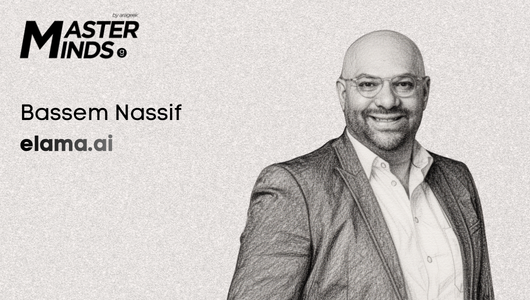
Bassem Nassif did not leave two decades in telecom and technology to chase noise. He left because he felt something was missing.
After years inside large organisations, scaling infrastructure and driving regional growth, he reached a private inflection point. The systems worked. The numbers scaled. But something about the experience felt cold. He kept returning to one question: what if technology could feel more human, not simpler in design, but more alive in experience?
That belief became the foundation for what would evolve into four interconnected companies: elama.ai, Stitch, TheIntern and Tali. None were built for spectacle. All were built to generate revenue, serve real customers, and sustain themselves.
“We focused on execution,” he says. “No hype. Just building.”
Why he chose execution over excitement
When asked about the early days, Nassif is clear that this was not a leap into startup theatre. It was a disciplined shift.
He did not begin with a grand masterplan to launch multiple ventures. He began by solving problems he could see. As enterprise clients surfaced recurring needs, patterns emerged. Instead of forcing one product to stretch across everything, he built focused platforms around each signal.
It was less a portfolio strategy and more a response to demand.
The result was an ecosystem, not because he intended one, but because the market kept asking for it.
How he thinks about operating versus building
On the question of what differentiates the first company, Stitch, Nassif frames it as an execution engine.
Enterprises, he observed, did not need more rigid software. They needed AI systems that adapt to how they actually operate. Stitch became the bridge between complexity and usable intelligence, building AI-driven platforms across marketing, customer experience, and operational automation.
It established deep enterprise relationships and operational trust. That trust would later underpin everything else.
If Stitch builds solutions, elama.ai builds intelligence.
When the conversation turns to Elama, his tone sharpens. This is where ambition scales. He describes it as an “Omni-Mind” platform, an intelligence layer that senses, understands and responds across an organisation. Instead of fragmented tools, it unifies sensing, thinking and acting.
“It’s not just automation,” he says. “It’s awareness at scale.”
Where Stitch executes, Elama architecturally reframes how AI sits inside an enterprise.
Why he built for students after serving enterprises
Asked to explain the leap from enterprise AI to TheIntern, Nassif points to a quieter problem.
Students graduate with theory but little exposure. Companies want experience but struggle to scale mentorship. The mismatch is subtle but systemic.
TheIntern was built around a single question: what if experience could be simulated?
The answer became AI-powered job simulations that allow young talent to experience real-world roles before entering them. It is an edtech platform, but Nassif resists the label. For him, it is a bridge between potential and opportunity.
“It’s probably the most emotional product we’ve built,” he admits. “We’re shaping confidence.”
It is also the clearest expression of his belief that technology should feel alive, not transactional.
Where lifestyle fits into an AI ecosystem
Pressed on why hospitality and entertainment entered the picture, Nassif explains Tali as the experiential layer.
If the other platforms focus on intelligence and productivity, Tali focuses on moments. It curates booking and payment experiences for venues, events and entertainment, aiming to make them seamless and digitally native.
He saw fragmentation in how people discover and experience nightlife and hospitality. Tali addresses that gap, not by adding complexity, but by refining flow.
“Technology should enhance moments, not workflows,” he says.
Even here, the philosophy holds. Make digital experiences feel natural.
Why he avoided heavy funding
On the question of capital, Nassif is unequivocal. He chose sustainability over speed.
From day one, the companies were built to generate real cashflow. Customers came early. Revenue loops were prioritised. Valuation headlines were not.
The ecosystem today is revenue-generating and EBITDA-positive. That matters to him more than press cycles.
“That foundation gives us freedom,” he says. “And resilience.”
It also shaped culture. Discipline over expansion. Value over visibility.
What traction actually means to him
When asked about growth, Nassif avoids inflated metrics. Instead, he points to trust.
Across the four companies, the group has collaborated with more than 100 top-tier enterprise customers across marketing, sales, HR, customer care and operations. The significance lies in breadth. They are not solving one narrow use case but embedding across functions.
That cross-functional presence signals something deeper than scale. It signals durability.
How he navigated pressure
Was it smooth? He laughs at the premise.
Building multiple revenue-generating companies simultaneously is emotionally demanding. Focus, capital allocation, team energy, all must be balanced constantly.
There were moments where slowing down was the only rational move. Moments where ambition had to yield to discipline.
In hindsight, those decisions became structural advantages. The companies matured without distortion.
What the ecosystem represents now
When the conversation turns to the present, Nassif is careful with his language.
“This is no longer an experiment,” he says.
Each platform now has its own identity, market and trajectory. Together, they form a cohesive group centred on intelligent experiences. Growth continues, but intentionally. Quietly. Without chasing noise.
It is, as he describes it, a different kind of success story. Less visible perhaps, but more grounded.
What this journey changed in him
Asked to reflect personally, Nassif shifts from strategy to transformation.
Entrepreneurship, he says, stretches you. It forces patience, humility and resilience. Watching ideas become products, and products become companies that impact real people, is deeply fulfilling.
Especially when built with intention.
What excites him about the next phase
Looking ahead, he speaks about convergence.
Intelligence, experience and human interaction are blending. AI will not merely power tools but shape how we live and work. Platforms that remain human-centric, he believes, will define the next era.
That is the trajectory he sees for his ecosystem.
If he had to compress the journey into one line, it returns to the beginning: technology should feel more human. Step by step, product by product, that belief became four companies and a sustainable operating group.
And in his view, this is still early.