 LEAP26
 AI
AI Saudi Arabia
 UAE
UAE Egypt
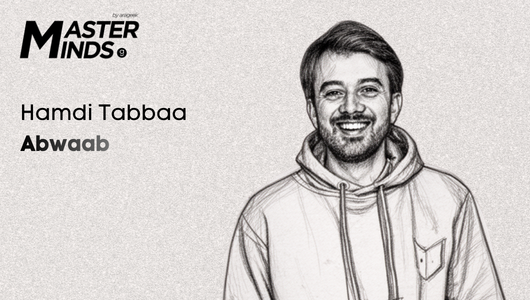
EgyptI am Hamdi Tabbaa. I aligned the company on one mission, which drove collective ownership.

7 min
Building teams, not just companies
When asked about the leadership lesson that travelled with him from Uber into Abwaab, Hamdi Tabbaa does not talk about control or scale. He talks about ownership. At Uber, building markets across the region meant hiring local leaders, trusting them with real responsibility and letting them operate like entrepreneurs. That approach stayed with him. At Abwaab, empowerment is not a slogan. Teams are expected to experiment, make mistakes and learn quickly, while staying anchored to the mission. For Tabbaa, leadership is less about control and more about creating the conditions where strong people take responsibility for what they build.
Why education felt unavoidable
On the question of why education became the problem worth solving, Tabbaa’s answer is grounded in what he saw across the region. In many MENA countries, households spend up to 35 percent of their income on education, much of it on private tutoring that compensates for weak public schooling. He describes streets in Cairo or Baghdad filled with students heading to cramped centres after school, chasing grades because final exams determine access to university and, by extension, a future. After seeing the impact Uber had in mobility, Tabbaa felt a responsibility to tackle education at scale. Technology, in his view, offered a way to deliver quality without making families pay the price twice.
Rethinking the learning model
When the conversation turns to Abwaab’s product, Tabbaa is clear that content alone was never the answer. The model evolved through years of iteration around three layers. The first is a deep technology and AI infrastructure that enables personalised learning journeys. The second is a human support layer, with teacher assistants and academic experts who actively guide students. The third is offline and hybrid touchpoints, such as testing centres and revision camps, designed to reinforce accountability. Together, these layers form what he calls a guided learning ecosystem. Students are not left alone behind a screen. Data plays a central role, with billions of learning interactions used to personalise education in ways traditional systems cannot, and independent research pointing to performance gains of up to 30 percent.
Execution as a learned skill
Pressed on how his background shaped Abwaab’s scaling strategy, Tabbaa traces it back further than Uber. Early in his career, he launched a supermarket chain in Jordan that failed. The experience taught him resilience, financial discipline and what it means to learn from his own pocket. Uber then sharpened his execution skills, scaling operations from a handful of drivers to tens of thousands. Alongside his co-founder Sabri, who led Careem in the region, that execution muscle became part of Abwaab’s DNA. His time working with governments on ride hailing regulation added another layer, patience, stakeholder management and narrative framing. Those lessons are now being applied as Abwaab pilots AI products with ministries of education.
Learning the hard way in the early days
Asked to reflect on Abwaab’s launch, Tabbaa points to timing and restraint. The company went live just six weeks before COVID. A partnership with the Jordanian government during lockdowns drove rapid growth, but it also pushed the team to scale before true product market fit. Expansion came fast, learning came later. Several years of iteration, restructuring and a renewed focus on student value were needed to reach a sustainable model. Those early missteps, he says, are the reason the company is stronger today.
Growth without compromising learning
On the balance between growth, quality and accessibility, Tabbaa rejects the idea that they must trade off. Technology, in his view, allows quality and scale to reinforce each other. As Abwaab grows, it gathers more data, enabling better personalisation and stronger outcomes. Academic experts are embedded across product and operations to keep pedagogy central. Every decision is filtered through three questions, does it improve learning impact, does it remain accessible, and can it scale.
Measuring outcomes, not minutes
When asked about avoiding the trap of optimising for screen time, Tabbaa draws a clear line. Education is not about time spent online but progress made. Students learn at different speeds and require different levels of guidance. Abwaab’s infrastructure is designed to handle that variability, combining continuous assessment with human support. Each student has access to a teacher assistant, supported by AI tools, and many participate in offline mock exams that mirror real testing conditions. Advancement, not engagement metrics, is the goal.
Data as a teaching partner
On the role of data, Tabbaa emphasises individuality. Every interaction a student has with Abwaab is captured and analysed, from assessments to engagement with teacher assistants. Proprietary systems stress test this data and feed it back into the product experience. The vision was there from day one, but it remains a continuous build. What makes it work, he argues, is a team that genuinely believes in using data to maximise learning value, not just efficiency.
Lessons from an early failure
Asked to revisit his Dukkan experience, Tabbaa returns to fundamentals. Running a business on thin margins taught him cost control, cash flow discipline and the importance of structuring ownership properly. Early on, he believed he needed to own everything himself. At Abwaab, significant ownership sits with the team. That shared stake reinforces both accountability and commitment to the mission.
The value of the Endeavor network
When the discussion turns to Endeavor, Tabbaa admits initial scepticism. The turning point came during the International Selection Panel in Rome, where intense questioning forced him to step back from daily operations and see blind spots. Beyond that, Endeavor offered something rare, a global peer group willing to share openly, without ego. Connections with other edtech founders led to exchanges between engineering and product teams, driven by the belief that impact matters more than competition.
Winning over top teachers
Pressed on talent, Tabbaa describes teaching as a muscle Abwaab had to build. Early on, without brand recognition, acquiring top teachers required negotiation and compromise. Retention, however, depends on infrastructure. Teachers need tools that help them deliver real impact. Abwaab’s combination of technology, human support and commercial strength creates an ecosystem where teachers can do their best work.
Choosing where to grow
When asked about expansion markets, Tabbaa avoids blanket statements. GCC countries tend to support premium offerings, while the Levant and North Africa demand scale and affordability. Despite differences, reliance on supplementary education is widespread across the region. Parents everywhere are investing heavily in their children’s futures, and Abwaab aims to meet students where they are, regardless of market.
Regulation, culture and reality
On regulatory and cultural barriers, Tabbaa notes that edtech remains young globally. Governments are still learning how to engage, though collaborations are increasing. Culturally, COVID pushed education fully online, then revealed the limits of that extreme. The future, he believes, lies in blended models that combine human touch with technology. Across markets, one constant remains, parents’ willingness to spend for better education.
Looking ahead
Asked to look five to ten years out, Tabbaa expects consolidation, deeper integration of AI and a stronger blend of online and offline learning. Distribution will matter as much as innovation. Companies that reach students effectively will be best positioned to translate advances in AI into real educational value.
From corporate comfort to startup risk
On advice to corporate leaders considering startups, Tabbaa is direct. Take the leap. Comfort delays growth. The hardest environments, he believes, are where real development happens.



What sustains the drive
Finally, when asked what keeps him going during tough phases, Tabbaa points to legacy. He wants to build something lasting and meaningful. Family support helps him stay grounded, and small routines, like morning sports, help manage the pressure. When things get heavy, he steps back and reminds himself why the work matters.