 Ai Everything
 LEAP26
 AI
AI Saudi Arabia
 UAE
UAE Egypt
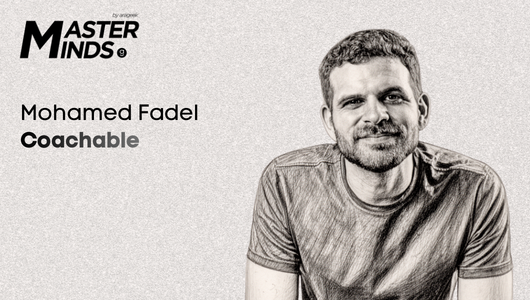
EgyptI am Mohamed Fadel. I chose reinvention over stability, again and again

6 min
Reinvention does not arrive gently
When asked about growth, Mohamed Fadel does not describe a steady upward curve. He describes rupture. Growth, in his framing, is forced by moments that demand a new version of yourself, moments where the old way of operating simply stops working. Looking back, every meaningful change in his life followed a shock, loss, professional failure, or a moment that stripped away certainty. He did not recognise reinvention while it was happening. The insight only emerged later, once the pattern repeated often enough to be undeniable. Reinvention, for him, is not a motivational idea. It is a response to pressure.
Making peace with failure changes your behaviour
Pressed on failure, Fadel is blunt. Failure taught him more than success ever could, and more importantly, it changed his relationship with action. Early on, fear of failing kept him cautious and overly controlled. Only after repeated setbacks did he realise that failure was not something to avoid but something to expect, even to seek. Once he accepted that falling down was part of the work, he loosened his grip, stopped overthinking, and moved faster towards what he actually wanted. In his view, failure is evidence of participation. It proves you were willing to step onto the battlefield and return after being knocked down.
Leadership starts with people, not authority
When the conversation turns to leadership, Fadel traces most of his thinking back to leading AIESEC globally. That experience reshaped his understanding of people and power. Everyone is different, he says, and leadership only works when that truth is taken seriously. You cannot satisfy everyone, but you are still responsible for putting people first. Leadership, as he sees it, is service, not control. Too many managers chase compliance instead of trust, and poor leadership reproduces itself when people learn that dominance is how authority works. For Fadel, leadership is about people long before it is about the leader.
Volunteers expose weak leadership fast
Asked to compare volunteer teams with for-profit startups, Fadel does not hesitate. Volunteers are harder to lead. Paid employees often stay because they need the salary. Volunteers stay only if the leadership earns it. That reality forces clarity. You have to care, you have to show up, and you have to lead well, or people leave. Fadel admits he failed repeatedly in those environments, but those failures made him better. Over time, he learned to recognise mistakes faster and to create enough safety for people to tell him when he was wrong. That feedback loop, he believes, is what real leadership looks like.
AI should augment humans, not replace them
On the question of AI, Fadel rejects both fear and hype. AI, to him, is an enabler. Its role is to help people do their work better and focus on what matters most. He sees the future workplace as augmented, humans and AI working side by side, increasing output not by replacing judgement but by freeing it. The danger, he argues, lies in blind adoption. Companies either avoid AI entirely or buy bloated systems without understanding how they serve the business or the people inside it. Too often, simple problems are sold expensive, unusable solutions when a focused, well-integrated tool would have done the job.
Expansion matters more than early success
When asked to advise someone at the start of their career, Fadel avoids the language of winning. He talks instead about expansion. Early on, the goal should be range. Try things, fail often, learn what fits and what does not. Success can wait. Expansion builds a broader, more resilient operator, someone better equipped to manage, execute, and decide later on. Chasing success too early narrows options. Expansion keeps them open.
Consistency is the only system that lasts
Pressed on frameworks, Fadel offers something almost disappointingly simple. Consistency. Keep going. Do not stop. He borrows James Clear’s idea of never missing twice, but the principle is older than productivity culture. Reinvention does not require complexity. It requires showing up again and again, iterating, improving, and refusing to quit. Over time, change happens almost quietly.
There is no clean split between ambition and growth
Asked about balance, Fadel rejects the premise. Personal growth and professional ambition are not opposing forces in his life. They move together. Different moments demand different priorities, but every experience feeds both sides. Wanting more from life, as he sees it, means wanting more as a human and as a professional at the same time.
Introversion is not a limitation
When the conversation turns to quiet leadership, Fadel becomes personal. Introversion, he argues, is widely misunderstood. Many of the world’s most powerful leaders are introverts, yet too many use the label as an excuse to shrink. Fadel describes himself as deeply introverted, yet he led tens of thousands of people in his mid-twenties. That only happened because he refused to believe introverts could not lead. For him, introversion is a strength, just like extroversion. The work is knowing how your energy works, protecting it, and then going all in when it counts.
Being human will become rare
Asked to look ahead, Fadel believes the most important leadership skill of the next five years will be humanity. Empathy, kindness, and genuine understanding are not new ideas, but they are becoming scarce. As attention shifts towards AI, prompting, and technical leverage, fewer leaders are investing in human connection. Those who do will stand out, not because they are innovative, but because they remember the basics.
Systems decide who survives
On what ultimately determines success, Fadel ranks systems above vision and culture. Every organisation has a vision. What separates those that endure is whether their systems can support growth. Culture sustains people through difficulty. Vision gives meaning. Systems make movement possible. Problems arise when companies scale but their systems do not. That breaking point is where operations fracture, talent burns out, and momentum stalls. Systems do not have to be perfect early on, but they must evolve or everything else collapses.
Time is the final filter
Asked how he chooses his current projects, Fadel relies on a single question. Will this contribute to the work and the person he wants to be decades from now? If not, he declines. Time is finite, and wasting it is the real risk. The only exception is when a project is clearly a means to an end, with a defined exit in sight.


Embarrassment is the price of entry
In closing, Fadel reflects on what he wishes he had learned sooner. Stop worrying about what people think. Fear of embarrassment kept him from moving faster for years. Looking back, he sees that hesitation as unnecessary. Quoting Steven Bartlett, he frames embarrassment as the cost of admission. Most people never pay it. Those who do get to play the game.