 Ai Everything
 LEAP26
 AI
AI Saudi Arabia
 UAE
UAE Egypt
EgyptI am Mohammad AlNajjar. I learned B2B sales fails without repeatable systems

5 min
Building sales systems, not heroic efforts
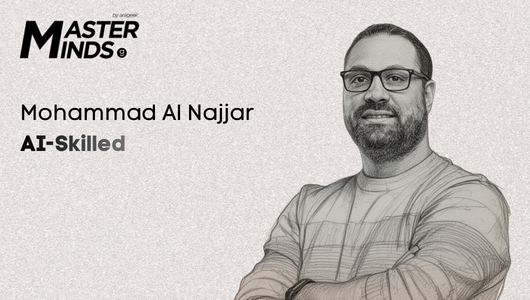
Mohammad AlNajjar has spent long enough inside B2B organisations to be sceptical of sales narratives built on individual brilliance. When asked to introduce himself, he frames his career in practical terms. More than 17 years in business development, mostly B2B, across companies at every stage. The consistent thread is not deal-making flair but an obsession with building sales systems that can produce sustainable growth without relying on luck or heroic effort.
He is clear that this mindset did not come from theory. It came from watching what happens when companies scale without structure. Strong individuals carry results for a while, then momentum slows, costs rise, and outcomes become unpredictable. For AlNajjar, sales only becomes reliable when it is treated as infrastructure.
Why B2B sales no longer works the old way
On the question of how B2B sales looks today, AlNajjar does not hedge. The model has fundamentally changed. Random calls and broad outreach have been replaced by processes driven by data, timing, and a detailed understanding of customer behaviour.
He argues that many companies still behave as if volume alone will compensate for poor targeting or weak systems. Even strong products struggle in this environment. Without a clear and repeatable sales process, teams burn time and energy without building momentum. Sales becomes noisy rather than directional.
Where most teams lose time and money
Pressed on the biggest failure point he sees, AlNajjar points to the same pattern repeating across companies. Sales teams spend the majority of their time on repetitive tasks. Prospecting, follow-ups, writing emails, logging activity, and updating systems.
These tasks are necessary, but they are also draining. Over time, teams become exhausted, pipelines move slowly, and costs increase. The work that actually requires judgement and human skill, closing and relationship-building, gets squeezed between administrative overhead. For AlNajjar, this imbalance is the root cause of underperformance.
The thinking that led to Skilled
When the conversation turns to the origin of Skilled, AlNajjar frames it as a practical response rather than a visionary leap. He had seen companies hire layers of business development representatives, sales managers, and tools, yet still struggle with inconsistent results.
The question that stayed with him was simple. If sales problems come from repetitive work overwhelming teams, why not automate that layer entirely? Skilled emerged from this logic. Remove the manual burden from the front of the sales process and allow people to focus on what humans do best.
What an intelligent digital sales employee actually does
Asked to explain what Skilled delivers in practice, AlNajjar is specific. Skilled provides an intelligent digital sales employee, Ali, that handles everything up to the closing stage. That includes defining the ideal customer profile, identifying decision-makers, running outreach, managing follow-ups, scheduling meetings, and updating the CRM.
The promise is not partial automation. While clients focus on closing conversations, the rest of the sales engine runs automatically in the background. Over time, the system improves as it learns, reducing friction rather than adding more tools to manage.
Why a system beats disconnected tools
On the question of differentiation, AlNajjar draws a clear line between Skilled and traditional automation software. Most sales stacks are fragmented. One tool for email, another for follow-ups, another for analytics. Each requires management, integration, and attention.
Skilled is designed as a complete system rather than a collection of parts. Companies define who they want to reach and the system executes and refines the process. The aim is not to optimise individual steps, but to remove the need for constant oversight altogether.
From uncertainty to predictable outcomes
When asked about the impact on performance, AlNajjar focuses on how decision-making changes. Companies move away from uncertainty. Instead of wondering whether leads will appear, they can plan around how many meetings will be generated.
This shift has practical consequences. Forecasting becomes clearer. Hiring decisions are more deliberate. Growth discussions move from hope to planning. For AlNajjar, predictability is the real value created by structured sales systems.
Who benefits most from this approach
On the question of ideal customers, AlNajjar keeps the scope tight. Skilled is built for B2B companies, particularly SaaS businesses, post-product-stage startups, and teams that want to scale without inflating costs.
The common denominator is not size, but intent. These are organisations that want sales to be structured, repeatable, and scalable rather than dependent on constant manual effort.
What comes next for Skilled
Asked to reflect on the next phase, AlNajjar outlines two horizons. In the short term, the focus is speed. Helping companies build effective outbound sales channels in weeks rather than months. In the medium term, the ambition is more structural. He wants Skilled to become a core part of B2B sales infrastructure across the region.
This is less about feature expansion and more about changing expectations. Sales should be something companies install, not something they constantly fight to control.
The future of sales is hybrid, not human versus AI

When the conversation turns to AI more broadly, AlNajjar is careful to reject extremes. He does not see a future where humans are replaced. Instead, he argues for a hybrid model where AI absorbs repetitive work and humans concentrate on relationships and decisions.
Companies that understand this balance early, he believes, will grow faster and operate more profitably. The advantage will not come from using AI in isolation, but from knowing exactly where human judgement still matters most.