 LEAP26
 AI
AI Saudi Arabia
 UAE
UAE Egypt
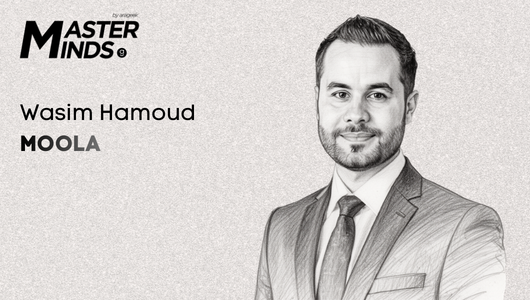
EgyptI am Wasim Hamoud. I scaled fintech responsibly, not recklessly

6 min
Wasim Hamoud does not describe his career as a sequence of promotions. He describes it as an expansion of accountability. The shift from engineer to founder was not about status, but about control over outcomes. Over more than a decade in Saudi Arabia’s B2B technology sector, he moved steadily from building features to shaping strategy, then to building companies. The through line is clear: he prefers ownership to abstraction.
From writing code to building companies
When asked about his early career, Hamoud traces it back to software engineering. He quickly realised he was less interested in individual features and more interested in the systems that turned those features into viable businesses.
Over the years, he transitioned into product management, then innovation leadership, eventually taking executive roles. He led product strategy, built cross-functional teams, launched digital platforms and scaled products in regulated environments. The pattern was consistent: increasing scope, increasing responsibility.
Entrepreneurship, he says, was not a leap. It was a logical next step. He wanted to move from building products inside organisations to building the organisations themselves.
Why strategy without execution fails
On the question of how he became what he calls a strategic planner and lean executer, Hamoud credits the realities of operating in emerging markets, particularly Saudi Arabia’s fintech sector.
Constraints sharpen thinking. Regulation, infrastructure gaps and evolving ecosystems leave little room for waste. Strategy without execution becomes theory. Execution without strategy becomes chaos. He learned to hold both. Think long term, act in small measurable steps.
That operating model, long horizon paired with short cycles, became a discipline rather than a preference.
Innovation is cultural, not cosmetic
When the conversation turns to his years in product and innovation leadership, Hamoud is clear that the formative lessons were not about feature velocity. They were about transformation.
Innovation, he argues, is not adding functionality. It is changing how problems are framed and solved. Leading innovation meant aligning vision, technology, compliance, operations and customer experience into one coherent direction.
Culture mattered more than ideas. Teams that think structurally innovate better than teams that brainstorm loudly.
Alignment beats talent
Asked to reflect on his time leading product development at T2, Hamoud reduces the experience to a single principle: alignment beats talent.
Strong engineers and capable designers are not enough. Without clarity of direction, speed collapses. His role was to translate business strategy into product roadmaps, align engineering with commercial goals, balance speed and quality, and make trade-offs under pressure.
More importantly, he focused on ownership. Velocity increases when teams feel accountable for outcomes rather than outputs.
Launching is easy. Scaling responsibly is hard.
Pressed on the most challenging launches he has led, Hamoud points to fintech. Compliance, banking integrations, risk controls and go-to-market coordination create layers of complexity that cannot be ignored.
One of his most demanding experiences involved building regulated financial products that required synchronisation between banks, regulators, technology teams and commercial stakeholders. Success came from early alignment, deep regulatory understanding, structured execution frameworks and disciplined iteration after launch.
He is blunt on one point: launching is easy. Scaling responsibly is the real test.
Why he chose ownership
When asked what triggered his move from corporate leadership to founding and investing, his answer is direct: ownership.
He wanted full accountability, not only for product metrics but for company outcomes. Founding allowed him to take long-term bets, shape culture from the beginning and design systems rather than components. Investing allowed him to extend that philosophy into the wider ecosystem.
The transition was less about independence and more about accountability density.
Building intelligent financial infrastructure at MOOLA
On the question of why he founded MOOLA, the starting point was practical. Businesses in Saudi Arabia were still managing expenses manually. Petty cash, reimbursements and fragmented banking tools created friction inside finance teams.
MOOLA was initially built as an all-in-one spend management and corporate card platform. The ambition was to automate financial operations and increase control. Since launch, the vision has expanded. It is no longer about cards alone, but about financial process automation.
Today, Hamoud describes the company’s direction as smart spend control, real-time visibility and operational efficiency, with the longer-term ambition of AI-driven financial decision support. In his words, it is about building intelligent financial infrastructure, not just payments.
The shock of fragility
Asked about the biggest reality shift in becoming a founder and chief executive, Hamoud points to fragility.
In corporate roles, resources are structured. As a founder, everything is interconnected and exposed. Cash flow, hiring, partnerships, compliance and product-market fit are tightly linked. A small mistake in pricing, positioning or recruitment can cascade.
The pressure is heavier. The reward is sharper. Wins are tied directly to conviction and resilience.
What he looks for as an investor
When the conversation shifts to his work with Riyadh Angel Investors, his focus narrows to one variable: the founder.
Markets evolve and products pivot, but founder quality compounds. He looks for clarity of thought, bias towards execution, coachability, speed of learning, market understanding and ethical grounding. Adaptability, in his view, reduces risk more effectively than projections.
Through Ebla Ventures, he sees recurring structural gaps in early-stage startups, especially in emerging ecosystems. Founders confuse product building with company building. Financial discipline is weak. Positioning is unclear. Teams overbuild before validating. Governance frameworks are thin.
Features are easier to ship than sustainable company architecture.
What separates exceptional founders
Pressed on what distinguishes exceptional founders from competent ones, Hamoud identifies three traits: vision clarity, execution discipline and emotional resilience.
Exceptional founders build structured momentum. They think in decades, act in weeks and learn daily. They are not opportunistic. They are directional.
Innovation inside constraints
On balancing innovation with lean execution, Hamoud insists that constraints are productive. His framework is simple: validate assumptions early, build minimum viable value rather than minimum viable product, ship fast, measure faster and kill what does not work.
Lean execution disciplines innovation. It forces ideas to answer to the market rather than ego.
The ecosystem shift in Saudi Arabia
Asked how he sees the Saudi startup and venture landscape evolving, Hamoud describes a structural shift. Regulatory support, capital and entrepreneurial ambition are aligning at scale.
The next phase, he believes, will prioritise fintech infrastructure, AI-driven software, regional expansion and globally competitive founders. But sustainability and governance will determine who lasts.
Access to capital is rising. Discipline must rise with it.
Advice to globally minded founders
When asked for advice to founders aiming for global competitiveness, Hamoud avoids slogans. Think bigger than geography. Build strong fundamentals. Establish governance early. Prioritise product quality. Maintain execution discipline.
Above all, solve real problems. Everything else compounds from there.