 Ai Everything
 LEAP26
 AI
AI Saudi Arabia
 UAE
UAE Egypt
EgyptIs Iris Recognition Making a Serious Comeback with Iris?


5 min
Iris recognition technology is making a comeback, with 2AJ showcasing a revamped system in Seoul.
The new system uses proprietary hardware and software, promising use from up to three metres away.
Unlike facial recognition, irises offer stable, accurate identification with minimal privacy concerns.
2AJ's trials in airports and government sectors highlight the potential for widespread adoption.
Controlling manufacturing processes may help reduce costs, promoting broader acceptance of iris recognition.
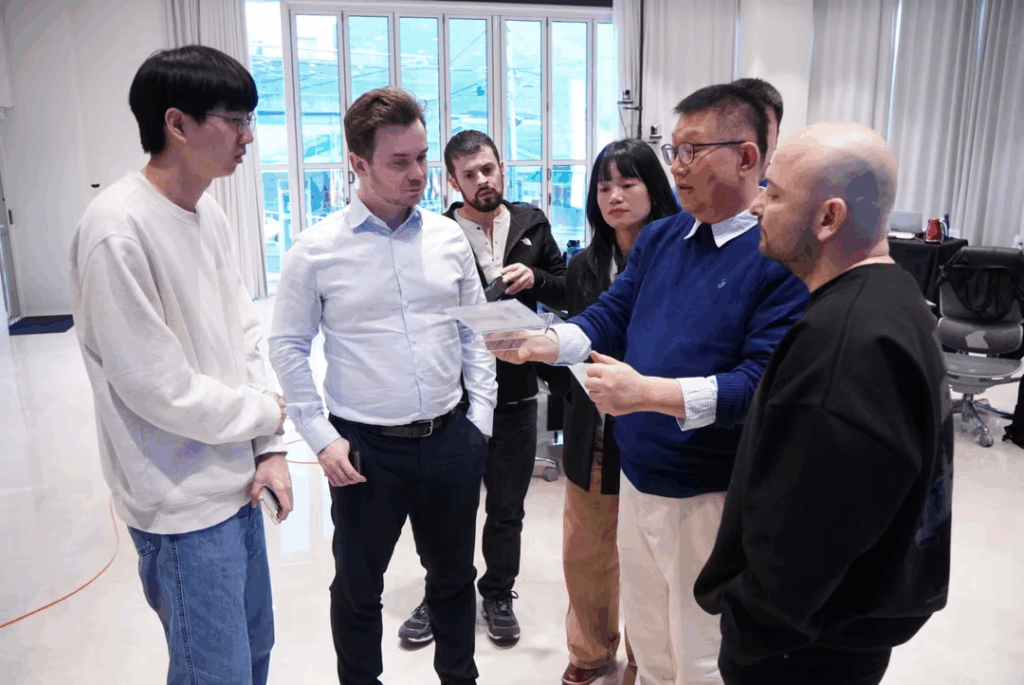
During our participation in the Global Media Meet-up in Seoul, hosted at the offices of Aving News and bringing together deep-tech Korean companies alongside international media, most conversations revolved around generative AI—platforms, language models, and content tools.
Amid that noise, one company stood out by moving in a completely different direction. A Korean firm called AJ2 is betting on a technology many assumed had already lost the race: iris recognition.
What we encountered in Seoul was not nostalgia for an old biometric method, but a serious attempt to reposition iris recognition as a modern, scalable identity solution—at a time when other forms of biometric identification are showing real cracks.
When Face Recognition Started to Lose Its Edge
From our long-term observation of identity technologies, the rise of face recognition over the past decade was rapid and aggressive. It was widely adopted because it was relatively cheap, easy to deploy, and frictionless for users.
But scale exposed its weaknesses. Masks broke it. Lighting conditions confused it. Deepfake images and videos fooled it. And as synthetic media became more advanced, bypassing facial recognition systems became increasingly trivial.
In Europe especially, the debate moved beyond technical performance into regulatory and cultural territory. Concerns around mass surveillance, privacy violations, and misuse led regulators to tighten restrictions. Trust eroded—and the search for alternatives began in earnest.
Iris Recognition: Scientifically Strong, Commercially Weak
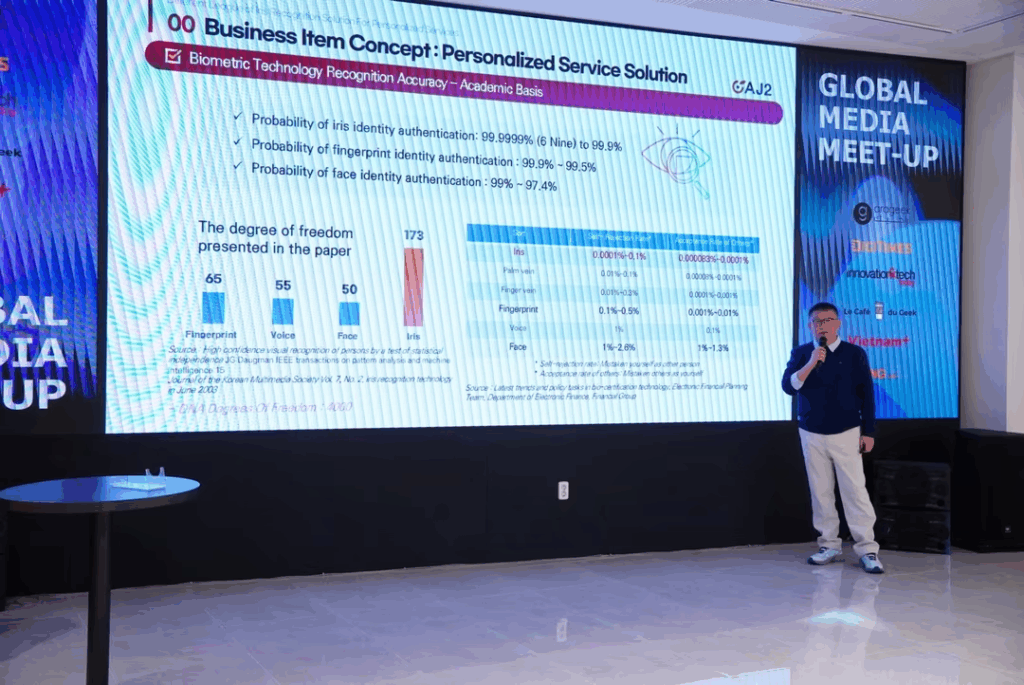
From a scientific standpoint, the iris was never the problem. It forms early in life, remains stable over time, and offers near-zero probability of duplication between individuals. It is unaffected by facial expressions, makeup, or aging.
Yet older iris recognition systems failed to scale commercially. The reasons were practical rather than theoretical: the need for close-range scanning, poor performance in outdoor lighting, expensive hardware, and uncomfortable user experiences.
In our view, the issue was never the concept itself—it was timing and execution.
How AJ2 Is Rebuilding Iris Recognition from the Ground Up
What AJ2 presented in Seoul was not an attempt to patch an outdated model, but a full reconstruction of Iris Recognition Solutions as an integrated system.
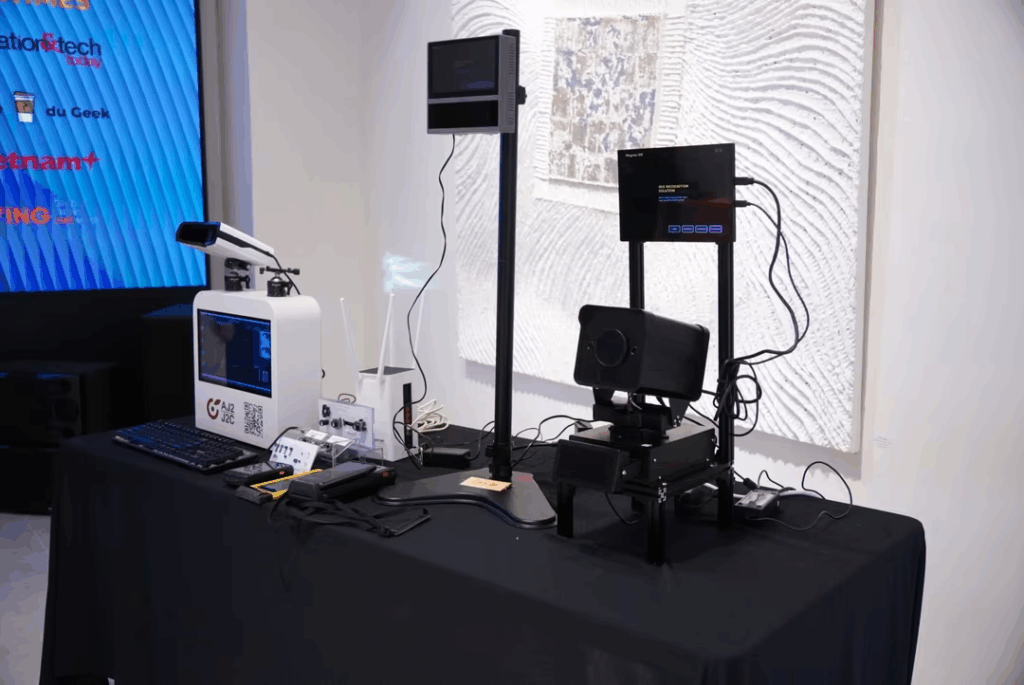
The company developed both hardware and software in-house, resulting in a tightly coupled, closed-loop platform built around:
-
Proprietary infrared (IR) LED illumination modules
-
Custom cameras designed for high-precision iris capture
-
Iris recognition algorithms not dependent on general-purpose AI models
-
Full hardware–software integration protected by multiple patents
The claim that genuinely caught our attention was the system’s ability to recognize irises from one to three meters away, outdoors, under direct sunlight, and even while wearing glasses.
From our perspective, this single capability moves iris recognition out of controlled lab environments and into real-world deployment.
Why the Timing Suddenly Makes Sense
The renewed relevance of iris recognition is not accidental. Facial recognition has become politically and legally costly. AI-generated identities are spreading fast. Regulations are becoming stricter, not looser.
In this context, AJ2 occupies a rare middle ground: more accurate than facial recognition, significantly harder to spoof, more acceptable from a regulatory standpoint, and less intrusive than fingerprint-based systems.
In a world increasingly skeptical of visual identity verification, this balance is no longer optional—it is foundational.
Beyond Demos: Real Deployments Taking Shape
What strengthened our confidence in AJ2’s direction was the fact that its narrative was backed by real use cases.
The company is currently working on or testing iris recognition solutions in:
-
Airports across the United States and Canada
-
Government tenders in Singapore
-
National-level discussions in Mexico
-
Secure payment pilots in Japan
Border control, airport security, and high-assurance identity verification are no longer future promises—they are active deployment scenarios. In our view, this signals genuine technological maturity.
The Commercial Question—and Whether It Has Been Solved
The hardest question remains cost. Facial recognition is cheap; iris recognition historically has not been.
AJ2’s response lies in vertical control. By owning the entire manufacturing chain—developing components in-house, reducing power consumption, lowering part costs, and eliminating reliance on scarce suppliers—the company claims to have removed the final barrier to large-scale adoption.
If these figures hold, AJ2 has not merely improved iris recognition—it has made it economically viable.
Beyond Technology: A Question of Trust
In our view, this is not just a story about cameras or sensors. It is a story about trust in the age of artificial intelligence.
As faces become easier to fake and regulations tighten, identity systems are being forced to evolve. AJ2 is betting that iris recognition—long ignored—has finally found the right moment and the right conditions to return.
Will AJ2 become a global standard? It is too early to say.
What is certain, however, is that the dominance of facial recognition is no longer guaranteed—and that the eye is quietly, confidently returning to the center of attention.
🚀 Got exciting news to share?
If you're a startup founder, VC, or PR agency with big updates—funding rounds, product launches 📢, or company milestones 🎉 — AraGeek English wants to hear from you!



✉️ Send Us Your Story 👇