 LEAP26
 AI
AI Saudi Arabia
 UAE
UAE Egypt
EgyptUniqconn: Are Cables Finally Reaching Their End?

5 min
Uniqconn aims to eliminate device cables by making wireline interfaces wireless.
Their 60 GHz chip offers ultra-fast, low-latency data transfer, much like invisible cables.
Practical uses include detachable cameras and laptops with zero internal wiring.
Mass production of their chip is underway, with major deals and products expected soon.
This innovation, supported by South Korea's government, could shift device design significantly.
Have you ever imagined placing your phone on a desk and having it instantly connect to a display, a hard drive, and a camera—without a single cable?
At AraGeek, this question no longer feels theoretical. It is becoming a very real technical possibility.
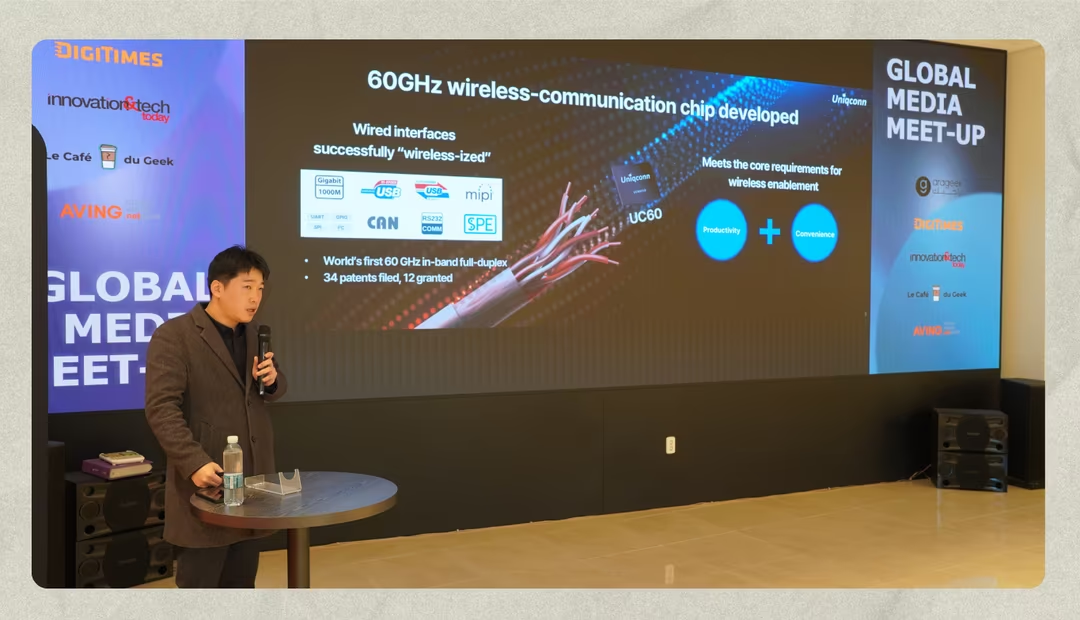
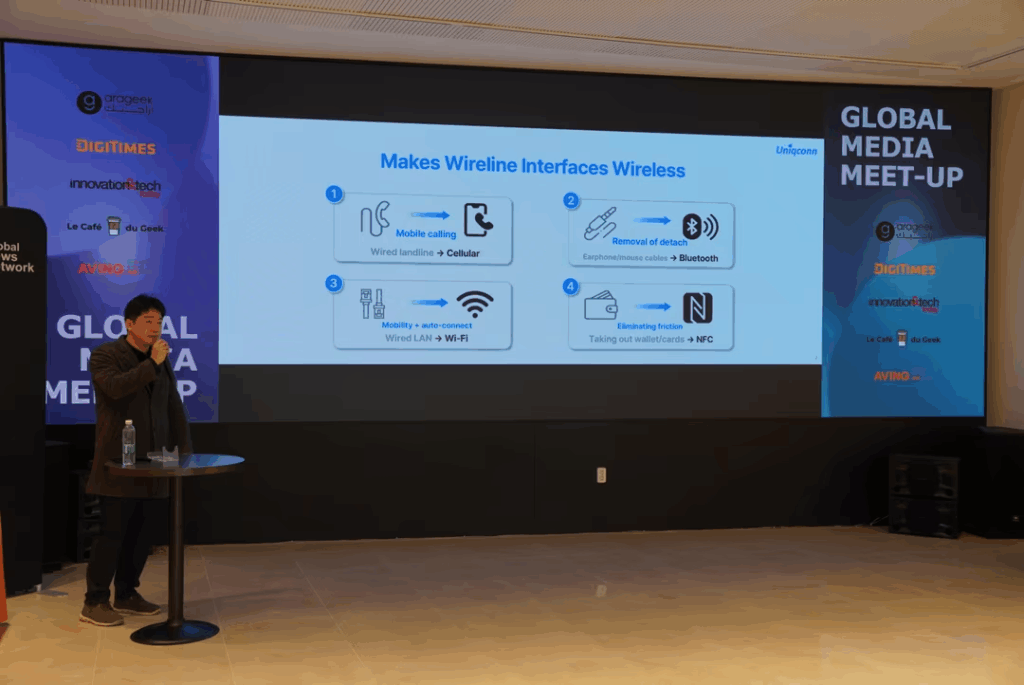
During our participation in the Global Media Meet-up in South Korea, hosted at the offices of Aving News, we came across a relatively small startup with an unusually bold idea. Its name is Uniqconn, and its mission is as direct as it is ambitious: to turn every wired interface into a wireless one—without sacrificing speed or latency.
One moment stayed with us in particular. The company’s CEO, YD Kim, summed up the entire vision in a single sentence:
“We make wireline interfaces wireless.”
No marketing layers, no exaggerated claims—just a difficult technical promise. From our discussion, it was clear this is a company thinking from the root of the problem, not its surface.

Why Cables Are the Real Problem
Founded in 2022, Uniqconn revolves around one core question: why do we still rely on short cables?
Wi-Fi, Bluetooth, and NFC all exist, yet none of them can truly replace USB or HDMI in terms of speed, stability, and ultra-low latency. In our view, this is where Uniqconn’s innovation lies. The company is not trying to improve traditional wireless—it is trying to replace the cable itself.
YD Kim was refreshingly candid when he said the company is “not attractive” because it does not work in AI, but in RF. In reality, working at the fundamental connectivity layer of hardware is harder, riskier, and often more impactful. Despite this, Uniqconn has raised over $25 million, grown to 47 employees, and opened offices in China, Japan, and the United States. This is not the trajectory of a hobbyist startup.
60GHz Technology: An Invisible Cable
At the heart of Uniqconn’s approach is a custom IC chip operating at 60GHz, manufactured by TSMC. The chip delivers speeds of up to 5 Gbps with near-zero latency.
What struck us during the technical explanation was its simplicity. No complex networking stacks, no layered protocols—just direct bit transmission, exactly like a physical cable.
One member of our team, with long experience in hardware, commented afterward that this simplicity is the real strength. Fewer layers mean fewer points of failure, and higher reliability—especially in signal-dense environments.
The effective range is typically 5 to 10 centimeters, extendable up to two meters with stronger antennas. That may sound limited at first, but in practical use—phones flush against displays, nearby storage modules, magnetically attached cameras—it makes perfect sense. As Kim noted, in smartphones, even half a centimeter can be enough.
Practical Use Cases, Not Theory
What we appreciated most about Uniqconn is its focus on real, tangible use cases. The technology has the potential to reshape how devices are designed from the ground up. Among the scenarios discussed:
-
Detachable high-resolution cameras
-
Wireless SSDs with no performance loss
-
Laptop hinges with no internal cables
-
Modular industrial robotics components
-
Smartphones that are easier to repair and upgrade
Comparisons with NFC inevitably come up, but they miss the point. NFC operates in kilobits; Uniqconn operates in gigabits. This is not an incremental improvement—it is a different category entirely.
In our view, this could even revive the long-abandoned idea of modular devices, which failed not because the concept was flawed, but because the technology was not ready.
From Lab to Commercial Production
After three years of development, Uniqconn has reached a critical phase. Mass production has already begun, with one million chips currently being manufactured. This scale matters, as it enables real testing of durability, thermal behavior, and long-term reliability. Initial shipments are expected in January.
The company is already working with major smartphone and laptop manufacturers, though names remain undisclosed due to confidentiality agreements. What we do know is that two consumer products are expected to be shown at CES 2026—and frankly, we are curious to see what a “world without ports” looks like in practice.
Korea’s strong government support for fabless semiconductor startups also plays a crucial role here. Without this kind of backing, competing globally in hardware would be nearly impossible for a young company.
Are We Really Approaching the End of Ports?
As we left Aving News, the discussion within the AraGeek team was clear. If Uniqconn succeeds, cables will not disappear overnight—but the way we think about connectivity will change. Devices could become easier to repair, less fragile, and far more flexible.
We believe real innovation is not always loud or driven by hype. Sometimes it comes from a technically “unattractive” company solving a fundamental problem we have ignored for years. Uniqconn may not change the world tomorrow, but it is clearly laying the first brick toward a less cluttered, more intelligent way of connecting devices.
The real question now is not whether we can live without cables—but when we finally will.
🚀 Got exciting news to share?
If you're a startup founder, VC, or PR agency with big updates—funding rounds, product launches 📢, or company milestones 🎉 — AraGeek English wants to hear from you!




✉️ Send Us Your Story 👇