 Ai Everything
 LEAP26
 AI
AI Saudi Arabia
 UAE
UAE Egypt
EgyptWARP Solutions: Long-Range Wireless Power Without Cables


5 min
Wireless charging could soon become as effortless as connecting to Wi-Fi.
WARP Solutions uses radio waves to transmit energy, revolutionising traditional charging methods.
Their WEP chip offers much higher efficiency compared to existing technologies.
This technology is being tested for both ground applications and potential lunar use.
Partnerships with giants like Samsung highlight its wide-ranging possibilities and future impact.
Can energy be transmitted through the air the way data is?
At AraGeek, this question no longer feels like science fiction.
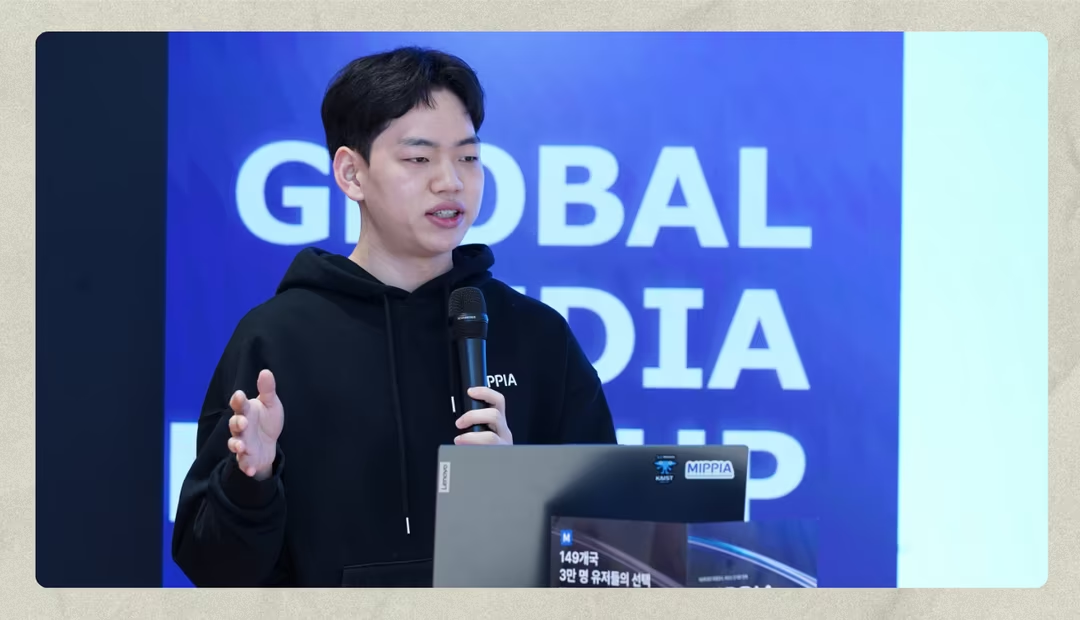
During the Global Media Meet-up in Seoul, hosted at the offices of Aving News, we met several Korean companies preparing for CES 2026. One of them, however, pushed us to rethink our relationship with electricity itself.
That company was WARP Solutions, driven by a simple yet unsettling idea: why do we still need cables to charge our devices?
From the first minutes of our conversation with Minsoo Kim—the company’s founder, also known as Mike—it became clear that this vision goes far beyond improving conventional wireless charging. He is not interested in placing phones on charging pads. He imagines a world where devices charge automatically, wherever they are, the same way they connect to the internet today—without conscious effort.

Wireless Charging… But Not as We Know It
When people hear “wireless charging,” they usually think of magnetic induction: a phone carefully placed on a charging base. In our view, that is only partially wireless.
WARP Solutions is trying to remove that limitation entirely.
The company’s technology transmits power using radio frequency (RF) waves, through smart antennas operating across multiple ISM bands, including 920 MHz, 4 GHz, and 5.8 GHz. As Minsoo explained it simply: “Think of Wi-Fi, but for electricity.” Power is broadcast, devices receive it, and convert it into usable energy.
At the core of this system are WARP’s proprietary WEP chips, which achieve up to 60% efficiency, even in non-ideal environments. This is made possible by a patented innovation known as MFMC.
For comparison, many competing solutions deliver less than 0.2 watts per chip. A single WEP chip can provide up to 3 watts. This difference is not incremental—it fundamentally changes what designers and engineers can build.
These numbers unlock use cases that were previously impractical, particularly in the Internet of Things, where size, maintenance, and complexity matter.
From the Lab to the Street… and Even the Moon
What impressed us most about WARP Solutions is that it is not selling a theoretical concept. The technology is already being tested in real-world projects.
In South Korea, the company is working with the Alchemist Group on a lunar exploration-related initiative. The idea is to use satellites to transmit power to drones operating on the dark side of the Moon, where solar energy is unavailable.
Minsoo was very clear on one point: the technology can transmit power through concrete. That single statement is enough to spark serious interest for anyone working in infrastructure or smart cities.
On Earth, the applications are equally compelling. WARP Solutions is collaborating with major Korean companies on projects involving road sensors, surveillance cameras, and electronic shelf labels in retail environments—scenarios where running cables is expensive, and battery replacement is inefficient.
One of the most striking examples is a collaboration with Samsung, resulting in a prototype USB-C dongle capable of charging a smartphone remotely. Imagine your phone charging while sitting on your desk, connected to nothing.
The company has also developed what it calls an “energy box”, a long-range charging unit for gaming and professional equipment. Another project currently in development embeds RF receivers directly into AA batteries, allowing existing devices to receive power wirelessly—without modification.
Global Ambitions and Regulatory Reality
Like any disruptive technology, RF-based power transmission faces regulatory challenges. Power transmission is tightly controlled, with legal limits reaching up to 30 watts in certain frequency bands. Anything beyond that requires special governmental approval.
In our view, this regulatory layer may be a bigger hurdle than the technology itself. Still, WARP Solutions appears prepared.

The company holds more than 35 patents and has obtained FCC Part 18 certification, a first for a Korean company in this category. Its partnerships with institutions such as KICT, SK Telecom, and Silfan strengthen its position and add institutional weight.
At CES 2026, WARP Solutions plans to showcase a bold demonstration: a floor lamp capable of charging 30 devices simultaneously.
Minsoo summed up the company’s philosophy with a sentence we genuinely appreciated at AraGeek:
“The goal is not faster charging. The goal is to forget charging altogether.”
Toward a Cable-Free Environment?
WARP Solutions is not merely promising convenience—it is proposing a shift in how we interact with energy itself. A world where electricity is embedded into the environment, invisible, continuous, and always available.
Whether homes, cities, or future exploration missions, this approach forces a fundamental question: what happens when power becomes ambient?
For us at AraGeek, this is not just an interesting technology. It is a reminder that real innovation often starts by questioning assumptions we stopped noticing—like the cable on the floor.
🚀 Got exciting news to share?
If you're a startup founder, VC, or PR agency with big updates—funding rounds, product launches 📢, or company milestones 🎉 — AraGeek English wants to hear from you!



✉️ Send Us Your Story 👇