 Ai Everything
 LEAP26
 AI
AI Saudi Arabia
 UAE
UAE Egypt
EgyptA Korean Company Blending AI, Military Training, and Assistive Vision


5 min
A Korean team introduced "physical AI" for practical real-world applications.
Their AI-powered sniper-training system uses real weapons without VR goggles, condensing vast ranges.
The system tracks weapon dynamics, simulating bullet paths and providing instant feedback.
They also developed an AI tool aiding users with low vision by detecting obstacles.
Their focus highlights solving real challenges over chasing trendy, less profitable technologies.
At AraGeek, this question was not theoretical. We heard it directly during the Global Media Meet-up in Seoul, hosted at the offices of Aving News, which brought together deep-tech Korean companies and international media.
Amid the familiar presentations around generative AI, platforms, and digital tools, one Korean team stood out by taking a completely different path. Led by Mason Kim, the company focuses on visual AI and real-world physical systems, rather than purely digital outputs.
From the first minutes of the presentation, it was clear that this was not a company thinking in terms of “tech demos,” but in terms of actual use. Two main products, two very different markets—but one shared foundation: turning vision and physics into data that can be analyzed in real time.
Real Sniper Training—Inside a Confined Space
The company’s core product is an AI-powered sniper training system that relies on virtual environments without VR headsets. At first, the idea feels counterintuitive. But the logic becomes clear once the system is fully understood.
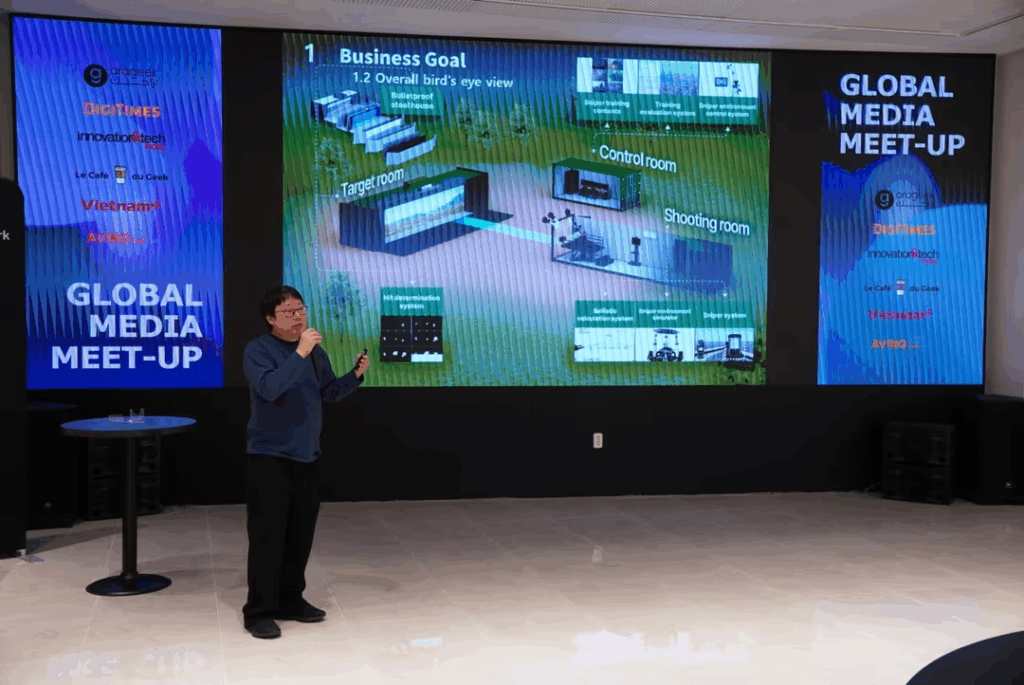
Instead of large outdoor shooting ranges stretching hundreds of meters, the system is built around:
-
A real firing room of roughly 100 meters
-
Bullet-resistant projection screens
-
Multiple cameras tracking the weapon and shooter posture
-
An AI system analyzing weapon angle and position
-
A ballistic simulation engine that allows a shooter to “hit a target one kilometer away” in a virtual environment
One AraGeek team member described it after the demo as “compressing the real world into a single room.” The shooter uses a real weapon, with real recoil and real sound, while the result is calculated digitally and visualized virtually.
Ballistics: When AI Becomes Physical
The heart of the system is not the screen—it is the ballistic intelligence engine.
Using camera data, the AI tracks the weapon, calculates firing angles and origin points, and simulates bullet trajectories while factoring in:
-
Distance
-
Target movement
-
Shooter angle
-
Environmental variables such as wind and weather
The outcome is instant. A successful hit is marked visually; a miss is flagged just as clearly. Everything happens in real time.
Crucially, the targets are not static. They can move vertically, change speed, rotate, or behave unpredictably. In our view, this is where the system truly diverges from traditional training setups that rely on targets sliding left and right on rails.
From the Korean Military to the U.S. Market
This system is not theoretical. The company confirmed that it is already supplying the solution to the Korean military, including special units. Feedback, as we were told, has been strongly positive. Soldiers described the experience as “game-like, but real and effective.”
The next step is entry into the U.S. market, particularly shooting clubs. In the United States, many ranges still rely on paper or steel targets. This system offers a safer, more versatile alternative that can be installed indoors, with full sound insulation and ballistic protection.
The company is not targeting military clients alone. Civilian users who want realistic training—without open ranges or wasted ammunition—are very much part of the strategy.
An Unexpected Direction: Vision AI for the Visually Impaired
At the end of the presentation, the team shifted to a completely different application.
Using the same core vision AI capabilities, the company introduced an assistive system for people with visual impairments. The solution identifies obstacles—chairs, stairs, hazards—and provides immediate audio alerts to help users move safely.
Mason Kim was direct about this product’s role. It is not the company’s main commercial driver. Most revenue comes from defense-related applications. This solution, he said, is a social responsibility.
From our perspective, this revealed a great deal about the team’s mindset. The same computer vision techniques used to track weapons, angles, and trajectories can be repurposed to support a group often overlooked in technological design.
The company plans to launch this product at the next CES, with pricing intentionally kept low to allow governments to procure and distribute it to those in need.
Why This Model Makes Sense
What we saw in Seoul was not two unrelated products, but a deliberate technical survival strategy. The team openly acknowledged that consumer VR entertainment was not a viable market—limited platforms, low device adoption, and difficult content economics.
Shifting toward defense and real-world applications was a conscious decision. Here, AI is not used for spectacle, but to solve physical, measurable problems: training, safety, movement, and perception.
AraGeek’s Takeaway
In our view, this company represents a particularly important form of Korean innovation—one that does not chase trends, but builds systems that function in the real world.
Whether training snipers or helping a visually impaired person avoid a chair in their path, the principle is the same:
See the world—and turn it into meaningful data.
In an era dominated by digital noise, that kind of focus is worth paying attention to.
🚀 Got exciting news to share?
If you're a startup founder, VC, or PR agency with big updates—funding rounds, product launches 📢, or company milestones 🎉 — AraGeek English wants to hear from you!






✉️ Send Us Your Story 👇