Conversation with Ebrahem Anwar – MasterMinds

14 min
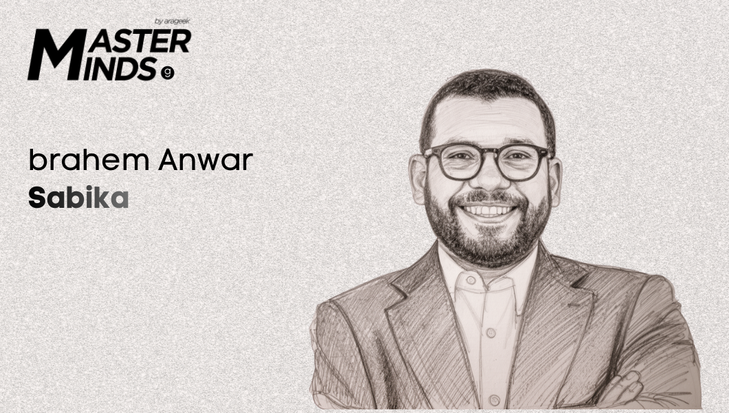
Today on MasterMinds, we meet an Egyptian entrepreneur whose journey blends innovation, resilience, and purpose across multiple industries. Ebrahem Anwar — CEO of Sabika, exited founder of Elmawkaa, and creator of ICanCoachYou.online and Daleducation.com — has built a career dedicated to using technology to solve real problems, empower people, and create transparent, accessible digital economies across MENA.
A serial entrepreneur, business mentor, and fintech innovator, Ebrahem has spent more than a decade founding and scaling ventures that merge impact with profitability. Today, he leads Sabika, a digital platform helping individuals and companies buy, sell, and invest in gold and silver in a secure, transparent, and Sharia-compliant way — making precious metals investment accessible to everyone.
His track record spans multiple successful ventures:
• Elmawkaa.com – a construction-tech marketplace later acquired by Ayen in Saudi Arabia.
• Daleducation.com – a platform dedicated to Quran memorization and learning.
• ICanCoachYou.online – a global SaaS marketplace enabling experts to monetize knowledge and reach learners worldwide.
Ebrahem’s journey reflects a belief in ethical business, practical innovation, and the power of mentorship. Whether building fintech platforms or guiding founders, he remains committed to helping entrepreneurs thrive — not just by sharing successes, but by openly discussing the lessons learned along the way.
Let us start from the beginning. How did your journey into the world of entrepreneurship begin?
I started very early, back in my university days in 2010, through a student organization called Enactus. For me, it felt like a second university. I learned what it means to build a project, how to work with a team, and how to win or lose while still learning.
I worked on dozens of projects, ranging from recycling cooking oil to ambitious ideas for generating electricity. That experience planted a deep passion for entrepreneurship within me, and the more I learned, the more I fell in love with this field.
Between engineering, programming, and entrepreneurship, when did you feel it was time to build your own company?
That moment came when I realized I understood three areas that are rarely found together: engineering, programming, and business. This gave me a unique perspective that I felt I could use to build something new with a different mindset.
I was not waiting for opportunities to come; I decided to create my own. I told myself: “If I am not going to start now, then when?” That is when I decided to build my own company.
Investment in precious metals is strongly tied to trust. How do you build trust and transparency on the platform?
Trust is not built in a day; it grows with time and with the people behind the company. The first foundation of trust is the question: Who is behind the company? We have well-known investors, a board of directors that includes respected figures such as Dr. Ashraf Ibrahim, reputable Sharia scholars, and a very visible team on social media.
We also hold official licenses from major institutions such as the General Authority for Investment and the Central Bank.
We always respond to customers’ questions with full clarity. The experience users have on the platform makes them return and recommend us to others. That is the true measure of success.
As a mentor to several entrepreneurs, what is the one piece of advice you always repeat to new founders?
I always tell them: start small. Build a Minimum Viable Product, not a fully developed project. Most beginners fall into the trap of trying to prepare everything perfectly and spending money on things that do not matter at the beginning, which destroys the dream early.
I always prefer that founders start with something simple to test the market and understand what people truly want. Success is not about starting big; it is about starting small and growing correctly. The ones who succeed are those who experiment, learn, and improve every day.
As a serial entrepreneur, are you considering a new project in the near future?
I always think about new ideas, but I have learned that the most important element in any venture is the team. An idea alone is never enough; the right team preserves the vision and continues during difficult times.
I am currently fully focused on Sabika, but if I meet a team with passion and strong values, we may start a new journey together. What matters most is that the journey has meaning.
Do you believe technology can transform the way people invest in traditional assets such as gold and real estate?
Absolutely. Technology has transformed everything, and investment is no exception. Today, anyone can invest in gold using their mobile phone without visiting a shop or fearing fraud. On Sabika, some users have achieved returns ranging from forty percent to five hundred percent due to timing and the ease that technology provides.
Real estate is also shifting toward digital transformation and will undergo significant change. Those who do not adapt will fall behind.
Do you believe that an exit is always the end of a journey, or can it be the beginning of a new adventure?
Exiting a successful company is not the end—it can be the first step toward a much bigger chapter. When you exit after a long journey, you walk away with lessons, experience, and a network that enables you to build something far greater.
For me, exiting Elmawkaa allowed me to focus fully on Sabika and enter a much larger domain with deeper impact. Every successful project opens a new door and broadens your perspective.
Do you believe the Arab market is truly ready for digital investment in gold and silver?
Not only is it ready — it is thirsty for such a solution. The proof is that Sabika reached more than half a billion Egyptian pounds in sales within only ten months, without spending millions on marketing. This clearly shows that people were waiting for the right platform.
Young customers are used to doing everything through their phones—so why should investing in gold be any different? Additionally, people are searching for ways to protect their savings as currencies fluctuate. So the answer is absolutely yes—the market was waiting for a solution like Sabika.
Elmawkaa was one of the notable ventures you worked on, and it was eventually acquired. What were the most important lessons you gained from that experience?
Elmawkaa taught me a tremendous amount. The biggest lesson was that a company is not your “child” that you cannot let go of; it is a project that requires flexibility to know when to continue, when to withdraw, or when to exit.
The acquisition was a pivotal moment that made me rethink the emotional attachment entrepreneurs often develop. I also learned that success is not always about staying—sometimes success lies in exiting at the right moment and starting a bigger journey.
The most important takeaway was that you should build your company from day one to be scalable or eventually exit-ready, not as something purely emotional.
How do you balance commercial goals with your values when starting new ventures?
I have a clear principle: if a project is not Sharia-compliant, then it is not for me. This does not reduce my opportunities; in fact, it increases them because God opens doors when intentions are sincere.
In every project, I ask myself: “Does this involve any doubt? Interest? Injustice?” If the answer is no, I proceed. If yes, I walk away. Although this forces me to decline many opportunities, it has protected me and helped me build trust with people.
I always consult knowledgeable scholars whenever I am uncertain.
If you could go back in time to your first startup, what would you do differently?
The first thing I would do is learn Design Thinking much earlier. Unfortunately, I did not understand what it meant to build a customer-centric product or truly identify the customer’s real problem until years later, when I traveled to the United States and learned how to listen to users and build based on their needs, not my assumptions.
I used to think that an idea alone was enough. Now I understand that without deep market understanding, an idea will not go far.
In your opinion, what are the next major trends in financial technology in the region?
In my view, digital investment in gold and silver is still at an early stage. No one has yet perfected the ideal model that allows people to invest easily, securely, and in a Sharia-compliant manner.
This is exactly what Sabika is working to achieve. There is also strong momentum toward Islamic finance and the use of artificial intelligence in financial services. People want solutions that are fast and safe, and whoever can deliver that will win.
Let us talk about Sabika — the idea of digital investment in gold and silver. How did the concept begin?
To be honest, I was not part of the founding team from the start. I initially joined as a consultant. But while working with them, I saw a big dream taking shape—an idea capable of transforming the market. The founders later asked me to join as Chief Executive Officer.
After careful consideration, I decided to leave my job in Saudi Arabia and return to Egypt to focus on Sabika. The idea originated from founders who believed there was a major gap in the market and that people needed a trustworthy digital platform to invest in gold and silver safely and in a Sharia-compliant manner. I decided to be part of that journey.
Sabika combines technology with strict Sharia compliance. How did you manage to achieve this balance technically and operationally?
This was one of the most challenging aspects, but we worked on it from day one. From a Sharia perspective, we do not take any step without consulting trusted scholars such as Dr. Bassam Aliwa, Dr. Fayyad Abdel Moneim, and Dr. Mourad Haidar.
We also comply with AAOIFI standards, which set guidelines for Sharia-compliant financial transactions. From a technical perspective, we built a system that allows customers to know exactly what they purchased, at what price, and where it is stored—exactly as if they were holding the gold physically, but in a digital format. We also ensure real physical storage through a partnership with EgyCash, which is licensed by the Central Bank.
Was moving between different sectors a challenge, or did it help you gain diverse experience that supported your work in Sabika?
It was definitely a major challenge. Every new sector felt like starting from zero, which can be exhausting. However, I always learned quickly and connected the dots between experiences. For example, while working in construction technology, I benefited from my engineering background.
And when I entered the educational technology and financial technology spaces, I used my programming and analytical skills. Every experience added new tools that helped me with the next step. Ultimately, this diversity made me far more prepared when I started working on Sabika.
What are your future expansion plans? Are there specific markets you are targeting?
We are following a very clear plan. In the first half of 2026, we will focus on serving businesses in Egypt, offering gold and silver investment solutions for institutions. In the second half of the year, we will begin expanding into the Gulf region, especially Saudi Arabia and the United Arab Emirates, where demand for Sharia-compliant solutions is very strong.
Additionally, we are preparing subscription-based products that include educational content, a smart assistant, updated prices, and other features to help users make smarter investment decisions.
What gap did you see in the market that convinced you the timing was right for Sabika?
The founders had already identified the gap, and that is what made me believe in the vision. Many people wanted to invest in gold and silver, but there was no trusted platform offering a safe, digital, and Sharia-compliant experience.
People were searching for an alternative that would keep them away from the stock market or cryptocurrencies, allowing them instead to invest in stable assets that protect their money, especially during inflation. The real gap was in trust and user experience—and Sabika solved both.
What is the biggest challenge you have faced as an entrepreneur in Egypt or the region, and how did you overcome it?
One of the biggest challenges was learning quickly and building a strong network that can support you during difficult times. In Egypt, success is not just about having a good idea and working hard. You must also learn how to navigate bureaucracy, secure funding, and manage diverse teams.
Personally, I learned to be patient with knowledge. Instead of trying to do everything on my own, I started reading, learning from others who came before me, and speaking with experts. That was a true turning point in my journey.
What is the most common mistake you see repeated by new entrepreneurs?
Honestly, perfectionism is the number one enemy of new founders. Many want to launch a perfect product from day one, which delays them so much that they never truly understand the market.
Another mistake is building a team composed of people who all have the same background—such as all programmers or all salespeople. You need diversity in skills and expertise to see the full picture and build a real company, not just an idea.
What is your long-term dream? Is it to build a massive company or to create meaningful impact in the entrepreneurial ecosystem
My dream is for people to understand what it means to build a company correctly, and to empower real entrepreneurs who have passion and values. That is why I wrote the book “Thirty Bullets to Protect Your Business Life” and created the course “From Zero to Exit.” I want everyone with an idea to find a clear path, understand how to protect themselves, and grow properly.
And of course, I want to build a company that becomes a role model for others in Egypt and the Arab world—not just in size, but in the value it provides.
You describe yourself as a believer in ethical entrepreneurship. What does “ethical business” mean to you?
For me, ethical entrepreneurship is not just a slogan or something to write in an “About Us” section—it is a lifestyle. I believe every business decision must be aligned with Islamic principles, not just in theory but in actual implementation. The most challenging part is knowing the right path but being tempted to take the easier one, yet still choosing what pleases God.
For example, you may have the chance to make more money through interest-based or deceptive practices, but you must say no. This requires daily effort, self-discipline, and consistency.
You have worked in Saudi Arabia, the United Arab Emirates, and Egypt. How do you compare the entrepreneurial environments in these countries?
These environments are completely different, and one of the biggest mistakes entrepreneurs make is assuming that all markets operate the same. Saudi Arabia is a large market, but it takes time to earn trust. The United Arab Emirates is extremely fast-paced and demands immediate results. Egypt has huge opportunities, but requires high flexibility.
Success in any country depends on understanding how people think and how decisions are made. Every market has its own “language” and “key,” and if you can understand and adapt, you can succeed anywhere.
You have worked on projects across different sectors—construction technology, educational technology, and financial technology. How do you choose which field to launch a new venture in?
I always look at the market first. I focus on what the market actually needs, not what I personally prefer. I also assess whether I have a strong team capable of executing the idea.
And everything must be fully compliant with Islamic principles—this is a non-negotiable foundation for me. I also prefer projects that involve deep technology and have strong potential for rapid growth. The project should not be limited or stagnant; it must have the ability to scale if executed well.