 LEAP26
 AI
AI Saudi Arabia
 UAE
UAE Egypt
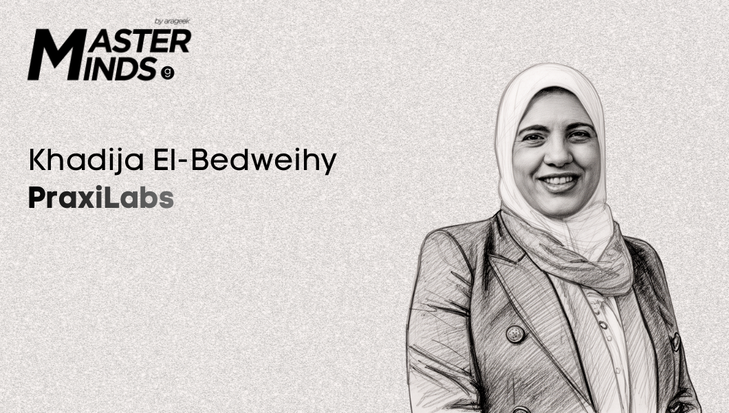
EgyptI am Khadija El-Bedweihy. I designed EdTech by studying people, not trends

5 min
Designing education from the human backwards
Educational technology often fails quietly. Platforms are launched, features pile up, adoption lags, and the blame lands on schools for resisting change. When the conversation opens with Khadija El-Bedweihy, a different diagnosis emerges. Technology is rarely the problem. Design is.
El-Bedweihy has built her career around a simple but demanding belief: education does not need more tools, it needs better understanding of the people expected to use them. As founder and operator of PraxiLabs and Skolera, she translates academic research into products that work inside real classrooms, not idealised ones.
How academia and entrepreneurship collided early
When asked how academic depth turned into entrepreneurial drive, El-Bedweihy traces it back to childhood rather than strategy. She grew up in an academically oriented household, with a clear expectation that education mattered. From her first days at university, teaching felt like a calling. She graduated top of her class, on track for a conventional academic career.
Running in parallel was another education. Her father shifted into business and founded an educational technology company supplying schools and universities with hardware. After school, she watched sales meetings, client negotiations, and the mechanics of trust. Without realising it at the time, she was absorbing management.
By the time she travelled abroad for her PhD, completed by the age of 22, those two tracks had already fused.
What studying abroad actually changed
On the question of studying overseas, El-Bedweihy is precise about the benefit. It was not prestige. It was structure. Working with experts, particularly in the UK, forced her to write clearly, which in turn forced her to think clearly.
At the same time, she is candid about the trade-off. Academia rewards depth and patience. Entrepreneurship rewards speed and exposure. For founders, she believes, too many years in academia can delay real-world learning.
Why awards mattered more than validation
Asked about the many competitions and awards her companies have won, El-Bedweihy reframes their value. Winning was never the goal. Visibility was.
Competitions brought credibility, marketing reach, and access to influential networks. In one case, winning Best Startup in Africa delivered $300,000, equivalent to a seed round. More importantly, they created momentum. People talked. Doors opened. The brand travelled faster than cold outreach ever could.
When virtual labs met a global shock
When the conversation turns to PraxiLabs’ growth, timing plays a central role. Years of research and feedback preceded the real launch in 2019. Early traction came from Egypt and Saudi Arabia, with ambitions to expand globally.
Then COVID-19 hit. Convincing customers was no longer the problem. Demand arrived overnight. Universities across continents reached out. PraxiLabs worked with institutions in 16 countries spanning Asia, Europe, the US, Africa, and the Middle East.
The decision to open experiments for free proved pivotal. Feedback flooded in. Universities in the US and UK began listing PraxiLabs as a recommended resource. Clients grew from 16 to more than 25 universities. Partnerships followed, including with the UAE Ministry of Education. Offices opened in Saudi Arabia and the UAE. What had been a regional experiment became global infrastructure.
Why a science startup was still worth the risk
Pressed on whether building a science-focused EdTech startup felt risky, El-Bedweihy does not deny the concern. Science education is complex, expensive, and slow to change.
Her approach was disciplined. Validate cheaply. Test demand before building fully. In 2016, the idea was tested with minimal cost. In 2017, customers paid. That was the proof. Only then did the team commit to full development.
What keeps education at the centre
Asked why she continues to focus on education despite its challenges, El-Bedweihy is clear. Education is difficult precisely because it matters most. While she has many ideas, her energy remains with Skolera and PraxiLabs. Scale comes before novelty.
Education, for her, is not a sector. It is the lens through which impact is measured.
What she relies on when things get hard
When asked what sustains her, the answer starts with passion. Without it, she says, no founder survives long enough. But passion alone is insufficient.
Rigidity is the enemy. Founders must trust themselves while staying open to feedback. Team, however, is the decisive factor. El-Bedweihy speaks of her teams not as staff, but as believers. Some developers have stayed for over five years. Shared vision matters more than hierarchy.
The hardest challenges were structural, not technical
On the question of obstacles, two stand out. First, investor reluctance. EdTech is often compared unfavourably to more immediately profitable sectors. Funding was difficult, forcing years of self-financing.
Second, resistance to online education itself. Before COVID-19, scepticism was widespread. Both companies spent years convincing institutions that digital learning was credible. The pandemic did not create belief, but it removed denial.
What success ultimately means
Asked what she hopes to achieve, El-Bedweihy avoids metrics. Impact is personal. Hearing individuals describe how they learned, progressed, or fulfilled a dream is the real measure. She wants that feeling multiplied by millions.
Science education, in particular, remains close to her heart. Access should not decide ambition.
Why startups offered scale that academia could not
When reflecting on the moment entrepreneurship became inevitable, El-Bedweihy points to scale. Teaching at university was meaningful, but bounded. The impact reached dozens, maybe hundreds.

She wanted something larger. While studying abroad, she saw education becoming fully digital, from teaching to grading. The region lagged behind. That gap gave birth to Skolera, a comprehensive learning management system designed for local realities, not imported assumptions.