 LEAP26
 AI
AI Saudi Arabia
 UAE
UAE Egypt
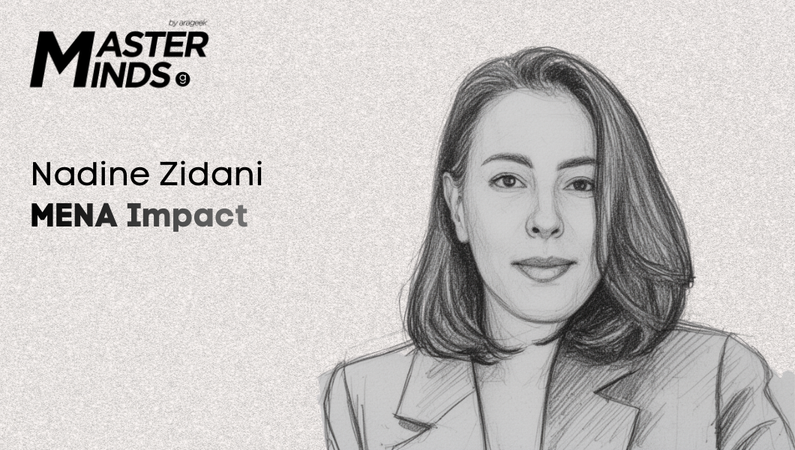
EgyptI am Nadine Zidani. I took a sabbatical, which led to MENA Impact

9 min
The question she could not avoid during COVID
When asked what changed her trajectory, Nadine Zidani does not dress it up as a grand epiphany. It was a year of introspection during the pandemic, a sabbatical that arrived in the least romantic form imaginable: no travel, no reset fantasy, just time and a sharper mirror.
After more than a decade in corporate roles, she began interrogating the basics. What had her work actually changed? Could she tolerate repeating the same operating rhythm for another ten years? What, beyond competence and progression, genuinely drove her? The answers pulled her towards sustainability and what she prefers to call “impact” work, not as a side project, but as a serious arena where business can be “an incredible force for good” if you are willing to do the hard, unglamorous parts.
That willingness, to move from reflection into structure, shows up again and again in how she talks about the region’s next chapter.
How governance training becomes an impact advantage
On the question of what her governance, risk, and internal audit background gave her, Zidani points to something many mission-led operators underestimate: fluency in how organisations actually make decisions.
Frameworks, risk mapping, opportunity assessment, and the mechanics of embedding priorities across different contexts, those skills travel well. But the more decisive advantage, she argues, is cultural and political literacy inside companies. She learned what motivates executives, what triggers caution, how change gets smuggled in through incentives rather than ideals, and how to translate purpose into language that does not get dismissed as naïve.
That translation work matters because she is not selling morality, she is designing pathways. In her telling, balancing purpose and profit is not a contradiction, it is a discipline. It requires understanding how leaders think when quarterly pressure arrives, how risk committees interpret new commitments, and how to build initiatives that survive contact with real budgets.
The region’s biggest misunderstanding: charity versus business
Pressed on what makes building a sustainable impact ecosystem in the Arab region difficult, Zidani goes straight to the misconception that slows everything else: impact is still widely treated as charity.
The category confusion is expensive. If impact is assumed to be non-profit activity, then investors struggle to see commercial pathways, founders struggle to price their work, and governments struggle to regulate and incentivise the right outcomes. She describes “impact business”, profitable companies built around a purpose, as still nascent in the region, which means capital is harder to access and awareness must be rebuilt at every level.
Her argument is deliberately practical. The opportunity, she notes, is not theoretical. She cites McKinsey’s estimate that technologies supporting climate resilience and adaptation could represent a $600 billion to $1 trillion private-market opportunity by 2030. In other words, there is money to be made solving real problems, but only if the region stops treating impact as a donation category and starts treating it as an enterprise category.
When “purpose” stopped being optional
When the conversation turns to why she believes purpose must sit at the centre of organisations, Zidani’s answer is blunt: scandal and backlash made the gap impossible to ignore.
She points to the growing visibility of major brands whose marketing claims outpaced their environmental and social practices. The distance between the image and the reality became too large to excuse as edge cases. For her, that is the moment purpose becomes a governance issue, not a branding exercise. Why does the company exist in the first place, and what does it cost to society when that question is never honestly answered?
She returns to a single test that cuts through clever narratives: “Is the world better with my business in it?” It is not sentimental, it is operational. If the answer is unclear, the strategy is already fragile.
A younger generation that is ahead of its elders
Asked to reflect on whether young people in the region are sufficiently aware of responsible business, Zidani pushes back against the usual pessimism.
She argues the concept resonates deeply with them, partly because the region’s challenges are not abstract. She points to a 2024 finding that 34% of youth in MENA are familiar with the UN Sustainable Development Goals, compared to 23% globally, as reported by the World Economic Forum. They have been exposed early, educated early, and are increasingly selective about who they will work for.
This is where her optimism becomes specific. If talent is already primed for purpose-led work, then the bottleneck is not values, it is infrastructure: capital, regulation, incentives, and credible success stories.
Public sector pragmatism, private sector urgency
When asked which side is more ready, public or private, Zidani refuses the easy binary and gives a more useful distinction.
Governments, she says, increasingly recognise they cannot carry social and environmental challenges alone. They need businesses that generate positive outcomes while creating jobs, companies that support national priorities and accelerate progress towards the Sustainable Development Goals. The private sector’s entry point is different: large organisations need practical solutions to speed up sustainability transformation, and they often cannot build those solutions internally fast enough.
This is where she sees impact-driven businesses filling a clear gap, bringing agility and on-the-ground innovation. In her framing, the ecosystem works when both sides stop treating impact businesses as decorative and start treating them as functional.
Why her model insists on being local
On the question of how MENA Impact differs from global frameworks, Zidani’s emphasis is not on rejecting global standards, but on refusing imported assumptions.
MENA Impact was born in the UAE and built around regional realities. She gives a concrete example: prioritising job opportunities for youth from underserved communities and countries in the region. The talent is there, she says, but access to meaningful work remains constrained. For her, “impact must be local”, built for the region and by people from the region, because social, economic, and cultural nuances shape what will work.
It is a critique delivered without theatrics. Global frameworks can be useful, but they do not always translate cleanly. Local design is not ideology, it is effectiveness.
What founders get wrong about profit and pivots
Asked what advice she gives founders trying to balance profit and purpose, Zidani starts with the part many do not want to hear: you are building a business first.
The model has to make sense, and revenue must be directly linked to the impact created. If the connection is vague, it becomes a marketing claim, not a business engine. She is also unromantic about pivots. Founders often begin with an idealistic vision, then realise that revenue is what allows impact to scale. The pivot is not a failure of values, it is an upgrade in realism.
Her line that stays with you is her refusal to treat balance as a personality trait. It is a discipline, meaning it needs structure, targets, measurement, and the humility to change course.
Funding, patient capital, and the missing story
Pressed on the biggest challenges social entrepreneurs face today, Zidani names two: money and narrative.
The funding gap is straightforward. She argues social entrepreneurs need patient capital and ideally equity-free funding early on, which is where government and philanthropy can play a stronger role. But the second challenge is the one she returns to as both a strategist and a storyteller: founders often cannot communicate complex, science-backed solutions in a way that lands. They “lose people in the narrative”, and when the narrative fails, visibility, funding, and partnerships follow.
Storytelling, in her view, is not decoration. It is infrastructure.
“Walk the talk” as an operating standard
When asked why she chose to certify MENA Impact as a B Corporation, Zidani frames it as accountability, not status.
You cannot advise organisations on sustainable practices if you are not testing those practices yourself. She wanted to experience the constraints first-hand, to understand what it takes to build a profitable company that still meets high social and environmental standards. She calls it one of the most demanding certifications in the world, and for her the value is the discipline it forces, the proof that the principles are not just content.
It is also a signal to partners and founders: the standard applies internally before it is applied externally.
Building what she could not find
On the origin of MENA Impact, Zidani describes a simple gap that became impossible to ignore. She began as a consultant working across startups, corporates, and governments on sustainability projects, then realised there was no real ecosystem for people working on social and environmental challenges to connect, collaborate, and grow in a way that reflected the region.
She felt isolated, joining global communities that did not match Arab realities, so she built what she could not find. Today, she describes MENA Impact as a community-powered platform driving sustainability and innovation across the region, with a “founders first” core supported by enablers and partners who co-create solutions.
Asked what role it will play next, she avoids being attached to a fixed format. The mission is to build the ecosystem, and the organisation can evolve as the ecosystem matures. What matters is staying focused on the problem and the value created.
The podcast episode that clarified the language problem
When asked which conversation from her Impact Talk podcast stayed with her, Zidani points to her discussion with Jalil Allabadi, founder of Altibbi. She recounts how it began as an Arabic medical dictionary and grew into a telehealth company offering 24/7 doctor access, AI-powered tools, and medical content across the region.
What stayed with her was not the growth story, but the discomfort with labels. Allabadi did not want to be called a social entrepreneur because he is building a profitable, venture-backed company. For Zidani, that tension captures the region’s language problem perfectly: impact is still treated as a moral badge rather than a business model, even when the outcomes are undeniably social.
The message she wants entrepreneurs to hear
Finally, when asked what she would say to entrepreneurs who want to serve both people and planet, Zidani challenges the most common advice: “just launch”.
She disagrees. Entrepreneurship is hard, and impact entrepreneurship is harder. If you do not know why you are doing it, the first serious obstacle will break you. But if you are ready to challenge the status quo and build something bigger than yourself, she sees the path as demanding and deeply rewarding. It will require resilience, conviction, and courage, but it is a choice rooted in clarity, not impulse.
In the end, her version of purpose is not a slogan. It is a test you can measure, a model you can fund, and a story you can tell well enough that others finally see what is already being built.