 Ai Everything
 LEAP26
 AI
AI Saudi Arabia
 UAE
UAE Egypt
EgyptEgypt Unveils Inclusive AI Campus to Foster 100 Tech Startups by 2030

5 min
Egypt launched the AI 100 Programme at its first inclusive AI Campus.
The four-year plan aims to scale 100 AI-native startups by 2030.
Built on “innovation, education and sustainability” within Sumou BLVD’s smart-city framework.
Schneider Electric and Plug & Play will link energy systems and global networks.
Success will depend on turning bold vision into scalable, revenue-generating companies.
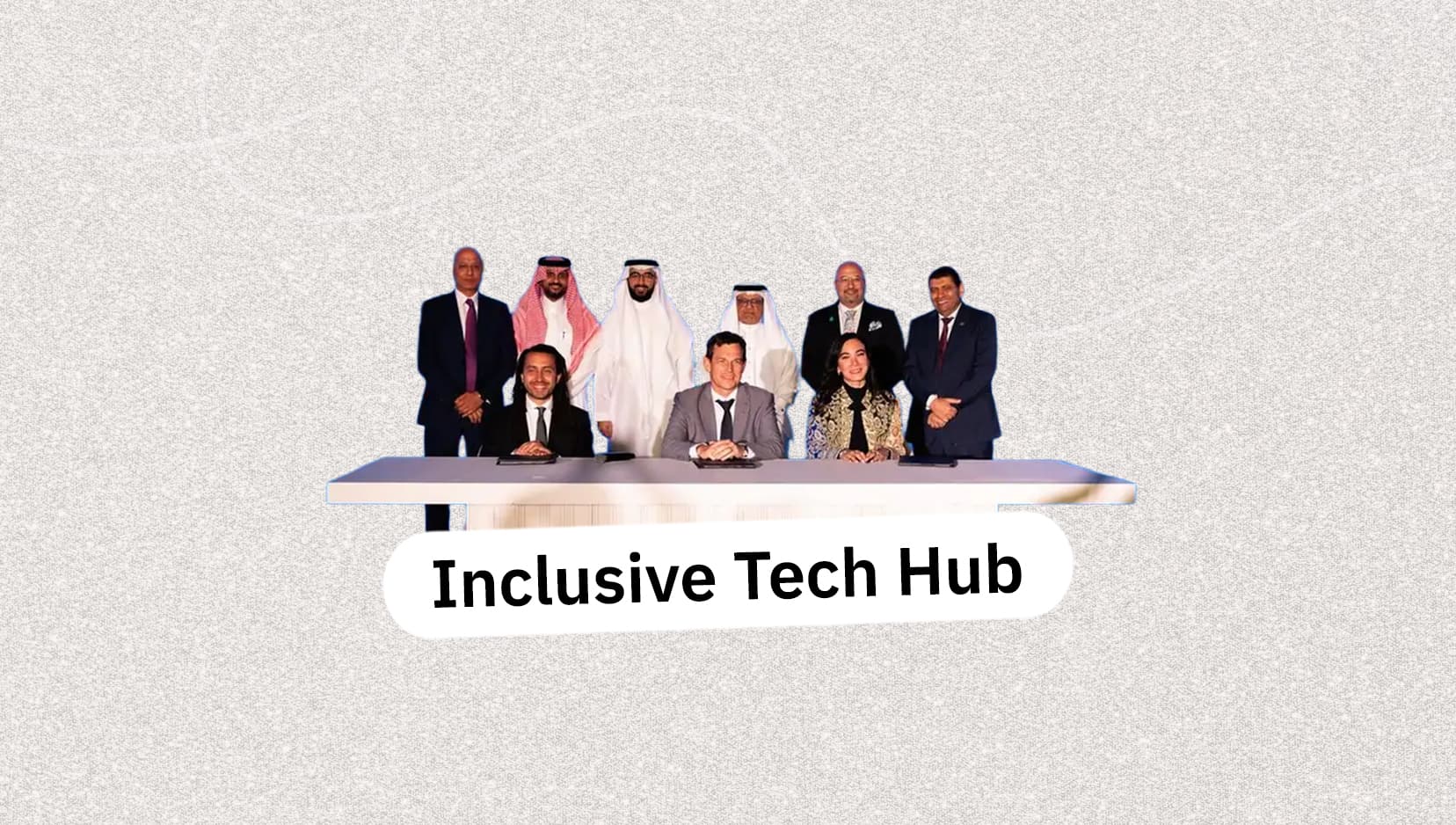
Egypt’s ambitions in artificial intelligence took a tangible step forward this week, as Schneider Electric, PARAGON | ADEER and Plug & Play Tech Center unveiled the AI 100 Program at what is being described as the country’s first inclusive AI Campus, located within SUMOU BLVD in New Cairo.
The initiative was formalised during an MOU signing ceremony at an exclusive SUMOU BLVD event, held on 19 April at the Khufu’s Boat Museum inside the Grand Egyptian Museum. It was one of those settings that makes you pause for a second — ancient history in the background, and conversations about AI, energy systems and startup pipelines in the foreground. Well… I mean, if that’s not symbolism, what is?
The launch gathered a heavyweight crowd. Egypt’s Minister of Supply, Dr Sherif Farouk, attended alongside senior government officials, business leaders and investors from across the region. Representatives from Sumou Investment and Sumou Holding Group were present, including Abdulrahman Al-Qahtani, Saeed Al Nahdi and Eng. Abdullah Al-Qahtani. From the development side, Eng. Bassel El Serafy of Adeer International and Ahmed Helmy, Chief Investment Officer, joined the line-up, along with Eng. Mohamed Bedeir, Chairman of PARAGON | ADEER, and its CEO, Eng. Bedeir Rizk. Schneider Electric’s North Africa and Levant Cluster CEO, Eng. Sébastien Riez, and Karima El Hakim, Regional Director of Plug & Play in Egypt, were also in attendance.
At the heart of all this is the AI Campus at Sumou BLVD — positioned as an open, collaborative hub inside a wider mixed-use urban development. The campus is built around three pillars: AI and innovation, education, and energy efficiency. The idea is to blend technology with sustainable infrastructure in a setting that connects residential, commercial and digital life. It sounds ambitious, yes, but also spot on for a region where smart-city talk is often louder than actual delivery.
The AI 100 Program is a four-year plan aiming to identify and scale 100 growth-stage, AI-native startups in Egypt by 2030. Rather than just offering desk space and Wi-Fi, the programme promises immersive bootcamps, applied AI training, venture workshops and capital-readiness tracks. There’s also direct integration into the Sumou Boulevard AI Campus ecosystem, with the goal of turning these companies into long-term anchor tenants.
Eng. Bedeir Rizk described the campus as a “deliberate convergence of innovation, education and sustainability,” adding that the AI 100 Program would act as the engine for forging high-impact partnerships. He noted that the collaboration with Schneider Electric marks the first step in a broader strategy to align global technology expertise with sustainable urban infrastructure.
For his part, Sébastien Riez pointed to Schneider Electric’s role in enabling smart, energy-efficient environments. He framed the campus as a kind of living laboratory, where AI systems and energy technologies can be tested and scaled in real-world conditions. That practical angle, I reckon, is what could make the difference. Too many tech initiatives look shiny on paper but struggle when it comes to implementation.
Karima El Hakim highlighted the importance of plugging Egyptian startups into Plug & Play’s global network. Through that channel, local founders could connect with international corporations and investors, giving them a chance to compete beyond the domestic market. On the flip side, this also raises expectations — startups entering such a programme will need to deliver, not just pitch decks and promises.
Sumou Boulevard itself is a joint venture between Egypt’s Paragon Developments and Saudi Arabia’s Adeer International, backed directly by Sumou Investment, a subsidiary of Sumou Holding. The project represents Sumou’s strategic entry into the Egyptian market through Adeer, blending Gulf investment discipline with local expertise. The development is positioned as a blueprint for integrated, next-generation urban communities — mixing living, working and technological innovation within what planners call a smart-city framework.
For readers at Arageek, many of whom are building companies in less-than-perfect conditions, this kind of initiative will definately spark interest. Access to structured support, global networks and infrastructure purpose-built for AI is not something you see every day in the region. I’ve met founders who spend months chasing small grants or battling outdated systems — it can be a bit of a faff, to say the least. So a campus designed to centralise opportunity? That could be a game-changer if executed properly.
And believe it or not, timing matters. Egypt’s startup scene has matured significantly over the past decade, but deep-tech and AI ventures still face gaps in funding, mentorship and infrastructure. By 2030, the success of this AI 100 Program will not be measured by how many events were hosted in a museum hall, but by how many scalable, revenue-generating AI companies are actually operating from the campus and beyond.
That said, the blueprint is there. The partners are established. The ambition is clear. Now comes the hard part — turning vision into value, and making sure that this AI campus becomes more than just another well-branded announcement on the region’s startup calendar.
🚀 Got exciting news to share?
If you're a startup founder, VC, or PR agency with big updates—funding rounds, product launches 📢, or company milestones 🎉 — AraGeek English wants to hear from you!

✉️ Send Us Your Story 👇