 LEAP26
 AI
AI Saudi Arabia
 UAE
UAE Egypt
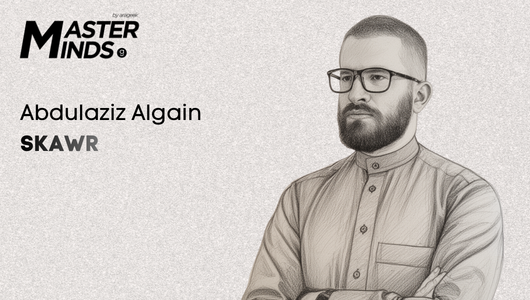
EgyptI am Abdulaziz Algain. I built SKAWR around one problem: liquidity

8 min
Abdulaziz Algain does not talk about growth as a marketing function. He talks about it as a system. For the Co-Founder of SKAWR, growth is less about channels and more about coherence, less about tactics and more about liquidity.
Again and again, he returns to one idea: companies fail not because they lack ambition, but because they mismanage flow, of information, of cash, of supply and demand.
Below is a conversation shaped around that belief.
When growth stops being a team and becomes a system
When asked what “real growth” means today, Abdulaziz Algain immediately moves away from product features or campaign performance.
Real growth, he argues, happens when a company operates as an interconnected system. Departments should not behave like departments. They should behave like organs. If one function improves, the others should respond.
In early-stage startups, especially, he sees founders making a critical mistake. They copy large corporations. They introduce formal training cycles, layered performance reviews, rigid departmental boundaries.
“That structure might work in a mature organisation,” he suggests, “but startups operate in uncertainty.”
In that environment, speed of communication matters more than hierarchy. Engineers should not be isolated. Growth should not belong to a team. The whole company should be the growth team.
The point is not chaos. It is connection.
Why SKAWR exists and why liquidity is the obsession
On the question of how SKAWR began, the origin is not a pitch deck. It is a decision.
Abdulaziz and his co-founder Saleh were initially split between building a last-mile logistics company or launching a marketplace. Then he watched a documentary about Yandex. It changed the direction entirely.
They decided to build a search company instead.
Not a narrow tool, but a multi-product company built around data and search, integrating mathematics, game theory, psychology and economics. The central problem is liquidity. Helping users transact faster. Helping businesses convert faster. Reducing friction between supply and demand.
He describes liquidity as the core issue across marketplaces and e-commerce. If people cannot find what they want quickly, if sellers cannot reach the right buyers efficiently, money slows down. When money slows down, growth slows down.
The team is now close to ten people, and he speaks with unusual candour about the impact of new hires. Adding people like Ziyad and Abdulraheem, he says, changed not only the company’s output but its standards.
Growth, for him, is also about who you let shape the system.
Why most search and pricing tools are too static
When the conversation turns to differentiation, Abdulaziz is blunt.
Most search solutions, even those claiming semantic intelligence, are static. They match keywords. They optimise within a closed environment.
SKAWR approaches search differently. Every user, he argues, has a different intent. That means innovation cannot slow down. Search does not end on the website. It starts with traffic. What happens before the click matters as much as what happens after.
This thinking extends into conversion rate optimisation. Search should not simply help users find products. It should complete the cycle, increasing the probability of transaction.
Pricing is still early for SKAWR, but he believes the infrastructure built for search will underpin pricing intelligence as well. Foundations first. Expansion later.
The marketplace mistake that kills momentum
Pressed on the biggest scaling mistakes founders make, Abdulaziz focuses on fundamentals.
Once marketplaces reach critical mass, many founders relax. They assume volume protects them. It does not.
Two metrics matter intensely: match time and match rate. How quickly does supply meet demand? What percentage of users actually get what they came for?
If match time is long, or match rate is low, even large marketplaces decay quietly.
He argues that many platforms over-optimise for a few high-value users while neglecting the rest. That imbalance becomes dangerous over time.
One of the few companies he believes has managed this consistently well is Uber. Not because it scaled quickly, but because it preserved liquidity at scale.
Why balancing product, sales and finance is structurally difficult
When asked why founders struggle to balance product, sales, recruiting and finance, his answer is psychological.
The personalities who excel in customer-facing roles differ from those who excel in structural roles like HR and finance. External functions provide fast feedback. Internal systems break slowly, and often silently.
That asymmetry tempts founders to prioritise what feels urgent and visible.
But neglecting finance or HR does not stall growth immediately. It undermines it gradually.
What Saudi startups still get wrong
Through his work with HalqahGrowth, he sees patterns in early-stage Saudi companies.
When asked what shows up repeatedly, he lists four.
First, a lack of systems thinking. Every role either accelerates or constrains growth.
Second, weak growth culture. High standards matter. Punishing mistakes slows experimentation.
Third, avoiding strong personalities in HR and finance. Surrounding yourself with agreeable voices creates long-term fragility.
Fourth, an inability to accept uncertainty. The best founders, he argues, remain calm under stress. They treat volatility as normal, not exceptional.
Why you should always invest in growth
On the question of timing, Abdulaziz rejects the trade-off framing.
You should always invest in growth.
In early stages, product and sales dominate. That is natural. But improving operations or hiring discipline does not flatten growth. If the company is truly connected, improvements compound.
If one area strengthens, others should benefit.
A company that grows in silos is misdiagnosing itself.
The lesson from Cura: build internally
Asked to reflect on his time as Director of Growth at Cura, he identifies one clear decision: building an internal growth team rather than relying entirely on agencies.
Ownership changed performance.
His regret is equally clear. They underinvested in brand.
The metrics he trusts and the ones he ignores
When evaluating growth health, Abdulaziz starts with two filters.
Internally, he examines the relationship between headcount and revenue. Discipline here is crucial, particularly in early stages. A small team generating millions is powerful. Scaling headcount prematurely erodes leverage.
Externally, he looks at whether the market itself is growing. If the tide is rising, optimisation becomes worthwhile.
On acquisition, he focuses on CAC payback period and average order value. The faster capital returns, the faster it can be redeployed.
He ignores LTV.
Not because lifetime value is irrelevant, but because it is predictive. CAC is real. LTV is a projection. Comparing the two, he argues, often creates false confidence.
He also increasingly prioritises contribution margin and free cash flow. Contribution margin reveals cost intelligence. Free cash flow fuels optionality.
Without cash, everything slows.
How Saudi Arabia’s momentum spills into startups
When asked about the broader ecosystem, Abdulaziz sees transformation.
Digitisation and structural reform have been substantial. But he also believes cultural shifts matter. The arrival of global football stars such as Cristiano Ronaldo, Karim Benzema, N'Golo Kante, Sadio Mane and Riyad Mahrez has drawn global attention.
More attention means more tourism. More tourism means more marketplace opportunity.
What excites him most, however, is young talent. He believes the emerging generation of Saudi founders is outperforming previous ones in ambition and capability.
Data is not reality
On data, Abdulaziz is unusually philosophical.
It plays a central role in decision-making. But scrutiny matters more than collection.
Data is a representation of reality, not reality itself.
He references the philosophy of falsification popularised by Karl Popper. Models are useful, but they are not truth. Companies often treat information as fact without attempting to disprove it.
For him, growth requires intellectual humility.
Building a growth team from first principles
When asked how to build a growth team from scratch, he returns to diagnosis.
Start with constraints. What is preventing growth? Roles may be missing. Mentalities may be misaligned. Sometimes it is speed. Sometimes it is uncertainty tolerance.
He prefers smart generalists over narrow specialists, with two exceptions: design and copywriting. Dedicated designers and copywriters increase both quality and speed.
He also believes companies underinvest in data scientists. One excellent data scientist, particularly one grounded in mathematics and startup reality, can change a trajectory.
Ignore product–market fit, sell more
Asked what advice he gives founders struggling with product–market fit, his answer is deliberately counterintuitive.
Ignore the concept.
Focus on selling. Sell to more customers. Use feedback to refine the product. Momentum clarifies fit faster than theory.
He also encourages founders to understand what customers use before and after their product. Context determines stickiness.
On the future and the only problem worth solving
When the conversation turns to the future of marketplaces in MENA, he avoids predictions but maintains optimism. E-commerce growth has been strong. He expects it to continue.
If he were starting again today, the problem would not change.
Liquidity.



Helping people transact faster. Helping businesses sell more. At some point, perhaps logistics again, maybe even post-IPO.
But for now, everything returns to flow.