 LEAP26
 AI
AI Saudi Arabia
 UAE
UAE Egypt
EgyptI am Dania Alshowaikh. I build brands that solve real problems

7 min
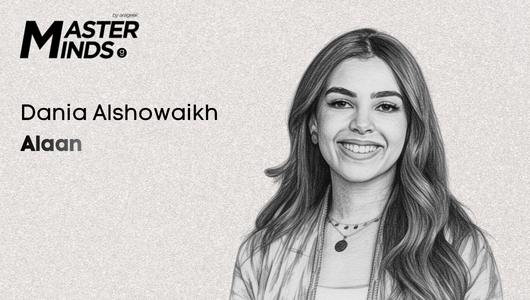
Dania Alshowaikh on Action, Money, and Building What Matters
Dania Alshowaikh does not describe her career as a straight line. If anything, she sees it as a series of decisions made in motion. Media and marketing led her into financial services. Financial services led her into fintech. And fintech, she says, felt less like a pivot and more like a natural progression.
The common thread has never been industry. It has been impact.
When asked to define herself, she hesitates. The answer, she says, keeps evolving. What has stayed constant is her interest in building brands that actually matter, not ones that simply look polished on the surface.
Why fintech felt inevitable
On the question of what pulled her into fintech, her answer is direct. Financial services remain surprisingly outdated for something so central to daily life. Money shapes freedom, choice, opportunity. Yet the systems around it are often clunky and inaccessible.
Early in her career, much of her work happened to involve financial services companies. That proximity gave her a front-row seat to the friction people experience with money. The curiosity stuck.
Her formal entry point came through Tarabut Gateway, sparked by a LinkedIn message about an open role. One conversation led to another. Soon she found herself working at the intersection of brand, technology and real-world behavioural change. That intersection, she realised, was where she wanted to operate.
Fintech, in her view, is one of the few sectors where technology can genuinely reshape how people behave, not just how systems are structured.
The mindset shift: progress comes from doing
When the conversation turns to which stage of her career shaped her most, she does not point backwards. She points to now.
Each role added something. But the biggest shift, she says, came from recognising that progress comes from action, not overthinking. The more she experimented, the clearer her direction became. “Action has always outperformed perfect plans.”
It is a philosophy that surfaces repeatedly in how she talks about risk, growth and decision-making. Clarity is rarely theoretical. It is earned through movement.
What being Entrepreneur in Residence actually means
Asked to unpack her current role as Entrepreneur in Residence at Alaan, she is quick to strip away the ambiguity of the title.
In practice, it means stepping in wherever needed, particularly as the company expands into Saudi Arabia. The scope has evolved over time. That fluidity is part of the appeal.
It is fast-paced. There is momentum. Adaptability matters. For Alshowaikh, the energy comes from being able to move across functions and support growth in real time rather than being confined to a narrow remit. The team, she adds, is among the strongest she has worked with, which makes the intensity sustainable.
Her focus, for now, is firmly on Saudi. Not on what comes next, but on executing what is already in motion.
Learning how builders think about money
When asked about her role hosting Money Moves, a show by Moniify, she is clear about the premise.
The idea is simple. Sit down with founders and operators who have built and scaled strong local brands in the region. Focus not on theory or headlines, but on decisions. How they approached money. How they assessed risk. How they thought about scale within their specific markets.
The intention is practicality. Regional relevance. Conversations that feel grounded rather than aspirational. For builders operating in the Middle East, she believes there is disproportionate value in learning from those who have navigated the same market dynamics firsthand.
The cultural gap in financial awareness
Pressed on the biggest barrier to financial awareness in the Arab region, she does not default to infrastructure or technology. She points to culture.
Money, in many parts of the region, remains a sensitive topic. Conversations are avoided. The result is hesitation, even intimidation, around financial decision-making. When dialogue is limited, confidence and literacy struggle to grow.
Fintech can build tools. But tools alone do not close awareness gaps. Open conversations do.
One Gulf, many markets
When the discussion shifts to her experience working with regional players such as Tarabut Gateway and Almoayed Technologies, she challenges the assumption that the GCC is a single, unified market.
Growing up in the region meant she understood the cultural landscape. What surprised her was how sharply business dynamics differ country to country. Decision-making structures, partnership models, scaling patterns, all vary more than surface similarities suggest.
The lesson was practical. You cannot copy and paste a strategy across borders and expect identical outcomes. Regional expansion demands nuance.
The branding mistakes fintech founders keep making
Asked to reflect on the most dangerous branding errors in fintech, her answer is unsentimental.
The first is prioritising optics over substance. No amount of visual polish compensates for a weak product. A strong brand rests on a real solution. Without that, design and messaging are cosmetic.
The second is unnecessary complexity. Overcomplicated names and layered messaging create friction. The most durable fintech brands tend to be clear and simple. In finance especially, clarity builds trust.
What will reshape Middle Eastern fintech
On the question of where the industry is heading over the next three to five years, she avoids grand predictions. Instead, she highlights patterns she is seeing on the ground.
Embedded finance will become standard. Payments, credit and spend tools will increasingly sit inside everyday platforms rather than exist as separate destinations.
Real-time financial visibility will change how businesses operate. AI-driven systems will turn transaction data into immediate insight, reshaping spend control and forecasting.
And progressive regulation, particularly around open finance and digital licensing, will act as a catalyst rather than a constraint. In her view, regulatory frameworks across the region are not merely catching up, they are enabling faster, more coordinated innovation.
Women leading fintech
When asked about the role of women in leading fintech companies in the region, she answers with measured realism.
The role should be equal. The reality is not there yet.
For her, gender balance is not a branding exercise. It is about product quality. Fintech serves a broad population. Leadership teams that reflect that diversity tend to build more thoughtful and inclusive solutions.
Representation is not symbolic. It shapes outcomes.
The risk she would take sooner
Asked what she would change if she were starting again, her answer circles back to action.
She would take risks earlier. She spent too long trying to identify the right decision rather than trusting instinct and experimenting. In hindsight, the biggest growth moments came from movement, not caution.
The pattern is consistent. Clarity follows courage.
Commercial and creative, not opposites
When the conversation turns to balancing commercial and creative instincts, she rejects the premise that they are separate forces.
The commercial side keeps her grounded in what matters. The creative side helps her explore ideas and make complexity accessible. Each tempers the other. One ensures viability. The other ensures relevance.
For Alshowaikh, the tension between the two is not something to manage. It is something to use.
Leaning into the present
Asked about her next professional dream, she resists the urge to project too far ahead.
Her energy is focused on the present, particularly on growth in Saudi Arabia. There is enough learning and momentum in the current chapter to sustain her ambition.
Sometimes, she suggests, the most exciting phase is not chasing the next opportunity. It is committing fully to the one already underway.