 LEAP26
 AI
AI Saudi Arabia
 UAE
UAE Egypt
EgyptI am Basil Mimi. I built parametric insurance on objective triggers

6 min
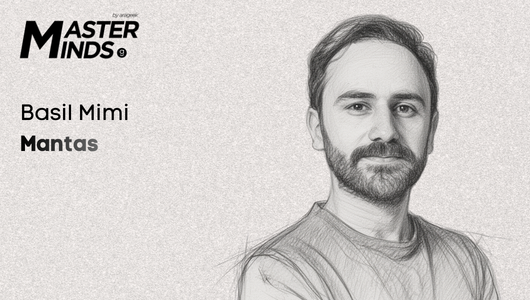
Basil Mimi on Measuring What Actually Hurts
Basil Mimi does not talk about cloud outages as technical glitches. He talks about them as balance sheet events. That framing runs through everything he is building at Mantas, and it is where the conversation begins.
When cloud risk becomes a financial event
When asked what digital risk businesses are still underestimating, Mimi goes straight to concentration.
Most companies now run critical operations on cloud infrastructure. The unspoken assumption, he argues, is that hyperscalers mean near-zero downtime. Yet revenue, payments, logistics, and customer support are often concentrated in the same cloud regions. When a region fails, cash flow can stop immediately.
“It is not a technical inconvenience,” he says. “It is a balance sheet event.”
That distinction is what drew him to tackle the problem first. Cloud outages generate objective, timestamped data. The exposure is measurable. For Mimi, that makes it suitable for parametric insurance. Clear trigger. Defined threshold. No claims ambiguity. In a sector crowded with subjective assessments and disputed losses, measurability becomes the edge.
The moment the gap became undeniable
Asked to reflect on when Mantas earned the right to exist, Mimi points to repeated production incidents, both internally and across third-party providers, with no financial protection attached to them.
He started asking CFOs how they quantified downtime and protected against outage exposure. Most had no structured answer. Very few had redundancy plans. Almost none had a risk transfer strategy.
That, he says, confirmed the gap.
The response was not to broaden the idea but to narrow it. They tightened their trigger architecture, formalised underwriting logic, and shifted from validating a concept to building what he calls a disciplined, scalable book grounded in verifiable data. The signal was not excitement from the market. It was the absence of structured thinking around a material risk.
Deciding what counts, and what does not
On the question of how to make parametric insurance feel fair, Mimi is unequivocal. It only works if the trigger is objective, external, and auditable.
Mantas measures region-level cloud availability across AWS, Azure, and GCP using Skyfeed, and integrates Skyscope with each insured for real-time monitoring of their infrastructure. If downtime exceeds a predefined threshold, payout is triggered. No subjectivity.
Just as important is what they exclude. Internal misconfigurations, coding errors, and application-level bugs sit within the company’s control. Those are operational risks, not insurable parametric events. The boundary, he insists, must be precise.
Fairness comes from transparency. Before binding, clients see the exact trigger logic, data sources, included cloud services, thresholds, and payout structure. If X hours occur in Y region, Z pays. The clarity is not a marketing choice. It is what drives adoption.
The discipline to stay narrow
Pressed on the hardest product decision so far, Mimi does not hesitate. They chose to narrow scope.
They could have expanded into broader cyber coverage early. The demand was there. The revenue would have followed. Instead, they stayed focused on cloud outage risk and built depth rather than breadth.
As an MGA, he sees their responsibility as writing scalable, profitable lines for capacity providers. That meant saying no to adjacent revenue and resisting the temptation to become a generalist. It hurt in the short term, but it preserved underwriting discipline.
The logic is consistent with how he decides what to build. If a product does not strengthen underwriting or compound into a better book, they do not pursue it. Even if it is “working”, it does not survive without strategic weight.
Regulation as infrastructure, not friction
When the conversation turns to what has worked, Mimi points to securing the right regulatory licence and approvals.
Introducing parametric insurance in cyber risk as a new line in the region is not straightforward. The process is extensive and slow. He admits he underestimated that complexity at first. Coming from fintech and AI, he initially prioritised product development, assuming a strong product and clear market demand would accelerate everything else.
He was wrong. Compliance required far more documentation, governance structure, and sequencing than he anticipated. It cost time and delayed market entry.
The eventual success came from reframing regulation as core infrastructure. They built the governance framework properly, engaged transparently, and treated every requirement as foundational. Discipline and patience, rather than speed, became the difference maker.
A reminder that scale is human
Asked about his single biggest career highlight, Mimi does not cite a funding round or product milestone.
He points instead to leading a team behind a gaming platform that produced a weekly show on MTV Lebanon, where charities were invited to speak about their projects. In one episode, they brought in a young cancer patient whose dream was to become a TV presenter. The team prepared her backstage and she opened the show that night.
For him, the moment reinforced something simple. Humanity matters. The companies and products that scale sustainably, he believes, are built with that at their core.
It is a surprising answer in a conversation dominated by trigger logic and underwriting discipline. But it explains the through-line. Even in parametric insurance, where formulas and thresholds rule, trust and human intent sit underneath.
Betting on what compounds
Asked about the best decision of his career, Mimi goes back to his twenties.
He deliberately stayed open. He exposed himself to different frameworks, technologies, and industries. He avoided locking into a single stack or niche too early. Instead, he focused on fintech, data infrastructure, and scalable AI systems because he saw those domains converging around real-world financial risk and decision-making.
The information he had was simple. Software cycles change, but data and financial systems compound. He chose to bet on skills that would remain durable across industries.

That belief now shapes Mantas. Measure what matters. Stay narrow. Build around data that compounds. And treat risk not as an abstract probability, but as something that hits cash flow when systems fail.
For Mimi, the thesis is straightforward. If downtime can stop revenue, it deserves the same financial architecture as any other balance sheet risk.