 LEAP26
 AI
AI Saudi Arabia
 UAE
UAE Egypt
EgyptI am Faisal Al Azem. I treated events as engines, which drove economies

7 min
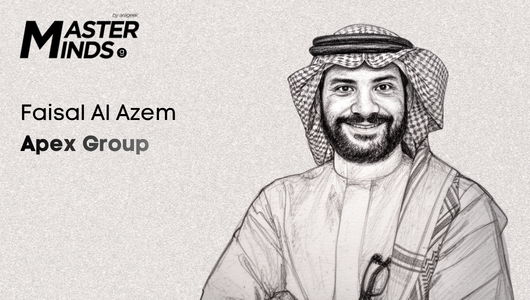
Faisal Al Azem on building systems, not events, and thinking beyond the brief
Faisal Al Azem does not describe his career as a linear ascent. He frames it instead as a gradual shift in perspective, from executing tasks on the ground to shaping systems that influence industries. That distinction sits at the centre of how he has led Apex Group into a different category altogether, one that sits closer to national strategy than traditional event delivery.
What starting on the ground taught him about influence
When asked about his early years, Faisal Al Azem returns to a simple but formative reality: he began as a promoter in 1999, learning in real time how people respond, decide, and engage.
Those early interactions shaped a mindset grounded in humility and observation. He learned quickly that influence is not abstract, it is earned through direct human connection. Titles, in his view, were irrelevant at that stage. What mattered was impact. That idea, that success is measured by what you move rather than what you hold, continues to inform how he defines ambition today.
How engineering shaped the way he leads
On the question of his transition through technical roles, his answer is less about career progression and more about cognitive discipline.
An engineering background, combined with experience in planning and procurement, trained him to think in systems. Precision, structure, and the ability to manage complexity became default settings. As a CEO, he has not abandoned that mindset, he has expanded it.
He does not separate creativity from execution. Events, as he sees them, are not moments. They are interconnected systems where timelines, resources, and experiences must align with near-perfect accuracy. The creative layer sits on top of that structure, not in place of it.
Why Cityscape 2009 changed his view of events
When the conversation turns to the launch of Saudi Arabia’s first Cityscape Saudi Arabia 2009, he describes it as a defining shift.
Until that point, events could be seen as platforms for visibility. Cityscape reframed them as engines of economic activity. It demonstrated how a well-positioned event can influence investment flows, shape sector narratives, and reposition entire markets.
That experience moved his thinking beyond execution. Events became tools of strategy, capable of shaping how cities and countries are perceived on a global stage.
The moments that moved him from operator to strategist
Pressed on the turning points in his career, he identifies a series of transitions rather than a single breakthrough.
Moving from operations into strategy marked one shift. Repositioning Apex from a service provider into a creator of intellectual property marked another. But the most consequential change came when the work itself aligned with national transformation.
That shift altered the scale of decision-making. The focus was no longer on delivering projects, but on contributing to something structurally larger than the organisation itself.
How Apex moved from execution to influence
When asked how Apex Group evolved, the answer is direct: the mindset had to change first.
The company moved away from executing predefined briefs and towards shaping the vision behind them. That required investment in creativity, partnerships, and proprietary event concepts. It also meant redefining what success looked like.
Today, Apex operates less as a vendor and more as a strategic partner, designing experiences that align with tourism growth, cultural development, and economic diversification.
What it takes to deliver at geopolitical scale
On the question of large-scale government and international events, his emphasis is on discipline rather than spectacle.
At that level, execution becomes non-negotiable. There is no tolerance for error. Delivering requires governance structures, highly trained teams, and the ability to anticipate issues before they emerge.
More importantly, it demands contextual intelligence. Every event carries political, cultural, and strategic weight. Understanding that layer is what separates delivery from leadership.
What has really changed in Saudi Arabia’s MICE industry
When asked about the evolution of the sector, he points to one word: ambition.
Under Saudi Vision 2030, the Kingdom has shifted from participating in the global MICE industry to actively shaping it. The scale of events, the level of coordination between public and private sectors, and the clarity of long-term vision have all accelerated growth.
This is not incremental change. It is structural repositioning.
Aligning a company with a national agenda
On the question of alignment, he is clear that Vision 2030 is not an external framework. It is embedded into how the company operates.
Projects are designed around its core pillars, tourism, culture, and diversification. Whether through large-scale events or international collaborations, the goal is consistent: to position Saudi Arabia as a global destination.
That alignment has also translated into tangible outcomes, including international partnerships and commitments that extend beyond the region, reinforcing Apex’s role as a connector between global markets and the Kingdom.
Balancing heritage with global expectations
When asked about Apex Tourism, his answer avoids the typical language of localisation.
Authenticity, he argues, is not a constraint. It is the foundation. The objective is not to replicate global models, but to elevate local identity through design, storytelling, and service standards that meet international expectations.
The balance is not achieved through compromise, but through clarity of identity.
Why Saudi companies are increasingly competitive
On the question of global competitiveness, he attributes the shift to a combination of speed, ambition, and structural support.
Saudi companies today operate with access to opportunity and the ability to execute at scale. When combined with cultural depth and a clear national direction, that creates a distinct advantage.
It is not just about capability. It is about momentum.
Technology as infrastructure, not enhancement
When the conversation turns to innovation, he removes any sense of optionality.
Technology, in his view, is foundational. It enhances experience, drives efficiency, and enables entirely new business models. From digital platforms like I Drive to immersive event formats, it is reshaping how audiences engage with both destinations and experiences.
The implication is clear: companies that treat technology as an add-on will fall behind.
Why community engagement is a leadership responsibility
Asked to reflect on his involvement in CSR and youth programmes, including initiatives linked to Hajj, his reasoning is straightforward.
Business does not operate in isolation. Its long-term value is tied to the strength of the society around it. Investing in youth and community is not peripheral work, it is foundational to building sustainable ecosystems.
Impact, in this context, extends beyond financial outcomes.
The next phase of Saudi Arabia’s event industry
Looking ahead, he sees a period defined by scale and scrutiny.
With major milestones approaching, including Riyadh Expo 2030, the opportunities are substantial: global partnerships, increased visibility, and continued sector growth.
The challenge, however, lies in maintaining quality while scaling, developing local talent, and embedding sustainability into operations. Growth alone will not be enough. Execution must keep pace with ambition.
Defining legacy beyond the company
Finally, when asked about legacy, his focus shifts away from Apex as an entity.

The ambition is broader: to contribute to the creation of an industry. To help position Saudi Arabia as a global hub for events, tourism, and cultural experiences. And to ensure that the work done today continues to shape how the Kingdom is perceived in the future.
It is a long-term view, consistent with the way he has framed his career from the beginning, not as a sequence of roles, but as a progression in impact.