 Ai Everything
 LEAP26
 AI
AI Saudi Arabia
 UAE
UAE Egypt
EgyptI am Ibrahim Gharbawi. I chose freelancing early, it shaped everything

7 min
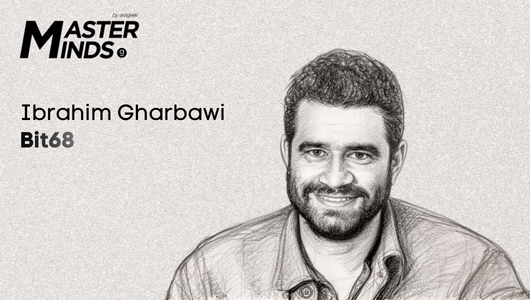
Introducing himself through the company he built
When asked how he introduces himself, Ibrahim Gharbawi does not reach for biography or personal positioning. He starts with the organisation. He frames himself as Founder and CEO of Bit68, then immediately moves to what the company has become, from a small team of around 15 engineers to nearly 70 across multiple specialisations. The emphasis is not on size for its own sake, but on evolution. Bit68, as he describes it, is no longer a delivery-focused software shop, but an integrated solutions company designed to create long-term value through strategic partnerships rather than transactional projects.
How engineering education shaped an entrepreneurial mindset
On the question of his Computer Engineering studies at the American University in Cairo, Gharbawi points to application over theory. His first year project involved building a website linked to stock market training, which exposed him early to the idea that software exists to serve real-world systems. That mindset was already forming before university. At sixteen, he joined a three-month Microsoft training programme, driven by a belief that technology should make life easier. The throughline is clear: education was a gateway, but initiative and experimentation did the real shaping.
Choosing freelancing over the corporate route
Pressed on why he started freelancing before graduation instead of joining an established company, Gharbawi frames it as a deliberate rejection of the traditional path. Freelancing, for him, was not a stopgap but an entrepreneurial training ground. It forced him to solve problems without templates and to build something of his own rather than inherit existing structures. He acknowledges that working inside a company might have avoided early mistakes, but his priority was always independence and building outside the corporate model.
When creativity turned into a career
Asked to reflect on when the work stopped feeling like a personal experiment and started looking like a profession, he points to volume and pressure. As demand increased, so did complexity, managing multiple projects, sectors and client expectations at once. Each successful launch under pressure reinforced the same conclusion: this was not a side pursuit but a long-term professional future.
Spotting the real gap that led to Bit68
When the conversation turns to the founding of Bit68, Gharbawi identifies a gap that had little to do with technology itself. He observed that many software companies executed requests without questioning intent. Clients were getting what they asked for, but not necessarily what they needed. The opportunity, as he saw it, was to become a partner that intervenes early, helps shape decisions and aligns technology with actual business goals.
Why execution alone is not enough
On the question of how Bit68 differs from traditional software houses, Gharbawi is direct. Bit68 does not operate as an executor. The work starts with discussion, review and market understanding. He stresses that understanding the client’s objective matters more than following their initial instructions. Sometimes that means pushing back, even when it contradicts the client’s first idea. In his view, that is what real leadership guidance looks like.
Defining needs before building solutions
Asked to explain what it means to define what clients need rather than what they want, he outlines a structured process. Ideas are unpacked, objectives clarified and needs prioritised before any build begins. Only then does the team propose a path that balances outcome, feasibility and delivery. This approach, he argues, serves both the client and the development team better than immediate execution.
Supporting products across their maturity stages
When asked about evaluating digital product maturity, Gharbawi describes a simple but disciplined framework. Products are assessed as ideas, growth-stage platforms or expansion-ready systems. Each stage demands different priorities. Bit68’s role is to support clients throughout this journey, from planning through continuous improvement, rather than disappearing after delivery.
Building trust in long-term partnerships
On the subject of trust, he returns to partnership. Bit68 treats clients as long-term collaborators, not contracts. Success is measured by client outcomes rather than hours billed. Transparency, clear timelines and post-delivery follow-up are non-negotiable. The relationship, he insists, does not end when the software ships.
Scaling culture while scaling headcount
Asked how he maintains commitment and quality as the team grows, Gharbawi points to structure and learning. Weekly cross-department meetings, continuous training and constant tooling improvements are how Bit68 stays aligned in a fast-moving market. He notes that the pace of change, especially with AI, makes complacency impossible.
Balancing deadlines, quality and ambition
Pressed on the hardest management challenge, he does not overcomplicate it. The tension between speed, quality and growth is constant. Managing that balance, without sacrificing standards or momentum, remains the most difficult part of running the company.
Projects that defined credibility
When the conversation shifts to major projects, he highlights e-commerce, particularly the Tradeline project, as a turning point. Acting as a main partner in its digital transformation, Bit68 delivered everything from the online store and mobile app to internal systems and customer service infrastructure. It was a milestone that expanded both capability and confidence.
Proving reliability in sensitive sectors
Asked how projects like Paymob, MidBank and Forsa shaped Bit68’s regional reputation, Gharbawi focuses on trust. These engagements demonstrated the company’s ability to handle complex, sensitive systems, reinforcing its position as a serious technology partner in regulated and high-stakes sectors.
Expanding beyond Egypt as a strategic response
On the question of economic volatility, he explains that international demand positioned Bit68 as a cost-effective partner for global companies. Expanding beyond Egypt was not opportunistic, but strategic. It turned economic pressure into growth momentum across the Middle East.
Why income diversification matters
Asked about revenue diversification, he is unequivocal. With around 40 percent of income coming from outside the local market, Bit68 is better insulated from shocks. For technology companies, he argues, relying on a single market is a structural risk in an increasingly global digital economy.
Product companies versus software houses
When asked to compare his earlier product startups with running Bit68, Gharbawi uses a clear analogy. Product companies resemble real estate developers, carrying investment and marketing risk. Software houses operate like contractors, executing defined projects without sharing those risks. The distinction shapes everything from cash flow to decision-making.
From service provider to success partner
Pressed on how software companies can move beyond execution, he returns to a simple principle. Client success must be the primary measure of project success. Without that shift, no process or positioning change will matter.
Preparing for AI without losing the human edge
On the rise of AI and agents, Gharbawi frames them as tools, not replacements. Bit68 is investing in AI to increase efficiency, particularly through agents that handle defined tasks quickly. The opportunity, he believes, lies in integration, not avoidance.
Threat or opportunity
Asked directly whether AI is a threat, his answer is firm. It is an opportunity that will create new roles and capabilities. It only becomes a threat for companies that refuse to engage with it seriously.
What still drives him
When asked what keeps him motivated after more than a decade, Gharbawi points to delivered value, team growth, new sectors and the ongoing challenge of finding unconventional solutions. Progress, not comfort, is the fuel.
Projects or people
On whether successful projects or developing young talent is more satisfying, he refuses to choose. Both feed directly into what he considers real success.
Rethinking work-life balance
Asked about balance, he rejects the weekly framing. In entrepreneurship, balance emerges over years, not days. The work is seasonal, intense at times, quieter at others, and that rhythm suits him.




Looking ahead
Finally, when asked about his long-term vision, Gharbawi is concise. He wants Bit68 to be an influential regional and global player while preserving its identity as a true strategic partner. His advice to young entrepreneurs follows the same logic: find a real problem, offer a real solution, and do not chase trends for their own sake.