 Ai Everything
 LEAP26
 AI
AI Saudi Arabia
 UAE
UAE Egypt
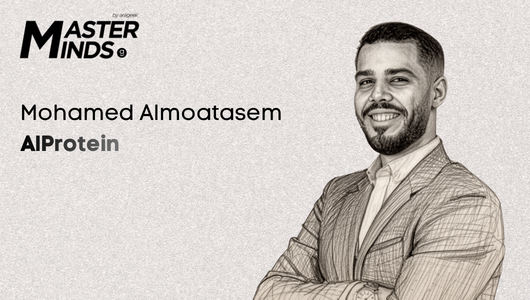
EgyptI am Mohamed Almoatasem. I used AI to cut protein costs dramatically

6 min
Turning science into something that actually ships
When asked to introduce his path, Mohamed Almoatasem does not begin with food. He begins with frustration. Trained as a renewable energy engineer, his early exposure to Egypt’s scientific ecosystem revealed a consistent pattern, strong research that rarely translated into real-world impact. Papers were published, then effectively shelved.
That gap became the starting point. At Zewail City, he met his co-founder Omar Zaghloul, and the two aligned quickly around a shared objective, not just advancing science, but deploying it. Their first move was not a company, but infrastructure, helping establish a deep-tech incubation programme designed to push research beyond the lab.
A later stint at Logitech added a different discipline. It introduced commercial reality, product standards, and the mechanics of competing globally. The combination proved decisive. Scientific rigour alone was insufficient. So was commercial instinct without depth. AlProtein emerged at the intersection of both.
Recognition, including Forbes 30 Under 30, followed. But the framing remains unchanged. The goal is still execution, not acknowledgement.
How he thinks about rigour versus speed
On the question of how his experiences shaped his mindset, Almoatasem points to contrast rather than continuity. Zewail City instilled a strict evidence-based approach. Hypotheses were not enough. Proof, benchmarking, and multiple inputs were non-negotiable.
That environment also introduced the mechanics of tech transfer, what it actually takes to move from lab validation to something an investor or customer can trust.
Logitech, by contrast, exposed scale. It sharpened his understanding of supply chains, buyer psychology, and global product expectations. It also revealed where large organisations slow down.
That gap, between rigour and speed, is where he believes startups win. At AlProtein, that philosophy is applied directly, building with scientific depth while moving faster than institutional systems allow.
Why food, and why now
When the conversation turns to the decision to focus on protein, the reasoning is grounded in necessity rather than trend. Food security, particularly in MENA, is structurally fragile. External shocks, such as the Russia-Ukraine war, exposed how quickly import-dependent systems can destabilise.
Rather than working around the constraint, Almoatasem chose to build into it. The question became how to produce nutrition locally without relying on scarce resources like fresh water or arable land.
The answer led to water lentils and spirulina. These are not new organisms, but their application at scale, in this context, is. They grow rapidly, require no fresh water, and deliver high protein density.
The ambition is not substitution alone. It is redesign, building a system that is both locally viable and globally competitive.
What AlProtein actually builds
Asked to clarify what the company does, Almoatasem is precise. AlProtein is not a consumer brand and not producing finished foods. It sits upstream, creating functional ingredients that food manufacturers depend on.
Its core products replace critical but often overlooked components. RubiPro substitutes methylcellulose, a widely used synthetic binder. CheesePro replaces water-intensive nut proteins in plant-based cheese.
The distinction matters. Instead of competing at the surface level of consumer products, AlProtein targets the formulation layer where cost, scalability, and performance are decided.
The underlying system is equally deliberate. Production requires no arable land and no fresh water. Compared to almond protein, which can demand around 10,000 litres per kilogram, the difference is structural.
At the centre sits OrionPro, an AI system that manages cultivation conditions with high predictive accuracy. The result is lower operational cost, higher yield, and consistent quality.
This combination, biological efficiency and digital control, defines the company’s edge.
What validation actually looks like
Pressed on the significance of the Geneva International Exhibition of Inventions, Almoatasem avoids framing it as a milestone in isolation. Instead, he treats it as external confirmation of something already proven internally.
The exhibition is highly competitive, with over 1,000 inventions from across the world. Winning a silver medal signals credibility, but more importantly, it validates applicability. The judging criteria extend beyond novelty to include industrial viability.
For AlProtein, that alignment matters. The goal is not to demonstrate possibility, but readiness.
This recognition builds on a broader pattern, participation in global programmes, industry awards, and inclusion in international rankings. Each reinforces the same point, that the technology translates beyond the lab.
The intersection of biology and software
When asked to explain the core innovation, Almoatasem frames OrionPro as a shift in how food production is managed. Traditional agriculture relies heavily on land, water, and labour. AlProtein replaces these with controlled environments and data-driven decisions.
On the biological side, water lentils enable continuous production cycles, doubling in biomass roughly every 24 hours. On the digital side, the AI system monitors and optimises conditions in real time.
This dual system drives both efficiency and consistency. Costs drop, yields increase, and environmental impact declines significantly.
The outcome is not incremental improvement. It is a different production model altogether.
Why they stood out globally
When asked what differentiated them at Geneva, Almoatasem returns to execution. The company presented a working 50,000-litre facility, not a concept.
That distinction is critical. Many competitors remain at the research stage. AlProtein demonstrated scalability, cost advantage, and active market demand, including over $2.1 million in signed letters of intent.
The team composition also played a role. Scientific depth combined with industry experience signals that the company can both build and deliver.
In his view, credibility comes from alignment, technology, operations, and market traction moving together.
The real challenges behind the narrative
Asked to reflect on obstacles, Almoatasem highlights three.
First, capital intensity. Biotech is typically expensive to scale. AlProtein addresses this through modular open-pond systems, avoiding the cost of closed bioreactors.
Second, regulation. Approvals such as those required in Europe are slow and complex. The company mitigates this by integrating regulatory expertise early and grounding its claims in established science.
Third, market perception. Convincing manufacturers that a startup from Africa can outperform established synthetic ingredients requires sustained effort.
Each challenge is structural, not temporary. The response has been to design the business model around resilience rather than react to constraints later.
Building infrastructure, not just a company
When the discussion shifts to the future, Almoatasem broadens the scope. Plant-based protein in MENA is not positioned as a trend but as an inevitability driven by resource constraints.
Most existing solutions are designed for Western systems. AlProtein is building for regional realities, water scarcity, limited land, and import dependence.
The long-term ambition is clear. Transform Egypt from a protein importer into a production hub. The company positions itself as infrastructure, not a product layer.
Its 2030 target, replacing 1,000 tonnes of traditional protein, reflects both environmental and economic intent.
What comes next
Asked about immediate priorities, Almoatasem describes a company at an inflection point. A seed round is underway, with half already committed.
Operationally, the focus is on scaling capacity fivefold to convert existing demand into revenue. At the same time, the company is establishing a dual presence, production in MENA and formulation development in Germany.






The objective is not incremental growth. It is setting a new standard for how protein is produced, combining biology, engineering, and artificial intelligence into a single system.
The underlying idea remains consistent with where he started. Science should not sit still. It should ship.