 Ai Everything
 LEAP26
 AI
AI Saudi Arabia
 UAE
UAE Egypt
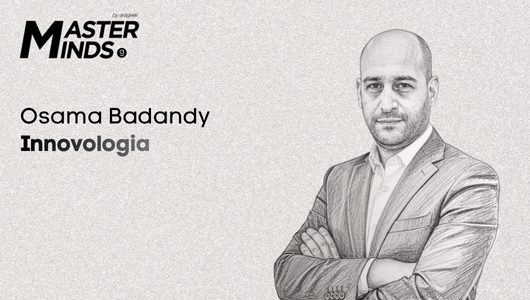
EgyptI am Osama Badandy. I built innovation systems so organisations could actually deliver

7 min
Innovation only lasts when execution becomes routine
When asked to define institutional innovation, Osama Badandy does not start with frameworks or terminology. He starts by rejecting a common illusion. Innovation, in his experience, is not an idea admired in meetings or a workshop that fades once the photos are published. It is a mindset before it is a toolset, and a practice before it is a slogan.
That mindset assumes the current reality is not final. The practice translates that belief into small, cumulative actions that lead to measurable and sustainable outcomes. What matters is not the brilliance of the idea, but whether the organisation can repeatedly turn ideas into results.
He draws the distinction sharply. Individual innovation can shine briefly. A person or a team may create something impressive, but without a system to absorb the idea, push it into execution, and track its impact, it fades. Institutional innovation is different. It allows organisations to execute regardless of individuals, because decision pathways, ways of working, and measurement already exist.
Why innovation collapses after the event
When the conversation turns to the challenges Arab organisations face, the diagnosis is direct. Innovation is still treated as a seasonal activity. Hackathons are organised, content is shared, enthusiasm peaks, and then routines snap back into place.
At that point, innovation breaks down. Not because ideas are missing, but because innovation never became part of daily practice.
Pressed on the root cause, Badandy points to a recurring gap between desire and execution. Strategies are written and initiatives announced, yet fundamental questions remain unanswered. Who owns the decision. Who funds experimentation. Who follows up. How impact is measured. Without these answers, innovation remains an intention, and organisations remain stuck in “we want” instead of moving to “we do”.
When innovation feels like a burden, something is wrong
Asked how innovation can be linked to operations without becoming organisational drag, Badandy is clear. If innovation feels like extra work, it has already failed. Innovation exists to reduce operational pain, not to add workload.
The linkage begins with reality, not theory. Bottlenecks, waiting times, recurring errors, unjustified costs. These are operational facts, not abstract questions. Real innovation starts by addressing them.
Once identified, these pain points are translated into focused innovation challenges with clear indicators. Teams run small experiments, measure results, improve, then scale. Innovation becomes a way of working embedded in operations, not an additional programme imposed from outside.
Energy without a system to absorb it
When asked about the current state of the innovator community in the Arab region, the assessment is cautiously optimistic. There is energy, participation, and a genuine desire for change. Workshops and programmes are well attended, and awareness is growing.
The problem appears after the training ends. Innovators return to organisations that are not designed to receive them. Decision-making is slow. Experimentation feels risky. Clear application pathways are missing.
The next phase, in Badandy’s view, must focus less on producing capable innovators and more on preparing organisations themselves to absorb and empower them. Without that, enthusiasm dissipates.
Communities must translate, not just inspire
On the role of innovation communities, inspiration alone is not enough. Their real value lies in translation. They turn large concepts into practical steps, simple tools, and experiments that fit organisational reality.
When communities succeed in this role, they reduce fear around application and provide real stories of success and failure. When they remain theoretical, they become pleasant gatherings with little impact inside organisations.
Why innovation centres often fail
When asked why many innovation units struggle to deliver results, Badandy points to a familiar pattern. Units are created without authority or execution pathways. They organise events and collect ideas, while execution happens elsewhere, or not at all.
Over time, organisations conclude that innovation has no impact. In reality, the system was never designed to deliver impact.
Innovation, he insists, cannot be confined to a single department. It must live where operations live, because that is where improvement opportunities appear. The role of an innovation centre is to enable, govern, and follow up, not to execute on behalf of everyone.
What makes an innovation model sustainable
When pressed on the essentials of a lasting innovation operating model, simplicity comes first. Governance is foundational. Someone must decide, approve, and be accountable. Many ideas stall not because they are weak, but because no decision ever arrives.
A clear end-to-end pathway matters just as much, from idea to experiment to execution and measurement. Break the chain at any point and confidence erodes.
Roles, resources, and tools support the system, but impact measurement sustains it. A model that cannot show results felt in operations cannot be defended or improved.
Measuring innovation so it can be managed
On innovation management systems, the argument is practical. These systems prevent innovation from becoming a story or perception. They create visibility across the journey and force organisations to confront outcomes.
What changed. Did service time decrease. Did quality improve. Did efficiency increase. Did the beneficiary experience improve.
Once innovation is measurable, it becomes manageable, and only then does it earn its place in daily work.
Hackathons are a starting line, not a finish
Asked about hackathons and workshops, Badandy does not blame the tool. The problem lies in what comes after. If the journey ends with announcing winners, the event is temporary.
If the hackathon is embedded in a clear pathway that moves from real challenges to experimentation, incubation, execution, and measurement, it becomes a strategic entry point to culture change. Without that pathway, organisations simply collect ideas they never execute.
Leadership is the real skills gap
When discussing the innovation skills gap among Arab leaders, the issue is not lack of knowledge. Many leaders are familiar with methodologies and attend programmes regularly.
The real gap lies in mindset and practice. Comfort with uncertainty. Decision-making with incomplete information. Giving teams space to experiment without fear of early punishment.
Leadership innovation is not about knowing the tools. It is about creating the conditions in which those tools can be used.
Ideas are plentiful, execution is scarce
On whether the region suffers more from an execution problem than an idea problem, the answer is unambiguous. Ideas are abundant. Execution requires mindset, practice, and systems that protect experimentation.
Mindset without practice stays abstract. Practice without mindset becomes mechanical. Innovation only works when both move together through a governed, measurable journey.
How innovation training has evolved
When asked how innovation training has changed, Badandy points to a decisive shift. Abstract concepts detached from reality no longer work. Innovation is not information to memorise, but a practice built over time.
At Innovologia, training is designed around real organisational challenges, real cases, and decisions that lead to experiments. The goal is not to leave with definitions, but with the ability to move from idea to step, from step to experiment, and from experiment to impact.
Government versus private sector innovation
On the difference between public and private sector innovation, the distinction is contextual rather than cultural. The private sector moves faster and experiments more freely. Government innovation is more complex, involving broader impact, multiple stakeholders, and stricter governance.
Both sectors can adapt, but through different approaches. When innovation succeeds in government, its impact is deeper and more systemic, affecting entire systems rather than single services.
Normalising failure without tolerating negligence
When asked how organisations can accept failure, Badandy starts with leadership. The critical distinction is between failure from conscious experimentation and failure from negligence.
Organisations must practise this distinction, not just state it. Documenting lessons, sharing learning, and rewarding courage to try builds psychological safety. When early punishment disappears, real innovation begins to surface.
The next five years




Looking ahead, Badandy is optimistic but realistic. The coming years will separate organisations that talk about innovation from those that manage it as a system.
The shift will be towards impact-driven innovation tied to operations, digital transformation, and measurement. His advice to leaders is simple. Do not make innovation an event. Make it a mindset and a daily practice. Build governance, decision pathways, and small measurable experiments. When that happens, innovation stops being a slogan and starts appearing in results.