 LEAP26
 AI
AI Saudi Arabia
 UAE
UAE Egypt
EgyptTop InsurTech Companies & Startups in MENA Region

18 min
Insurance change in MENA is “incremental”, tackling friction rather than chasing disruption or hype.
Each market is fragmented, with Saudi, UAE, Egypt and Jordan demanding deeply localised approaches.
Leading InsurTechs fix operations, claims and workflows, often serving insurers, employers or hospitals.
Infrastructure and compliance matter more than flashy apps or bold consumer reinvention.
The region shows a “quiet shift” toward practical, regulation‑ready technology built for real behaviour.
Across the Middle East and North Africa, insurance has never been a sector that changes overnight. It moves cautiously, shaped by regulation, legacy infrastructure, and deeply rooted consumer habits. Yet beneath the surface, a quiet shift is underway. InsurTech companies across the region are no longer trying to “disrupt” insurance with bold promises; instead, they are fixing what has long been broken — inefficient operations, opaque pricing, slow claims, and distribution models built for a pre-digital era.
What makes the MENA InsurTech landscape distinctive is its fragmentation. Each market carries its own regulatory logic, consumer psychology, and maturity curve. Saudi Arabia’s ecosystem is driven by compliance pressure and scale, the UAE by comparison and convenience within a broker-heavy environment, Egypt by trust and affordability, and Jordan by infrastructure-led digitisation and pragmatism. There is no single playbook that works everywhere, and the most durable startups are those deeply localized to their home markets.
Rather than chasing consumer hype, leading InsurTechs in the region operate across multiple layers of the insurance stack. Some simplify how policies are bought and renewed, others sit invisibly inside claims and underwriting workflows, and a growing number focus on health and assistance services where operational friction is highest. In many cases, their customers are not end users at all, but insurers, employers, hospitals, or regulators looking for efficiency rather than reinvention.
This list of top InsurTech companies and startups in the MENA region reflects that reality. These are not businesses built on theory or borrowed models, but on firsthand engagement with local regulators, insurers, and policyholders. Together, they illustrate how insurance in MENA is evolving the only way it realistically can: incrementally, compliantly, and with a sharp understanding of what users will — and will not — change.
Top InsurTech Companies & Startups in Saudi Arabia
Salamatech
is a good place to start because it reflects the real tone of the market. From our conversations with insurers and TPAs, what keeps them awake at night is not disruption — it is operational friction. Policy endorsements that take days, claims stuck between hospitals and administrators, underwriting decisions buried in spreadsheets. Salamatech stepped into this reality with a deliberately unglamorous promise: make existing systems work better.
Rather than forcing insurers to rip out legacy infrastructure, Salamatech built modular tools that quietly sit on top of existing processes. This matters in Saudi Arabia, where compliance timelines and internal approvals often dictate technology adoption more than ambition does. Its strongest traction has been with mid-sized insurers and self-insured corporates managing employee medical coverage, a segment where margins are thin and inefficiency is costly. We’ve seen how access to real-time data shortens decision cycles — but we’ve also heard insurers admit that cultural change inside operations teams remains slower than the software itself.
Tameeni

If Salamatech speaks to the supply side of insurance, Tameeni reflects how Saudi consumers actually behave. Despite mandatory motor insurance, most buyers still shop purely on price, often renewing blindly or relying on brokers they don’t fully trust. Tameeni simplified that journey, not by educating users deeply, but by meeting them exactly where they are: impatient, comparison-driven, and mobile-first.
As a licensed digital broker, Tameeni localized its comparison logic around Saudi traffic records, vehicle databases, and insurer pricing quirks. That localization is not trivial — generic aggregators fail quickly here. What stands out to us is not the technology, but how explicitly Tameeni prioritizes clarity. Exclusions are shown upfront, insurer ratings are visible, and the full purchase cycle takes minutes. Still, aggregation has its limits. Insurers remain cautious about margin erosion, and many products remain structurally similar, which means differentiation often collapses back to price.
HealTec

Health insurance, however, is where friction becomes deeply operational — and HealTec understands that. Instead of selling insurance, it embedded itself between insurers, employers, and providers. For Saudi SMEs in particular, health coverage is often the single largest employee benefit cost, yet it’s managed poorly, with low engagement and reactive claims handling.
HealTec’s platform reframes health insurance as a service layer rather than a document. Digital cards, instant approvals, and visibility into utilization feel basic elsewhere, but in Saudi Arabia they still replace phone calls and stamped forms. Insurers we spoke to see value in the data, especially as pressure grows to control loss ratios. That said, preventative care remains a long-term play; employee behavior does not change overnight, and many employers still prioritize cost over wellness, regardless of dashboards.
Sure Global Technology

While consumer platforms attract attention, much of the real transformation happens invisibly. Sure Global Technology operates in that quieter layer, building core insurance systems for startups and mid-sized insurers who simply cannot afford long internal development cycles. In a regulatory-heavy environment like Saudi Arabia, compliance is not an afterthought — it is the product.
Sure Global’s advantage lies in baking Saudi regulatory requirements directly into its architecture, reducing the risk of launch delays. We’ve seen takaful operators and new insurers lean heavily on this model to get to market faster. But there is a tradeoff: configurability accelerates deployment, yet limits extreme differentiation. For many insurers, however, speed and compliance are worth that compromise.
MedGulf
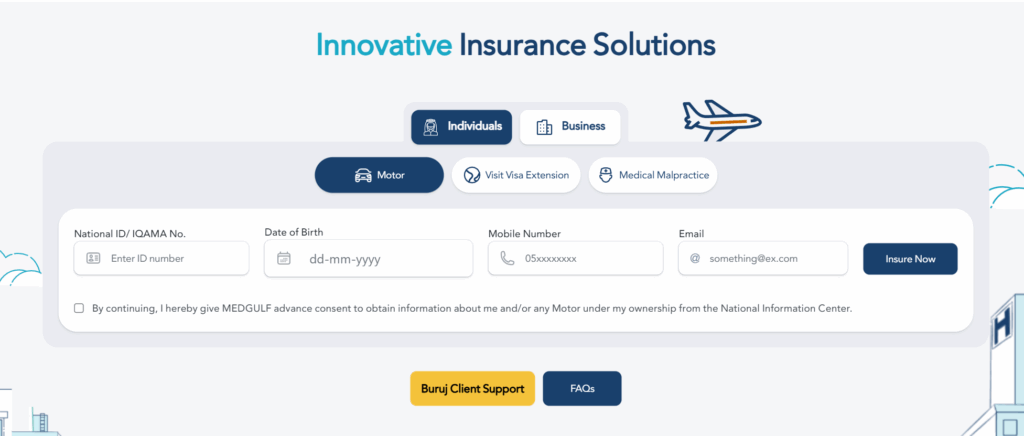
Finally, MedGulf Digital Labs offers an interesting hybrid model that we expect to see more of locally. Spun out with startup-like autonomy but backed by a real insurer, it benefits from something most founders lack: immediate access to live customer data and claims volumes. This allows experiments — from telematics-based motor pricing to AI-supported claims triage — to move beyond pilots much faster.
What impressed us most is not the technology itself, but the governance structure. Traditional insurers in Saudi Arabia often struggle to innovate without disruption to core operations. Semi-independent labs like MedGulf’s bridge that gap, though their challenge will always be scale: proving that experiments can survive corporate gravity once integrated back into the parent organization.
Taken together, these five examples show that Saudi InsurTech companies are not moving in one direction, but across layers of the insurance stack. Some simplify buying, others repair infrastructure, others turn insurance into a service rather than a contract. Collectively, they reveal a market shedding digitization theater and embracing something more pragmatic: compliance-ready tools built for local behavior, regulatory reality, and the slow — but unmistakable — shift in how Saudis expect insurance to work.
Top InsurTech Companies & Startups in UAE
Covering insurance in the UAE has always been an exercise in decoding contradictions. We live in a country where digital wallets are mainstream, yet insurance policies still arrive as PDFs dense enough to scare off even the most patient reader. Consumers say they want transparency, but many still default to a familiar broker WhatsApp number. Regulators push digitisation, while legacy insurers quietly drag their feet. Against that backdrop, the current wave of insurtechs is not just building apps — they are negotiating with deeply embedded habits.
What follows is not a celebration of disruption for its own sake, but a closer look at which companies are actually nudging the market forward, and where their models still strain against local reality.
Policybazaar
When Policybazaar.ae entered the UAE, there was understandable scepticism. A data-heavy comparison model that worked in India or Southeast Asia would have to survive a very different environment here: mandatory health insurance, broker-dominated distribution, and consumers who rarely believe the first price they see. What stands out to us is how deliberately the company has localized its approach.
The platform’s biggest contribution is not the comparison grid itself — users expect that — but its sustained effort to strip back insurance language. In our conversations with founders and operators in the space, many underestimate how intimidating policy wording remains for first-time buyers, especially SMEs setting up health coverage under regulatory pressure. Policybazaar’s plain-English explanations may sound like a small detail, but in a market addicted to fine print, it’s a meaningful intervention.
That said, the model isn’t frictionless. By leaning more heavily on mid-sized insurers, the platform gains flexibility, but it also limits breadth. Some of the largest insurers still prefer controlling their own distribution or protecting broker relationships. Policybazaar’s in-house advisory layer helps bridge this gap, particularly during claims — the true moment of truth — but scaling that human touch without reverting to traditional brokerage costs remains a live challenge. Still, among the top insurtech companies in the UAE, Policybazaar feels like an attempt to build infrastructure rather than just capture leads.
Yallacompare
Yallacompare has always felt slightly more understated, and that may be by design. It appeals to a specific UAE consumer profile we encounter often: price-sensitive, comparison-driven, and quietly distrustful of “recommended” products. Many users arrive on the platform before they even land in the country, Googling health or motor insurance weeks ahead of relocation or renewal deadlines.
What we noticed in reviewing user journeys is how the platform frames decisions around lifestyle and budget rather than insurer brand hierarchy — a subtle but important shift in a market where big names often overshadow suitability. Yallacompare’s refusal to lock itself into exclusive insurer arrangements adds credibility, although it likely caps short-term monetisation.
There are trade-offs. Independence is hard to maintain when insurers increasingly demand volume commitments, and not all providers are comfortable with nudges toward minimal adequate coverage rather than premium-loaded policies. But for SMEs juggling cash flow, or individuals navigating the UAE’s notoriously strict compliance rules, the platform plays a quiet but useful role. It doesn’t eliminate the complexity of insurance, but it does lower the cognitive cost of engaging with it.
Bayzat
Bayzat sits in a different category altogether. To call it simply an insurtech misses the point; it is closer to operational plumbing for SMEs. Anyone who has watched a startup founder in Dubai wrestle with HR, payroll, and medical insurance renewals on spreadsheets will understand why Bayzat found traction when it did.
The real innovation here isn’t just digitizing health insurance distribution, but embedding it into daily business workflows. When insurance becomes part of onboarding and payroll rather than an annual headache, adoption follows naturally. Employees, too, are no longer passive policyholders; they track claims on their phones, often for the first time.
Still, Bayzat’s model depends heavily on SME compliance and growth. When startups downsize or delay renewals, the pressure shows. There is also the ongoing challenge of insurer integration — not all carriers are equally committed to real-time data exchange, despite public rhetoric. Yet among UAE-based insurtech scaleups, Bayzat remains one of the clearest examples of how vertical focus can trump flashy consumer features.
Hala Insurance
Hala Insurance reflects a generational shift we’ve been hearing about for years but are only now seeing materialize. Younger UAE residents — especially long-term expats — have little patience for call-center scripts and aggressive upselling. Hala’s emphasis on speed, clarity, and restraint feels intentionally anti-broker in a market built on brokerage margins.
The mobile-first experience works well for straightforward motor policies, where users mostly want confirmation and compliance, not advice. Health insurance, as always, is harder. Simplification has limits when regulations dictate coverage tiers and employer obligations. Hala’s experiments with short-term and micro-insurance are interesting, particularly for freelancers and gig workers, but these remain small slices of a tightly regulated pie.
What Hala demonstrates, more than scale, is cultural alignment. It mirrors how fintech won trust in the UAE: by showing up, staying simple, and not pushing unnecessary add-ons. Whether that discipline holds as growth pressures increase is the real test.
InsureMyTrip Middle East
Travel insurance is one of the few categories where user intent is clear and timing is non-negotiable. InsureMyTrip Middle East benefits from that clarity. UAE residents travel frequently, often on complex routes involving visas, stopovers, and last-minute bookings. The platform’s focus on destination-specific validation is not glamorous, but it addresses real anxiety, especially for Schengen or UK visa applicants.
We’ve heard repeatedly from users that instant policy validation can be the difference between submitted paperwork and a delayed trip. The educational content around stopovers and adventure travel also reflects regional behaviour — few markets combine long-haul layovers and high outbound travel frequency quite like the UAE.
Like others, InsureMyTrip relies on insurers willing to customize products, and not all are. But its narrow scope is also its strength. In a region where many platforms try to do everything at once, InsureMyTrip shows that focus still wins.
Top InsurTech Companies & Startups in Egypt
Defined as one of the most quietly transformative corners of Egypt’s fintech scene, InsurTech has not grown through sudden disruption or dramatic consumer shifts. Instead, it has evolved in response to a market that distrusts complexity, resists paperwork until forced, and still leans heavily on brokers, personal relationships, and phone calls when things go wrong. From our conversations with founders and insurers alike, what stands out is not how radical these startups are, but how deliberately grounded they have had to be.
Below are five Egyptian InsurTech players worth examining—not as success stories, but as case studies in how innovation bends to local reality.
Amenli
We’ve noticed that for most Egyptians, buying insurance is not an active decision—it’s something triggered by a car purchase, a bank requirement, or an HR email. Amenli’s real contribution sits exactly there. It does not try to “sell insurance enthusiasm.” Instead, it meets users at a moment of mild anxiety and tries to remove enough confusion for them to move forward.
Starting with car insurance was no accident. Motor policies remain one of the few insurance products individuals will actively seek out on their own. From there, Amenli expanded cautiously into medical and property coverage, leaning on licensed insurers for underwriting while focusing on comparison, explanation, and post‑purchase follow‑up. That separation of roles matters in Egypt’s regulatory climate, where online brokerage is still evolving and compliance missteps can stall growth overnight.
What feels refreshingly honest is Amenli’s refusal to mimic traditional broker pressure tactics. The platform uses simplified language and comparison logic, which works well for first‑time buyers, but we’ve also seen where it struggles: users still want reassurance. Many end up calling anyway. Digital convenience helps, but trust is still built verbally, often at the last mile.
Amenli’s steady, low‑noise growth mirrors the nature of insurance itself in Egypt. No hype, no rush—just incremental adoption in a country where patience is often a competitive advantage.
Yodawy
If Amenli works at the surface of insurance, Yodawy operates deep inside its machinery. And that, arguably, is where Egypt’s healthcare insurance needed intervention most.
Rather than chasing consumers, Yodawy focused on the operational chaos between insurers, pharmacies, employers, and patients. Anyone who has dealt with medical approvals in Egypt knows the bottlenecks: phone calls, unclear coverage, delayed reimbursements, and pharmacies caught in between. Yodawy rebuilt that flow digitally, starting with pharmacy benefit management and expanding outward.
From what we’ve seen, insurers are far more receptive to this kind of InsurTech than to consumer‑facing challengers. It does not threaten distribution, pricing power, or brand control. Instead, it reduces leakage, fraud, and inefficiency—three words that immediately get an insurer’s attention. Pharmacies benefit too, getting clearer approvals and faster reconciliation.
The trade‑off, of course, is invisibility. Most insured members don’t know Yodawy exists. But that’s almost the point. In a market where flashiness often hides weak execution, Yodawy’s quiet infrastructure role may prove more defensible long‑term than any sleek consumer app.
MENA Assistance Technologies
This is the kind of company users only notice when something goes wrong—and that’s precisely why it matters.
Assistance services, whether roadside, medical, or emergency‑related, are where insurance promises are tested in real time. We’ve seen how manual coordination, scattered vendors, and slow response times erode trust faster than any denied claim. MENA Assistance Technologies tackles that operational gap by digitizing assistance workflows end‑to‑end.
The platform connects insurers with service providers, tracks response quality, and introduces accountability into moments that are usually chaotic. In Egypt, where reliability often matters more than policy pricing, this layer can quietly influence an insurer’s reputation.
The challenge, as always, is adoption. Insurers are cautious about changing operational systems, especially ones tied to live incidents. But once implemented, these tools are hard to remove—another example of InsurTech winning not by disruption, but by becoming indispensable.
Top InsurTech Companies & Startups in Jordan
Insurance innovation in Jordan has never arrived with fanfare. It has crept in quietly, shaped less by venture capital headlines and more by daily frustrations: the long queues, the stamped papers, the broker who never quite explains what you’re paying for. Over the past few years, we’ve noticed that the most meaningful InsurTech progress in the Kingdom isn’t coming from loud disruptors trying to “reinvent” insurance, but from small teams who understand exactly where the system strains — and where Jordanians are willing, cautiously, to accept change.
MadfooatCom
MadfooatCom’s insurance services arm is a good place to start, precisely because it doesn’t feel like an insurance startup at all. It grew out of a payments platform most Jordanians already trust for bills and government fees. From our conversations with users, that familiarity matters more than any sleek interface. People aren’t logging in because they want a new insurance experience; they’re there because they already pay traffic fines or electricity bills on MadfooatCom. Insurance simply slipped into an existing habit.
What stands out to us is not technological sophistication, but restraint. The platform focuses on compulsory motor insurance and renewals — the unglamorous but unavoidable products — and works closely with local insurers and regulators instead of trying to bypass them. In a country where consumer mistrust toward insurance is high and compliance missteps can stall a product overnight, this embedded approach makes sense. The limitation, of course, is scope. MadfooatCom isn’t fixing underinsurance or policy literacy in any deep way. But it is proving that insurance adoption in Jordan improves when it feels administrative, not aspirational.
MedLabs
A very different pain point is tackled by MedLabs Consult, which sits at the uncomfortable intersection of healthcare providers and insurers. Anyone who has dealt with medical insurance in Jordan knows the bottleneck: approvals that arrive late, claims that bounce back and forth, patients stuck waiting while departments argue over coverage codes. MedLabs doesn’t pretend to solve this with an app for consumers. Instead, it digitizes the conversations insurers and hospitals already have — approvals, claims, lab results — and removes some of the human friction that causes delays.
From what we’ve seen, insurers appreciate the efficiency but remain cautious. Faster claims mean faster payouts, and that’s a sensitive subject in a margin-pressed market. Still, the direction is telling. Jordanian InsurTech isn’t always about selling policies; sometimes it’s about fixing the plumbing beneath them. MedLabs’ challenge will be scale: healthcare systems are notoriously complex, and integration work is slow, especially in a sector still adjusting to digital records.
eSanad
Then there is eSanad, which hardly looks like an InsurTech story at first glance. It’s government-backed infrastructure, not a startup brand, but its impact on insurance digitization is hard to ignore. By linking insurance documents directly to official records, eSanad removes something fundamental in Jordanian bureaucracy: the reliance on paper as proof of existence. For motor insurance and business coverage especially, this matters. Verification used to mean physical visits and stamped copies. Now it’s increasingly a database query.
We’ve noticed younger founders building quietly on top of eSanad rather than around regulation. That’s a shift. For years, startups complained about red tape; now they’re learning to design within it. The risk, of course, is dependency. When innovation leans too heavily on government systems, progress can slow with policy changes or technical bottlenecks. Still, anchoring InsurTech in regulatory reality may be the only viable path in Jordan.
Damana
Damana reflects another subtle change: how people choose insurance, not how it’s issued. The platform presents itself as a digital brokerage, but its real contribution is clarity. Policies are explained in straightforward language, comparisons are transparent, and there’s less of the traditional agent pressure that many Jordanians have learned to distrust. Younger professionals and small business owners — often price-sensitive and underinsured — seem to respond well to this approach.
That said, digital brokerage has its limits in a market dominated by relationships. Many customers still want to call someone when filing a claim, not chat with a screen. Damana’s decision to work only with locally licensed insurers helps build credibility, but sustained growth will depend on balancing automation with human reassurance — something no algorithm has fully solved yet.
Amino Health
Amino Health’s Jordan operation points to a quieter but potentially transformative layer: data. Its focus on employer-sponsored health insurance reflects where spending is concentrated and where inefficiencies hide. By analyzing utilization patterns and cost drivers, Amino challenges long-held underwriting assumptions that often rely on blunt averages rather than real behavior.




From what employers tell us, the insights are useful, but adoption isn’t frictionless. Many companies are still adjusting to the idea that data can — and should — influence coverage design. Insurers, too, are wary of analytics that question established pricing models. Still, the move toward evidence-based decisions feels inevitable, especially as healthcare costs continue to rise.
Taken together, these examples tell a story about Jordanian InsurTech that is grounded and unspectacular — and that may be its strength. Innovation here is not about flashy products or massive funding rounds. It’s about fitting technology into a market shaped by regulation, skepticism, and habit. Progress comes when startups respect those constraints while gently nudging behavior forward. In Jordan, that realism may be the most disruptive force of all.