 LEAP26
 AI
AI Saudi Arabia
 UAE
UAE Egypt
EgyptChatSign Brings Real-Time AI Sign Language Translation to the Real World

4 min
NYU Abu Dhabi unveiled ChatSign, translating speech into sign language in real time.
The AI tool supports Arabic, English, ASL and Emirati Sign Language.
Spun out in 2024, it’s tested at events and heading to 2026 Commencement.
Founders aim to ease “costly” interpreter access in hospitals and airports.
Pilots are planned across the UAE before regional and international expansion.
NYU Abu Dhabi has unveiled ChatSign, a new artificial intelligence system designed to translate spoken language into sign language in real time, and it’s already moving beyond the lab.
The platform, now spun out as a commercial venture under the name ChatSign Technology, aims to tackle a problem that many in the Deaf and hard-of-hearing community know too well: access to interpreters can be limited, costly and, at times, a bit of a faff to arrange. By using AI to convert spoken Arabic and English into sign language instantly, the team hopes to make everyday interactions smoother in places like hospitals, government offices, airports and universities.
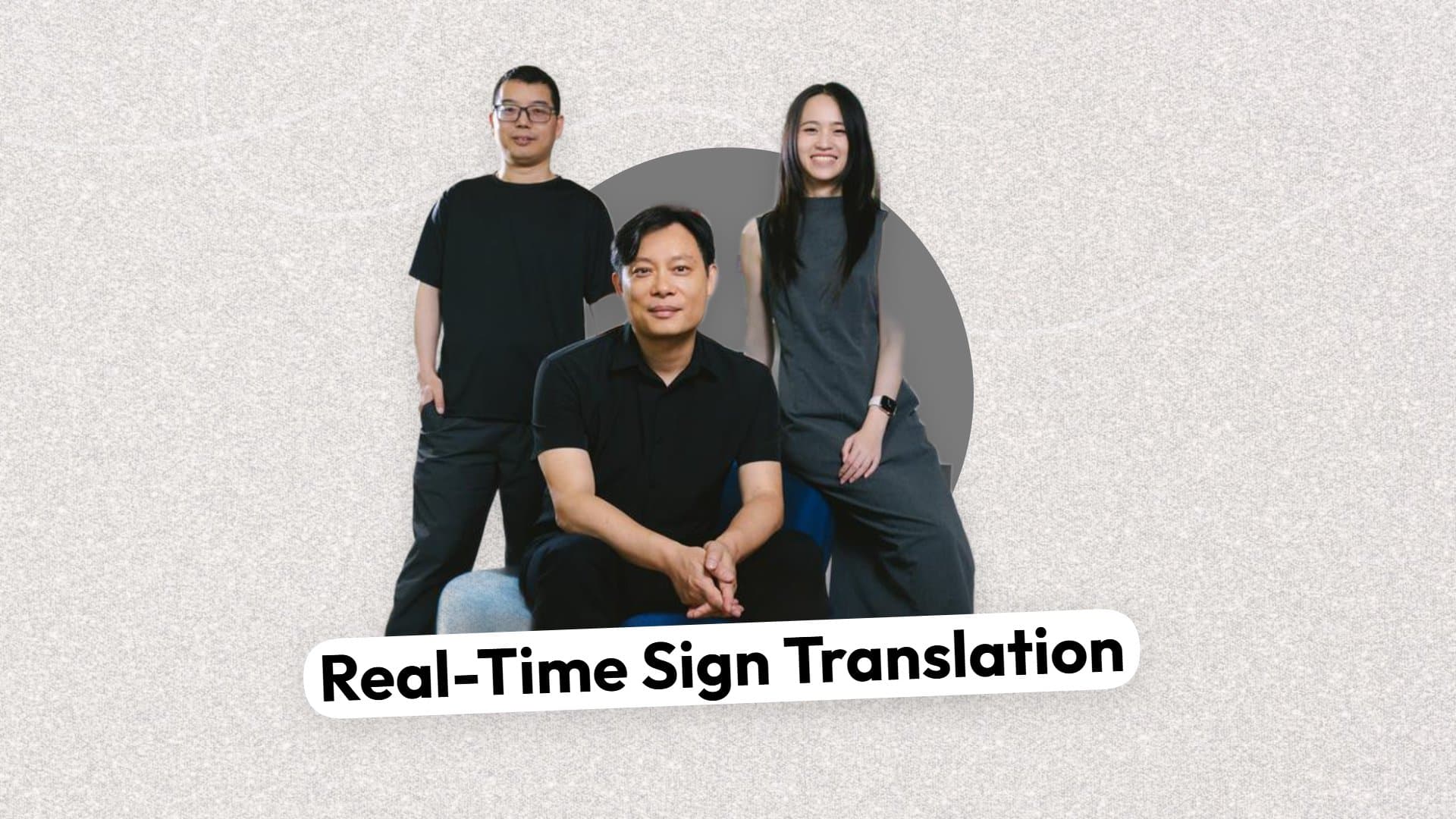
The technology was developed at NYU Abu Dhabi by Associate Professor Yi Fang, who also directs the Embodied AI & Robotics Lab. He founded the venture alongside CEO Zhifei (Maggie) Li, a 2026 graduate in Computer Science and Mathematics, and Zhenhua Li, the company’s Chief Product Officer and a senior research engineer at the university. Together, they have built a system that supports both American Sign Language and Emirati Sign Language. Sign-to-speech and text-to-sign features are also nearing readiness for real-world use.
According to Fabio Piano, Interim Vice Chancellor of NYU Abu Dhabi, the spin-out represents more than just a tech product. He described ChatSign as an example of how the university translates research into ventures addressing tangible societal needs, integrating entrepreneurship and education along the way.
Fang has likened the ambition of ChatSign to what smartphones did for communication, suggesting that AI-driven accessibility tools could become just as widespread. It’s a bold comparison, but not entirely far-fetched. Since its inception in 2024, the project has moved quickly from research concept to patent-protected prototype. In late 2025, the team tested the system during a live campus event focused on accessibility, delivering real-time translation to more than 200 students. The technology is also set to be used at NYU Abu Dhabi’s 2026 Commencement Ceremony, where it will provide live speech-to-sign translation.
I’ve seen many startups in the region pitch “AI for good”, but few manage to demonstrate practical deployment this early. That said, scaling hardware-based systems across multiple environments is never straightforward. Reliable real-time translation, especially across two spoken languages and multiple sign languages, is technically demanding. If ChatSign can keep accuracy and speed spot on, it could open serious doors.
The startup has already showcased its system at events including Make it in the Emirates, Dubai AI Week and AccessAbilities Expo, and reached the semi-finals of the GITEX Expand North Star competition. It is currently exploring pilot partnerships across sectors and geographies, with plans to expand first across the UAE, then regionally and internationally.
Maggie Li has said the team focused on building something that works in real-world settings where speed and clarity are essential, while continuing to learn from users. The longer-term vision is ambitious: to see ChatSign devices deployed globally within the next decade, making communication as accessible to Deaf and hard-of-hearing communities as it is to hearing individuals.
At Arageek, we often talk about startups that push boundaries in fintech or climate tech. Accessibility tech sometimes gets less spotlight, even though its social impact is huge. I remember attending a regional startup forum where accessibility solutions were tucked away in a small corner of the exhibition hall — well, I mean, almost hidden. Yet the founders there were some of the most determined I’ve met. In that sense, seeing an AI spin-out from the UAE tackling sign language translation at scale feels not just timely, but necessary.
ChatSign is now actively seeking collaborators for data collection, validation and pilot deployments across physical and digital environments. The road ahead will require robust partnerships and constant refinement. But if the early momentum is anything to go by, this could be one of those quiet breakthroughs that gradually becomes part of everyday infrastruture, and we may one day wonder how we managed without it.
🚀 Got exciting news to share?
If you're a startup founder, VC, or PR agency with big updates—funding rounds, product launches 📢, or company milestones 🎉 — AraGeek English wants to hear from you!


✉️ Send Us Your Story 👇