 Ai Everything
 LEAP26
 AI
AI Saudi Arabia
 UAE
UAE Egypt
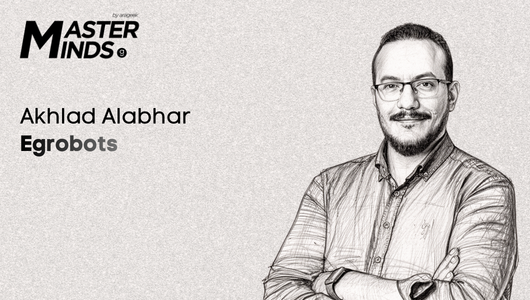
EgyptI am Akhlad Alabhar. I lost a farm, so I built robots instead

5 min
When technology meets failure, not theory
Akhlad Alabhar does not talk about robotics as an abstract future. When asked about where the idea truly began, he traces it back to a very specific failure. While working in the banking sector in Saudi Arabia, he invested in a date-palm farm in Egypt’s Bahariya Oasis. What followed was not a learning curve but a collapse. Nearly 60 percent of the trees were lost due to poor agricultural management and the absence of reliable, data-driven tools.
For someone trained in computer engineering and control systems at Alexandria University, the gap between what technology could do and what agriculture was actually using became impossible to ignore. The problem was not a lack of effort from farmers, but a lack of systems that could sense, analyse, and respond with precision. That realisation became the intellectual seed for what would later become EGRobots.
From banking intelligence to agricultural reality
When the conversation turns to his professional background, Alabhar is clear that banking shaped how he thinks. Years spent working with data warehousing, predictive models, regulatory frameworks, and enterprise automation taught him discipline. Decisions had to be accurate, scalable, and defensible. There was no room for guesswork.
That mindset followed him into agriculture. In mid-2022, he made a deliberate decision to step away from employment and focus fully on building a solution of his own. He studied farmers’ needs, tested assumptions, and repeatedly reworked the business model. EGRobots was officially launched in 2023, but not before several iterations clarified a hard truth. Technology only matters if it survives real conditions and delivers practical value on the ground.
What recognition actually means
Asked to reflect on external validation, Alabhar points to a moment that still carries weight. EGRobots was featured in the opening keynote of GoogleIOConnect in Berlin, marking the first time an Egyptian company appeared in that context. The significance, for him, was not publicity.
Being highlighted at GoogleIOConnect in Berlin sent a different signal. It demonstrated that locally built technology, when grounded in real problems, can compete on global stages. For Alabhar, it was less about prestige and more about proof. Egyptian engineering could stand alongside international peers without dilution or imitation.
Building in a market with almost no peers
Pressed on competition, Alabhar does not frame the market as crowded. Robotics development in Egypt remains limited, and the barriers are structural rather than technical. Hardware manufacturing, supply chains, and funding ecosystems are still fragile.
Instead of treating other players as rivals, EGRobots has focused on collaboration. The goal is not dominance but localisation. Alabhar sees the long game as building an industry that can sustain itself across Egypt and the wider Arab world, rather than extracting short-term advantage from scarcity.
Robots as products, not experiments
When asked about tangible output, Alabhar is specific. The company has developed five distinct types of robots, each designed for practical deployment rather than demonstration. These will be formally announced at TransMEA in Egypt and Beban in Saudi Arabia.
The ambition is not novelty. It is consistency. EGRobots aims to become a foundational player in regional robotics, producing systems that can be manufactured, maintained, and scaled locally.
Funding, hardware, and uncomfortable constraints
When the conversation turns to challenges, Alabhar does not soften the reality. Agri-tech is a difficult sector for fundraising, particularly when hardware is involved. Building physical systems in Egypt adds layers of complexity, from component sourcing to manufacturing reliability.
Despite this, the company has raised USD 500,000 to date. For Alabhar, the figure matters less than what it represents. Survival, momentum, and enough runway to keep building without compromising standards.
The traffic robot and state-level trust
Asked about the traffic-management robot that has attracted public attention, Alabhar describes it as part of a broader institutional relationship. The project is being developed in collaboration with Egypt’s Ministry of Interior, which approached EGRobots to build the system locally.
The robot uses AI capabilities not previously deployed in Egypt, including conversational AI, and more than 70 percent of its components are locally manufactured. Initial deployment will focus on traffic management, but the collaboration is designed to expand into other sectors. For Alabhar, the key milestone is trust. A state institution committed to adopting locally built robotics at scale.
Thinking beyond the next product cycle
When asked to look ahead, Alabhar frames the next phase as infrastructural rather than commercial. The priority is research and development at the intersection of AI and robotics, with the intention of serving both Arab and global markets. Competitive pricing matters, but sustainability matters more.
The company’s operations are anchored in Egypt, with offices in the UAE and Saudi Arabia. Its AI applications already reach across Arab and African markets, but Alabhar remains cautious about speed. Expansion only works if the foundation holds.
Advice rooted in uncertainty
Asked to offer guidance to others building companies in AI and robotics, Alabhar avoids formulas. Technology, he believes, will change dramatically within five years. That volatility creates opportunity, but only for those who read signals carefully and remain patient.

Endurance, adaptability, and acceptance of uncertainty define his outlook. Success is not guaranteed, and failure is not always avoidable. For Alabhar, building a company is an exercise in judgement, not prediction, and ultimately, an acceptance that outcomes extend beyond individual control.
What remains constant is the decision to build. Not in theory, not in abstraction, but in response to problems that refuse to be solved any other way.