 Ai Everything
 LEAP26
 AI
AI Saudi Arabia
 UAE
UAE Egypt
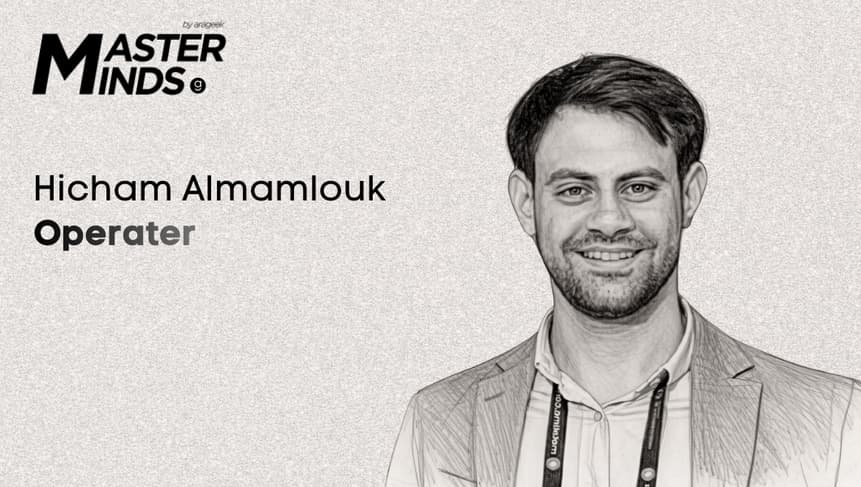
EgyptI am Hicham Almamlouk. I think early hiring is a trap, so I built AI agents to do the execution work first.

8 min
Doing more without hiring more
Early-stage startups love a comforting story: growth equals headcount. More customers means more people, more tools, more layers, more meetings to coordinate the meetings about the tools. Hicham Almamlouk has spent most of his career poking holes in that logic.
He is not anti-people. He is anti-chaos. His obsession is simple: if a small team is doing the right work, why does scaling so often feel like the team is drowning in its own coordination?
How he defines his work when nobody is watching
When asked about how he defines himself professionally today, Almamlouk doesn’t reach for the usual founder theatre. He calls himself a startup operator, which is less a label and more a responsibility. His work sits where growth, retention, and operations collide, the messy place where strategy gets tested by reality.
He talks about “translating complexity into execution”, and that phrase matters. Plenty of startups can explain what they want. Far fewer can turn it into a system that repeats without breaking. For Almamlouk, building a company is designing infrastructure that keeps a small team moving fast, even when pressure rises.
What working across countries taught him about execution
On the question of what changed after working across Turkey, Bulgaria, and Saudi Arabia, his answer is blunt: talent is global, execution is local. The work gets done, or doesn’t, based on how people communicate, take ownership, and make decisions inside their culture.
The trap, he suggests, is pretending one operating style fits everywhere. The better approach is to build principles that travel well, then tune leadership and incentives to local reality. Respect is not a nice-to-have here, it is a performance variable.
The moment he stopped shipping code and started shipping outcomes
Pressed on the biggest turning point in his career, he points to a shift that sounds small but isn’t: moving from writing code to owning outcomes. Project management forced him to think in impact, trade-offs, and people, not just implementation.
That mindset, in his telling, makes founding feel almost inevitable. You stop asking “how do I build this?” and start asking “why does this matter, and what next?” Once your brain flips into that mode, you can’t unsee how many teams confuse output with progress.
What a unicorn taught him about scaling that most founders miss
When the conversation turns to lessons from Insider, he doesn’t talk about stacks or clever architecture. He talks about consistency. Scalability, to him, is less about technology and more about repeatable decisions: clear product principles, tight customer feedback loops, and ruthless prioritisation.
One line he drops is quietly sharp: onboarding is part of the product, not a support function. That’s a warning as much as a lesson. If you treat onboarding as an afterthought, you build a churn machine and call it growth.
Why the first 30 days decide the future
Asked to reflect on early customer experience, Almamlouk makes it sound almost sacred. If onboarding is confusing or value is delayed, churn stops being a surprise and becomes “structural”. That is his word, and it is doing work.
He frames the first month as the period that sets a company’s trajectory. “Time to value” becomes the real KPI hiding behind everything else. Teams that win don’t just solve tickets, they remove friction before it can become habit.
First-time founders chase validation, repeat founders chase clarity
On the question of mindset, he draws a clean line. First-time founders optimise for validation. Repeat founders optimise for speed and clarity. Experience, he argues, teaches you two uncomfortable truths.
First, most problems are not unique. Second, focus beats perfection almost every time. His advice is not philosophical, it is operational: build, ship, get feedback, iterate. The point is to shorten the loop between belief and evidence.
How a small team stays focused long enough to earn an exit
When asked about what led to Sald’s acquisition and what nearly derailed it, he goes straight to the constraint: limited resources while growing fast. The core challenge was staying focused while everything around you tries to pull you into “more”.
He credits the outcome to three things: product clarity, strong customer relationships, and solving a real pain point in a clean, defensible way. No mythology, no miracle. Just decisions that compound.
Why most AI initiatives fail, even with good tools
When the conversation turns to what pushed him to build Operater, Almamlouk makes a claim that will annoy some people, which is usually a good sign. Startups spend millions on tools and AI, yet most AI initiatives fail because AI lacks context and execution power.
In his framing, founders are buried in coordination instead of building. The result is familiar: AI becomes a fancy adviser that generates suggestions, not outcomes. His fix is straightforward in concept and hard in practice: give AI real-time context and access so it can actually operate autonomously, not just talk about work.
He has a line that captures his worldview in one hit: “We have lots of vibe-coding tools, it’s now time for a vibe-scaling tool.” Underneath the joke is a serious point. The bottleneck is no longer “can we build?” It is “can we execute repeatedly without adding layers of people to manage the execution?”
The case against early hiring, and why it is not anti-human
Pressed on how he convinces founders that AI agents can replace early hiring, he reframes the whole debate. Early hires, he argues, are usually for execution, not strategy. If that’s true, then the question becomes practical: what is the cheapest, fastest, most scalable way to get execution done while you are still learning?
His answer is agents. “Cheaper, faster, infinitely scalable” is the pitch, but the real principle is the last line: hiring should come after clarity, not before it. In other words, don’t hire to find product-market fit. Find clarity, then hire to multiply it.
What startup teams look like when execution is automated
Asked whether AI agents will change startup structure, Almamlouk doesn’t hedge. He expects a “micro-startup” world where 10 to 20 people can build companies worth billions. The teams are smaller, flatter, and more outcome-driven, with agents handling execution-heavy roles.
That prediction is easy to mock, but his logic is consistent. If coordination cost drops, you don’t need layers. If execution becomes cheaper, you don’t need to hire as early. The winners will be the teams who redesign how work is done, not the teams who bolt AI onto the old workflow and call it transformation.
The three scaling mistakes that quietly kill momentum
When asked about common mistakes in fast-scaling startups, he lists the classics, but with the operator’s sting. Hiring too early. Overbuilding features. Mistaking activity for progress.
The last one is the real villain. Activity looks like motion, and motion is comforting. Progress is measurable and often uncomfortable. His warning is simple: scaling without operational clarity doesn’t fix problems, it amplifies chaos.
What founders in MENA keep struggling with, and what they misdiagnose
On the question of what challenges founders in the region repeatedly raise, he doesn’t romanticise it. He mentions an immature ecosystem, gaps in support and funding, go-to-market clarity, early hiring, and burn management.
One line stands out because it’s not what people like to admit: many struggle with knowing when to say no, which is often more important than saying yes. That is an operator talking. Your constraints do not care about your ambition.
Saudi, Turkey, Europe, and the real race that matters
Asked to compare Saudi Arabia with Turkey and Europe, he calls Turkey and Europe more mature, largely because they started earlier and built focus over time. But he thinks Saudi is moving faster than most people realise, with capital, ambition, and government support aligned.
His “next challenge” isn’t more money or more programmes. It is building globally competitive products, not just local successes. That’s a higher bar, and it forces founders to care about retention, distribution, and product quality beyond a single market’s comfort zone.
The simple personal rule that holds everything together
When asked to sum up the most important lessons he’s learned, he splits it cleanly. Professionally: systems beat heroics. Personally: resilience matters more than confidence.
Momentum, he says, comes from consistency, not big moments. He advises founders to obsess over the problem, not the solution, and trust that clarity shows up if you keep running tight loops with reality.
The advice he would give, if he had to bet on one playbook
Asked what he would tell young entrepreneurs in MENA, Almamlouk keeps it direct. Build global from day one. Focus on real problems, not trends. Keep teams small, costs low, execution tight.




Then he returns to the theme that runs through everything he says: design your company to scale before you try to grow it. Build fast, be ruthless with growth, maintain retention, and take extra good care of early adopters. They do not just validate you, they shape what you become.
If you are looking for inspiration, you are in the right place and If you see yourself in this, we would love to hear from you at press@arageek.com