 LEAP26
 AI
AI Saudi Arabia
 UAE
UAE Egypt
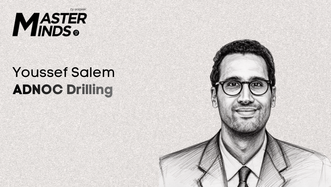
EgyptI am Youssef Salem. I integrated AI into finance before calling it innovation

5 min
Where financial discipline meets industrial scale
There are CFOs who manage numbers, and there are CFOs who shape systems. When the conversation opens with Youssef Salem, it is clear he belongs to the latter group. His career has unfolded at the junction of capital markets, advanced technology, and operational complexity, where decisions are measured not only in returns, but in durability.
Today, Salem serves as CFO of ADNOC Drilling, the world’s largest integrated drilling company, while also chairing Enersol, a global AI-driven energy platform. The throughline is not sector hopping, but scale, moving from transactions to operations, and from advising outcomes to owning them.
Why actuarial science came before finance
When asked about his early direction, Salem traces it back to an attraction to uncertainty itself. Actuarial Science, studied at American University in Cairo, appealed because it forced structured thinking around risk, probability, and long-term outcomes.
That foundation trained him to think in scenarios rather than point estimates. From there, the transition into corporate finance and transactions felt natural. Over time, however, advisory roles stopped being enough. Salem wanted responsibility for execution, for decisions made with incomplete information and real consequences. The title of CFO came later, almost incidentally, as responsibility compounded.
Becoming “young” in public markets without chasing the label
Pressed on becoming one of the youngest CFOs on both Nasdaq and Abu Dhabi Securities Exchange, Salem is quick to downplay age as an objective. The goal, he explains, was never novelty. It was progression.
Each step added complexity, first technical mastery, then leadership, then judgment under pressure. Public markets simply became the arena where those skills were tested most visibly.
How AI changes energy without replacing fundamentals
When the conversation turns to energy and technology, Salem is precise. Energy remains a fundamentals business. Safety, uptime, execution, cost discipline. AI does not replace these, it enhances them.
The real shift is from reactive to predictive operations, and from intuition-led decisions to data-augmented ones. In finance, that same shift enables sharper forecasting, better capital allocation, and faster risk detection. Companies that win will integrate AI into daily workflows, not just strategic narratives.
Navigating stress at Swvl
Asked about navigating turbulence at Swvl, Salem’s answer centres on discipline rather than reinvention. Focus narrowed to markets and products with the strongest unit economics. Cost structures were tightened. Contract quality became paramount.
Consistency mattered more than speed. Execution replaced experimentation.
Today, Swvl operates as a tech-enabled mobility provider anchored in contracted, recurring revenue. Recent public disclosures point to improving profitability and revenue growth, validating the shift toward predictability.
Lessons from taking a MENA unicorn public
On the question of what public markets really demand, Salem offers three lessons. First, public markets are a different sport. The cadence and scrutiny are relentless. Second, narrative must survive stress. A story that only works in growth is fragile. Third, predictability is a product feature. Beats, raises, and consistency matter as much as vision.
Going public rewards repeatable economics and management teams that can operate calmly under scrutiny.
How the CFO role changes with scale
When asked to compare CFO roles across stages, Salem draws sharp distinctions. In listed, government-backed entities, the CFO is a steward. Governance, disclosure, and credibility dominate. Mistakes compound.
In unicorns and late-stage companies, the CFO becomes a translator and architect, turning growth into unit economics and building systems that can withstand audits and investor examination.
In early-stage environments, the role becomes hybrid. Finance, operations, and strategy blur. Cash runway is oxygen, and survival depends on speed and clarity.
What investment banking taught him that spreadsheets cannot
Reflecting on his 13 years in investment banking at Moelis, where he executed over $150bn across more than 60 transactions, Salem points to pattern recognition under pressure.
Capital behaves differently in stress. Stakeholders respond to incentives, not models. And even the mathematically right answer can fail if timing, execution, or human behaviour are ignored.
Managing finance at industrial scale
Asked about the challenges of leading finance at ADNOC Drilling, Salem highlights four. Capital allocation at industrial scale, deciding where each incremental dollar generates the highest risk-adjusted return. Cash flow discipline across cycles. Balancing growth with returns to preserve ROIC logic. And meeting public-market standards of transparency and governance.
At this scale, finance becomes as operational as it is analytical.
Why AI now shapes investment decisions
As Chairperson of Enersol, Salem sees AI as decisive in two dimensions. Operationally, it defines new performance baselines through predictive maintenance, optimisation, and safety analytics. From an investment perspective, it raises the bar. Defensible data, workflow integration, and measurable ROI are no longer optional.
The focus is on technologies that scale globally and deliver tangible performance advantages, not experimental prototypes.
Education, talent, and what is still missing
When asked about academia, Salem believes fundamentals are necessary but insufficient. Modern finance requires applied exposure, real datasets, product thinking, and comfort with ambiguity. Finance is no longer a siloed discipline.
That same logic shapes his involvement as Adjunct Professor and ecosystem builder, including founding Qora71, now Stryde71, and serving as Entrepreneur in Residence at Hub71.
Growth, governance, and a false trade-off
Pressed on whether growth and governance conflict, Salem rejects the premise. Governance only slows companies when it is treated as bureaucracy. Designed correctly, it accelerates decision-making by clarifying thresholds, data, and accountability.
The real mistake, he argues, is the opposite one. Many startups fail not by growing too fast, but by not growing fast enough when economics allow it.
Looking five years ahead





On the future convergence of AI, energy, and finance, Salem expects three shifts. AI embedding directly into field operations and safety systems. Capital allocation becoming more data-driven with faster portfolio rotation. And the emergence of new platforms at the intersection of energy services and advanced technology, with the region exporting solutions globally.
The ambition is not participation, but authorship.