 LEAP26
 AI
AI Saudi Arabia
 UAE
UAE Egypt
EgyptDealfuze Debuts AI-Driven Demo Day to Democratise MEA Venture Access

5 min
MENA and Africa posted record venture totals, yet access remains deeply uneven.
Pre-seed funding is just 1,5% in Africa, with 82% concentrated in four countries.
Dealfuze launches an AI-curated Online Demo Day to fix “who you know” funding.
Founders face endless cold emails as 65% of VC deals rely on connections.
With capital rising but connectivity lacking, merit-based matching feels overdue.
There’s no shortage of capital headlines across the Middle East and Africa these days. Venture funding in MENA jumped 74% to hit $3.8 billion in 2025, while Africa recorded $4.1 billion in financing, its strongest performance since 2022. On paper, that sounds spot on. But scratch beneath the surface and a different picture appears.
Access to that capital remains far from equal. In Africa, pre-seed funding makes up just 1.5% of total venture investment, well below the 4–6% typically seen in the United States. More than 82% of the continent’s VC money flows into just four countries. Across the wider MEA region, the problem is less about ambition and more about connection. Founders aren’t struggling with ideas. They’re struggling to get in the right room.
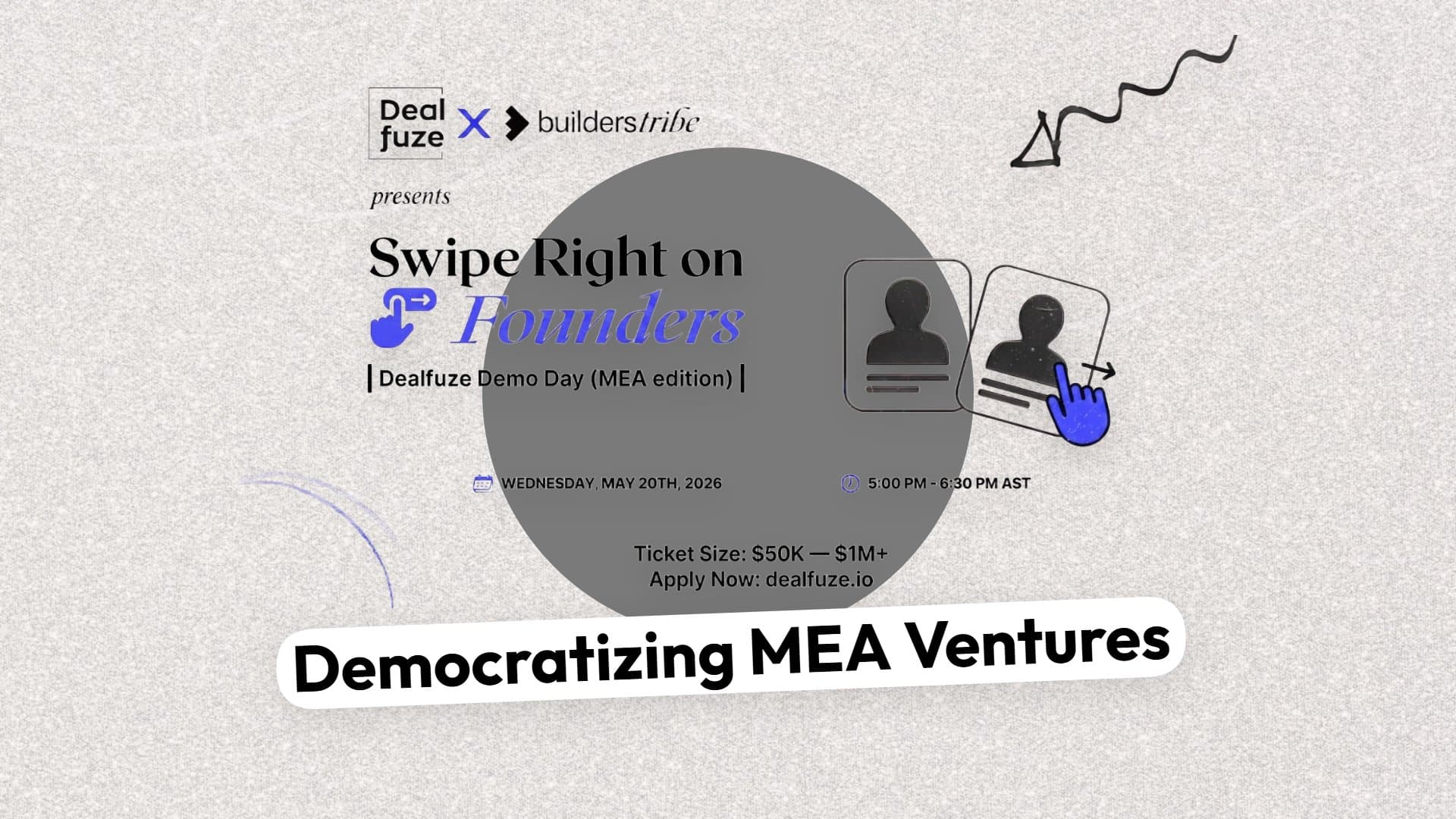
It’s against this backdrop that Dealfuze, a London-headquartered platform with deep roots in MEA, has launched its closed beta waitlist alongside what it describes as the region’s first algorithmically curated Online Demo Day, scheduled for 20 May 2026. The concept is simple, at least in theory: use artificial intelligence to match startups and investors based on sector focus, stage, geography and investment thesis, rather than who happens to know whom.
I’ve seen how much of a faff fundraising can be for early-stage founders in the region. Endless cold emails. Warm introductions that go nowhere. Pitch decks floating in inbox limbo. Arageek has long championed founders trying to break through these invisible barriers, so the idea of structured, merit-driven discovery feels timely, and, frankly, overdue.
Dealfuze says its platform is sector-agnostic and built for pre-seed, seed and early-stage startups. The upcoming Online Demo Day will feature companies selected through its matching engine, which cross-references founder data with investor mandates. In other words, it aims to filter signal from noise at a time when both are growing fast.
And the broader numbers illustrate that tension. MEA’s combined VC market reached $5.3 billion in 2025. Yet Europe deployed €66.2 billion over the same period, putting the regional gap into sharp relief. In Africa, the pre-seed ecosystem raised only $46.5 million across 281 deals last year, even as overall VC funding rose 40%. With major accelerators such as Techstars and Y Combinator scaling back operations on the continent, private pre-seed capacity has reportedly dropped by more than 60% between 2019 and 2025.
Dealfuze appears keen to position itself at this inflection point. Investors from firms including A-Typical Ventures, Blossom Capital, Emtech VC, Launch Africa Ventures, Pennington Promise Capital and Shorooq Partners have confirmed they will attend the demo day, alongside other regional and global VCs typically writing cheques between $50,000 and over $1 million. The event is co-hosted with Builders Tribe, a tech community active across the GCC and Africa.
Mohamed Al Sheraie, founder of Dealfuze, has argued that while 2025 was a record year for venture activity, many early-stage founders outside the four dominant hubs remain overlooked. He believes venture discovery in the region should be driven by merit and execution, not geography or personal networks.
His co-founder, Mostafa Zaghloul, has pointed to another telling stat: 49% of MENA venture capital in 2025 came from international investors, the highest level in five years. Yet many founders never reach those global backers simply because they lack the right introductions. Female founders across Africa receive just 10% of equity funding, despite representing more than a third of applicants. As Zaghloul has suggested, that’s not a talent issue, it’s a network gap.
There’s academic backing for this view. Research from Harvard Business School shows that 65% of VC deals involve a mutual connection between founder and investor. That reinforces the same circles, the same archetypes, over and over again. Meanwhile, Africa still accounts for less than 1% of global venture capital despite being home to 18% of the world’s population. Only 5% of seed-stage startups make it to Series A. The odds are… well, steep.
Mahmoud Al Anany, Dealfuze’s CTO, has framed the issue as one of infrastructure. As AI tools make it easier than ever to build startups, he argues, the real bottleneck has shifted. Capital is available, but connectivity is not. Matching the right founder to the right investor across more than 50 countries and dozens of sectors becomes a data problem, not just a networking one.
On the flip side, algorithms are not magic. I reckon technology can open doors, but trust still closes deals. Relationships matter in venture, and they probably always will. That said, if a platform can widen the top of the funnel and give overlooked founders, from rural communities, refugee backgrounds, or with disabilities, a fairer shot at being seen, that’s a step many in the ecosystem will welcome.
Dealfuze is still in closed beta, and its real impact will depend on adoption and execution. But at a time when venture money is rising while access remains uneven, experiments like this feel more than just timely. They feel neccessary.
🚀 Got exciting news to share?
If you're a startup founder, VC, or PR agency with big updates—funding rounds, product launches 📢, or company milestones 🎉 — AraGeek English wants to hear from you!

✉️ Send Us Your Story 👇