 Ai Everything
 LEAP26
 AI
AI Saudi Arabia
 UAE
UAE Egypt
EgyptDell and Armada Target Saudi Arabia’s Edge AI Market with New Collaboration

4 min
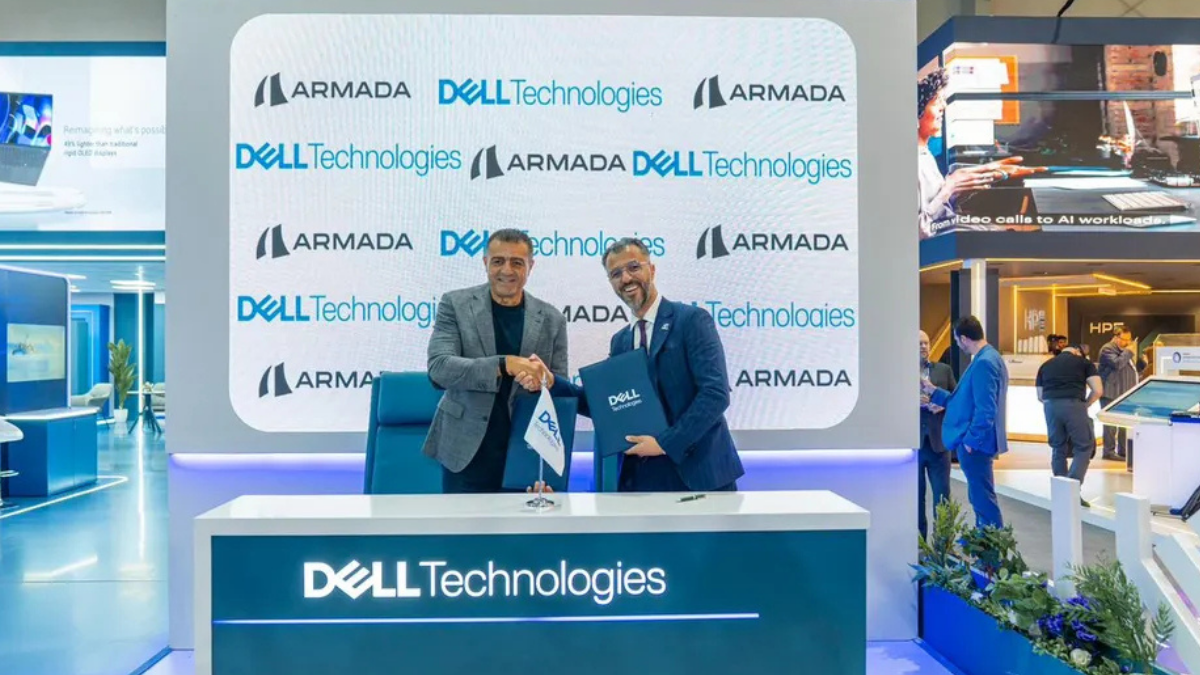
Dell and Armada signed an MoU at LEAP 2026 for mobile edge data centres.
The aim is bringing computing power closer to where data is created.
Their setup combines Dell hardware with Armada’s containerised units for remote operations.
This could support edge AI in energy, telecoms, manufacturing and public infrastructure.
No rollout details yet, but “latency, resilience and data sovereignty” are driving interest.
Dell Technologies and Armada are exploring a new push into Saudi Arabia’s edge infrastructure market, after signing a Memorandum of Understanding during LEAP 2026 in Riyadh to look at rolling out containerised mobile and edge data centres across the Kingdom.
The plan, in simple words, is to bring computing power closer to where data is actually created rather than sending everything back to a distant central facility. That could matter quite a lot for AI workloads in sectors like energy, telecoms, manufacturing and public infrastructure, where operations are often spread out and, at times, in places where connectivity can be a bit of a faff.
Under the proposed setup, Dell’s enterprise hardware and infrastructure stack would be combined with Armada’s containerised data centre technology. These are modular units, packed with compute, storage and supporting systems, that can be deployed near industrial sites, field operations or remote assets instead of relying only on permanent data centre buildings. It sounds practical, and I reckon that’s why this angle may get attention in Saudi Arabia, where AI ambition is moving fast but not every use case fits neatly inside a hyperscale campus.
Mohamed Talaat, Vice President for Saudi Arabia, Egypt, North Africa and Levant at Dell Technologies, said the collaboration is meant to expand resilient mobile edge infrastructure in the Saudi market. He said pairing Dell’s high-performance hardware with Armada’s containerised design would help enterprises deploy edge AI with “speed, scale and reliability” in line with Saudi Vision 2030.
From Armada’s side, Rabee El Mohammadi, Vice President of Sales and Partnerships for MEA, said the partnership could improve the company’s ability to deliver AI and edge infrastructure for organisations with demanding operational needs. He said combining Armada’s edge platform with Dell technology would allow computing resources to be placed directly in field operations, remote assets and other critical enterprise environments.
That said, this is still an MoU, not a full rollout. The two companies have not shared details on investment size, project capacity, deployment sites, first customers or launch dates. So for now, it is more a framework for possible projects than a done deal. On the flip side, even without those specifics, the direction is spot on for a market like Saudi Arabia, where latency, resilience and data sovereignty are becoming bigger parts of the AI conversation.
The logic behind edge AI is fairly straightforward. If data can be processed locally, closer to machines, facilities or physical infrastructure, organisations can react faster and keep operations running even when links to central cloud systems are limited. For industries such as energy and telecoms, that can be very useful. And believe it or not, this is often where the real-world startup lesson appears too: flashy scale gets headlines, but practical deployment wins trust.
For readers at Arageek, this sort of move taps into a wider shift across the region. I still remember startup founders telling me at regional events that building around local constraints — patchy connectivity, remote operations, hard-to-reach sites — was not a weakness but an advantage, well… I mean, if you solve the real problem on the ground, the technology becomes much more valuable. Dell and Armada seem to be leaning into exactly that idea here.
The companies also said they plan to use Dell’s authorised regional channel partner network to widen access to enterprise customers in Saudi Arabia. That could help if the partnership moves from strategy slides to actual deployments, especially in sectors where distributed operations are common and centralised infrastructure alone is not enough.
Saudi Arabia’s AI and data centre buildout is usually discussed through the lens of large central facilities, but this agreement points to another layer of the market. Not every workload belongs in a giant campus. Some need to sit much closer to the action. Whether Dell and Armada can turn this into meaningful projects is the key question now, and that will definately be the part worth watching.
🚀 Got exciting news to share?
If you're a startup founder, VC, or PR agency with big updates—funding rounds, product launches 📢, or company milestones 🎉 — AraGeek English wants to hear from you!




✉️ Send Us Your Story 👇