 LEAP26
 AI
AI Saudi Arabia
 UAE
UAE Egypt
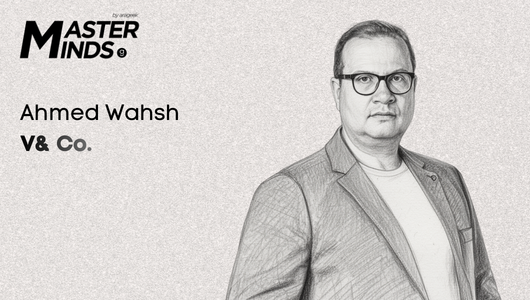
EgyptI am Ahmed Wahsh. I treated logistics as a system, not a service.

6 min
Opening
Ahmed Wahsh does not talk about growth as an ambition. He talks about it as a consequence. Across his career, from early corporate roles to building and scaling multiple logistics businesses, his thinking has been shaped by one consistent belief: logistics is an operational discipline that exposes weak thinking fast. V& Co did not emerge as a brand play or holding structure. It emerged as a response to fragmentation, inefficiency, and shallow solutions across the region’s e-commerce supply chain.
How his early career shaped an operator’s mindset
When asked about his professional beginnings, Wahsh traces a deliberate path rather than a series of promotions. His early years at Aramex and later at ISS, a subsidiary of Piraeus Bank, grounded him in large-scale operations and structured environments. That foundation became critical when he co-founded GlobEX, which grew into one of Egypt’s leading e-commerce shipping and delivery companies before being acquired by Souq.
Following the acquisition, his time inside the Souq ecosystem, and later Amazon, deepened his exposure to scale, process discipline, and the consequences of operational failure. He later participated in launching Bosta, further sharpening his understanding of last-mile complexity. These roles, he says, were cumulative. Each one added operational depth that eventually led to forming V& Co as an integrated group rather than another standalone company.
Why logistics and e-commerce reward serious thinking
On the question of sector choice, Wahsh is clear that logistics is not forgiving. It represents a full customer journey, from purchase intent to final delivery, where failure at any point can collapse the entire experience. What drew him in was precisely that intolerance for superficial fixes.
He describes logistics as a field that demands alignment between operations, technology, and people. There is no room for slogans or shortcuts. Either the system works under pressure, or it does not. That reality, he argues, attracts operators who are willing to think end to end rather than optimise in isolation.
Moving from standalone companies to a group model
When the conversation turns to structure, Wahsh explains that V& Co was not planned as a group from the outset. Over time, a pattern became clear. The market was not suffering from a lack of companies, but from a lack of integration. Individual problems were being solved in silos, often creating new bottlenecks elsewhere.
V& Co emerged as a response to that gap. Today, the group oversees 12 companies operating across logistics, technology, human resources, marketing, and business enablement. These entities operate across Egypt, the UAE, and Kuwait, with ongoing expansion into Saudi Arabia, Qatar, and Oman. The unifying logic is not ownership alone, but operational interdependence.
Why VHubs anchors the operational model
Asked to identify the group’s structural core, Wahsh points to VHubs. It was built to address a specific weakness in e-commerce logistics, namely the high cost and low efficiency of serving remote and underserved areas.
VHubs operates as a technology-enabled shared infrastructure. Shipping companies can pool resources, reduce duplicated costs, and extend coverage without building parallel networks. The result is wider reach, faster delivery, and more consistent service quality, without increasing operational strain.
Treating human capital as an operational system
Pressed on the role of HR within a logistics group, Wahsh argues that people are often discussed emotionally rather than operationally. Out Hyre and Fortemove were created to address this gap from two different depths.
Out Hyre focuses on supplying trained, ready-to-deploy operational teams. Fortemove operates upstream, designing HR structures, performance systems, and recruitment frameworks that can sustain growth in complex environments. The objective is not staffing volume, but building teams that can operate predictably under pressure.
Centralising customer experience without diluting accountability
When asked about quality control across multiple entities, Wahsh explains that Integrate functions as an operational control layer. Specialised in enterprise contact centre solutions, it enables real-time performance monitoring, exception handling, and complaint resolution across the ecosystem.
Rather than decentralised customer service teams operating in isolation, Integrate standardises response quality and visibility. This allows the group to scale without fragmenting the customer experience.
Removing operational distractions from shipping companies
On the subject of SMV and adjacent solutions, Wahsh describes a consistent theme: removing friction that distracts operators from their core business. SMV addresses fleet and driver management, along with the administrative burden that often comes with it.
Alongside SMV, companies such as Merage, Ecomilez, and PUDO Network cover heavy shipping, middle-mile operations, and pickup and drop-off infrastructure. Together, they form an integrated supply chain layer that reduces handoffs and inefficiencies.
Completing the e-commerce ecosystem
Asked about recent investments, Wahsh points to early 2026 as a period of deliberate expansion. OTE was added to provide fulfilment and order management services, launching first in Kuwait and later expanding into the UAE, with further regional plans underway.
Blink also joined the group to support flexible transportation models within the UAE. The common thread, he notes, is scalability without compromising operational discipline.
Why growth does not start with marketing
When questioned on visibility and expansion, Wahsh is explicit that fame is not a strategy. Marketing, in his view, starts with understanding the market, clarifying the business model, and delivering a coherent customer experience.
Itelity operates within the group as an operational marketing partner, building marketing systems that reflect operational realities rather than short-term promotional goals. The focus is on alignment, not noise.
Technology as infrastructure, not positioning
On technology, Wahsh rejects the idea of it as a branding layer. Within V& Co, technology structures workflows, connects teams, and improves execution. It is designed to support field operations, not abstract dashboards.
Through vSoft, the group developed Dispatch, a SaaS platform for managing delivery operations and shipment tracking. Dispatch integrates with other group entities while maintaining clear boundaries, ensuring that technology enables coordination without role overlap.
Why specialisation beats consolidation
Asked to choose between a single-company model and multiple specialised entities, Wahsh sides firmly with specialisation. Each company within V& Co operates with independent management, a defined mandate, and clear accountability.
This structure, he believes, allows deeper focus and faster problem-solving. Complexity is addressed through coordination, not forced consolidation.
Competing on sustainability, not volume
On competition, Wahsh sees it as both inevitable and healthy. The differentiator, in his view, is not speed of expansion but the ability to sustain quality at a reasonable cost. Growth follows disciplined execution, not the other way around.
He also points to systemic challenges, including unregulated operators and the lack of formal training frameworks. Addressing these issues, he believes, will define the sector’s next phase.
Looking ahead
Asked to reflect on the future, Wahsh sees rising demand across Egypt and the Gulf, accompanied by a need for better regulation, deeper training, and broader technology adoption. Through V& Co, his aim is not simply to compete, but to enable the market to operate at a higher standard.