 Ai Everything
 LEAP26
 AI
AI Saudi Arabia
 UAE
UAE Egypt
EgyptI am Amjad Salakhou. I shifted from tasks to decisions, and projects stopped failing

5 min
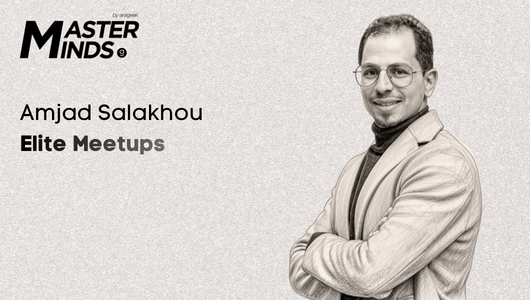
From tasks to decisions: how Amjad Salakhou reframed project leadership
Sixteen years into his career, Amjad Salakhou no longer describes himself as a project manager in the conventional sense. What emerges instead is a practitioner focused on enabling decisions, not ticking off tasks. The distinction matters because it shapes how organisations execute, govern, and ultimately succeed.
How he defines his professional identity today
When asked about how he introduces himself now, Salakhou frames his role around judgement rather than delivery. He positions himself at the intersection of execution, data, and governance, where the quality of decisions determines outcomes long before timelines slip. Over time, he moved away from task completion as a measure of success and towards decision quality, having seen repeatedly that projects fail not because schedules collapse, but because decisions are made without data or an integrated view.
What separates traditional and data-driven project management
On the question of methodology, Salakhou draws a sharp line between looking backwards and looking ahead. Traditional project management records what has already happened. Data-driven management anticipates what might happen. In his view, data should not exist to satisfy reporting requirements, but to forecast risk, reduce uncertainty, and support timely choices. The real advantage belongs to those who can interpret numbers before they harden into problems.
Why large organisations struggle to execute well
Pressed on execution challenges inside large institutions, Salakhou returns to three recurring issues: conflicting stakeholder priorities, slow decisions, and the absence of a holistic project view. These are not solved by more process. They are addressed when governance is clear, data is accessible, and PMOs are embedded in decision-making rather than relegated to monitoring progress from the sidelines.
How PMO maturity differs across regions
When the conversation turns to PMO maturity in the Arab region, Salakhou acknowledges progress but identifies a deeper limitation. The challenge is not setting up a PMO, but empowering it. Too many offices operate operationally, while more mature global models treat the PMO as a strategic instrument for value creation and long-term alignment.
What his research revealed about PMO maturity
Asked to reflect on his academic work, Salakhou is clear that the presence of a PMO alone creates little value. Impact emerges when the PMO functions as an intelligent intermediary, linking strategy to execution and converting data into decisions. His research points to flexible, hybrid models as the most effective approach, particularly in environments where imported frameworks often fail to fit reality.
Why data governance changes public sector decisions
On the subject of government entities, Salakhou explains that data governance shifts decision-making from individual judgement to institutional logic. With accurate data and clear ownership, decisions become faster, more reliable, and less costly. For him, investing in data governance is inseparable from investing in service quality and long-term sustainability.
How he sees the real role of data analysts
Asked about the contribution of data analysts, Salakhou rejects the idea of a back-office function. He sees analysts as decision partners whose value lies in interpreting what reports do not show, linking indicators to context, and warning leadership before risks escalate into crises.
Balancing agility with governance
When asked how organisations can remain agile without losing discipline, Salakhou argues for smart governance. Goals and responsibilities must remain fixed, while execution tools stay flexible. Agility without governance creates chaos. Governance without agility creates paralysis.
Why he launched Elite Meetups
Turning to Elite Meetups, Salakhou explains that the initiative grew from dissatisfaction with superficial professional networking. He wanted a physical space for dialogue, experience-sharing, and honest professional awareness that reflects market reality rather than the polished image projected online.
What changed after 22 meetups and 600 participants
Asked to assess impact, Salakhou points to a mindset shift among participants. Many stopped focusing on “the next job” and started thinking about the value they bring. For him, that reframing is the foundation of sustainable professional growth.
How topics are chosen
On the question of content curation, Salakhou outlines a simple filter. Topics must reflect current market needs, anticipate future demand, and be practically applicable. Anything that does not help professionals make better decisions or build real capability is deprioritised.
The biggest gap in professional awareness
Pressed on the most damaging misconception he sees today, Salakhou highlights the confusion between busyness and impact. Hard work alone does not create value. Value comes from understanding trade-offs and making the right choices, not from accumulating tools or certifications.
AI, personal branding, and professional clarity
When asked about artificial intelligence and personal branding, Salakhou avoids extremes. AI will reshape roles rather than erase them. Personal branding, meanwhile, has become a way to clarify professional value in a crowded market. Those who combine technical competence with clarity about their contribution will remain influential.
Advice for aspiring consultants
On advising professionals moving into consulting, Salakhou emphasises problem understanding over solution-selling. Consultants must learn the language of decision-making, not just specialisation. Consulting, in his view, is built on trust, clarity, and influence, not information alone.



Where project management and data analysis are heading
Asked to look ahead, Salakhou sees a clear divide emerging. Those who integrate strategic thinking, data literacy, and stakeholder management will move forward. Execution-only project managers will fade into the background, while decision thinkers and institutional value creators take the lead.