 LEAP26
 AI
AI Saudi Arabia
 UAE
UAE Egypt
EgyptI am Imane Adel. I scale businesses with discipline, not hype

8 min
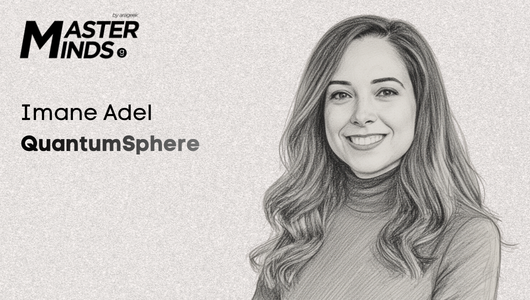
Imane Adel does not describe herself as a founder first. She calls herself a builder.
When asked how she introduces herself today, she is direct. As Founder and Managing Partner of QuantumSphere, she operates at the intersection of payments, blockchain and strategic growth, advising enterprises and high-growth startups navigating emerging markets and regulatory complexity. Where others see barriers, she sees competitive moats.
Her career traces a consistent pattern. At Visa, she was on the ground across 28 African countries, learning that strategy only works if it survives operational reality. At Mastercard, she moved from solution sales to owning regional P&Ls across MENA, discovering that revenue leadership is less about product superiority and more about ecosystem design. Later, building a blockchain business unit from zero reinforced a belief that the future belongs to those willing to move without a playbook.
The through line is clear. She is brought in to build what does not yet exist, new markets, new regulatory pathways, new business models. “I don’t optimise existing systems,” she says. “I create new ones.”
What global operators teach you about scale
On the lessons she carried from organisations such as Visa, Mastercard and Yahoo, Adel reduces it to three principles.
First, scale requires discipline. Regional dominance is not a function of ambition but of repeatable playbooks, tight unit economics and structured partnerships. Flashy launches are irrelevant if the fundamentals are weak.
Second, speed is a feature. In emerging markets, regulatory frameworks shift quickly and competitors appear overnight. Waiting for clarity means surrendering ground. The winners move with incomplete information and adjust in motion.
Third, partnerships trump products. Global payment networks succeed because they orchestrate ecosystems of issuers, acquirers, governments and fintechs. No company wins alone. At QuantumSphere, she applies the same logic, connecting clients not just to ideas but to banks, regulators and infrastructure providers who make execution possible.
Why execution, not technology, became the focus
When the conversation turns to why she founded QuantumSphere, Adel points to a pattern she kept encountering.
Founders and executives would present transformative ideas, blockchain remittances, embedded finance platforms, digital banks targeting underserved markets. Then they would hit the same walls: regulatory complexity, fragile partnership structures, P&Ls that worked on slides but collapsed under scrutiny.
“These weren’t technology problems,” she says. “They were execution gaps.”
Traditional consultancies, in her view, either lacked hands-on fintech experience or relied on frameworks that did not survive contact with real markets. She believed she could offer something rarer: advisory grounded in actual P&L ownership, regulatory licensing and zero-to-one market entry in jurisdictions where the rulebook is still being written.
At a certain point, she adds, optimising one company’s growth was no longer enough. She wanted to be in the room across industries and geographies, shaping multiple critical decisions rather than just one balance sheet.
Closing the gap between knowing and doing
Pressed on QuantumSphere’s core value proposition, Adel distils it to a single tension: knowing versus doing.
Most companies understand they need digital transformation, new market entry or blockchain integration. What they lack is someone who has secured licences across multiple jurisdictions, restructured red P&Ls to black, and negotiated the partnerships that determine survival.
“We don’t deliver slide decks,” she says. “We deliver execution roadmaps that survive reality.”
She cites work on blockchain-based remittances where the constraint was not code but compliance and cost structure. By restructuring the economics and navigating licensing across corridors, the client improved settlement speed, lowered fees and built what she calls a regulatory moat. In another case, advising a digital bank meant shaping partner selection, product architecture and sequencing from scratch.
Her emphasis is consistent: cross-market fluency matters. What works in one MENA market can fail in another. Context is strategy.
Where blockchain and AI create real impact
Asked to separate substance from hype, Adel applies a simple test: if removing the technology makes the solution impossible, not just slower, then it matters.
For blockchain, she points to cross-border payments and tokenised asset management. Remittance corridors that charge migrant workers 8 to 10 per cent can drop below 1 per cent with instant settlement. Tokenised debt can modernise bond issuance and secondary trading with transparency that traditional systems struggle to match. It may not be glamorous, she notes, but it drives economic development.
For AI, the real shift is decision automation. Credit underwriting for thin-file customers, real-time fraud detection, segmentation at scale. The visible applications draw headlines, but the invisible infrastructure drives inclusion and profitability.
The convergence of both technologies, particularly in embedded finance, is where she sees outsized potential. AI handles risk and personalisation. Blockchain provides settlement rails. Together, they enable non-financial companies to offer services once limited to banks.
Why universal strategies fail in emerging markets
On the question of cross-cultural strategy, Adel is unequivocal: universal playbooks do not exist.
Expanding payments across Africa and the Middle East taught her that strategies must be built from the ground up. Digital adoption, regulatory posture, banking infrastructure and customer behaviour differ sharply between markets that outsiders often group together.
When a fintech announces plans to expand into MENA, her first question is not about product-market fit but about sequencing. Which market first, and why? Regulatory timelines differ. Distribution costs vary. Partnerships require different political and commercial approaches.
Her experience across more than ten markets has sharpened pattern recognition. Underestimating regulatory timelines, overestimating brand portability, launching without distribution, she has seen the same mistakes repeated. The advantage lies in spotting landmines before stepping on them.
The MENA fintech inflection point
When asked to assess the state of fintech in the region, Adel describes an inflection point.
Regulatory frameworks in the UAE and Saudi Arabia have improved markedly. Talent density is rising. More operators with global experience are choosing to build locally. Yet she sees a gap between activity and impact. Too many startups optimise for fundraising headlines rather than durable unit economics.
The opportunity, she argues, lies in infrastructure. MENA can leapfrog legacy systems and build blockchain-native rails and AI-enabled frameworks from day one. The risk is sustainability. As capital tightens, only companies built with discipline will survive.
Her work with the MENA Fintech Association centred on bridging regulators, institutions and startups, ensuring the region builds an ecosystem rather than a loose collection of ventures.
The mistakes founders repeat
Asked about common strategic errors, Adel identifies three.
First, mistaking activity for progress. Teams celebrate features, press and funding while ignoring customer acquisition cost, lifetime value and profitability.
Second, underestimating distribution. In fintech, trust and partnerships determine scale. A strong product without distribution fails. A mediocre one with the right partners can win.
Third, scaling before validating. Expanding geographies or product lines before proving a model works in one market adds complexity that kills execution.
The deeper issue, she argues, is optimising for perception over reality. Durable businesses are built in metrics, not in announcements.
What discipline really means in scaling
On sustainable growth, Adel returns to a single word: discipline.
The startups that scale treat growth as a system. They interrogate their economics by cohort and channel. They sequence expansion ruthlessly, perfecting one corridor or segment before replicating it. They build partnerships early, as infrastructure rather than afterthoughts. And they treat capital as an accelerant, not a crutch.
“External capital should accelerate what’s working,” she says. “It shouldn’t subsidise what’s broken.”
Skydiving, decision-making and perspective
When the conversation shifts to her experience with skydiving, Adel links it directly to leadership.
Preparation reduces fear. Perspective shrinks problems. Once committed, hesitation is dangerous. And trust is non-negotiable. The parallels to board decisions, regulatory negotiations and market entry are not abstract for her. They are operational.
The result is a mindset comfortable with ambiguity and decisive under pressure. In her view, leaders freeze not because they lack intelligence but because they lack preparation.
The CEO role in an AI world
Asked how AI will reshape leadership, Adel predicts a split.
One archetype, the operator-CEO, uses AI to compress decision cycles and automate non-strategic work. The other, the delegator-CEO, relies on layers and meetings that algorithms will soon replace.
Speed will become table stakes. Judgment will become scarce. Culture will differentiate. Information will be abundant; the ability to interpret and act will command a premium.
Technology, she argues, amplifies talent. It does not replace it.
Advice for builders at the intersection
In closing, Adel offers guidance to young professionals and founders.
Optimise for learning, not titles. Early operational exposure compounds faster than impressive credentials. Focus on impact over perception. And treat your career as a portfolio of capabilities rather than a ladder.
For founders, her advice is blunt: build businesses that could survive on revenue alone. Fundraising is optional; sustainable economics are not.
Above all, she returns to relationships. Markets shift and technologies evolve, but trust endures. Be the person others want in the room when decisions are difficult. In volatile markets, reputation becomes the ultimate moat.

For a builder who thrives where rulebooks are still being written, that is the constant.