 Ai Everything
 LEAP26
 AI
AI Saudi Arabia
 UAE
UAE Egypt
EgyptI am Karima El Hakim. I chose ecosystems over titles, and scaled impact

9 min
Building ecosystems is an operating job, not a branding exercise
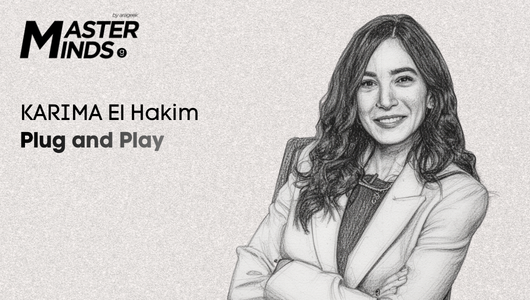
Karima El Hakim does not frame her work as venture capital in the abstract. When asked to describe herself today, she starts with identity and function rather than title: an Arab and African ecosystem builder who happens to invest. That framing matters, because throughout her career the throughline has been operating inside complex systems and learning how capital, governance and execution actually interact.
She is currently a Partner at Plug and Play Tech Center, leading growth, investments and strategy across Africa. She was part of the founding team that launched Plug and Play in Egypt and, over the past four years, has been responsible for expanding its footprint, investment activity and long term positioning across the continent, including work on an Africa focused fund. But the way she approaches that role is shaped less by Silicon Valley mythology and more by years spent inside regulated, layered organisations.
How operating inside institutions shaped her view of venture
When asked about the milestones that most shaped her thinking, El Hakim points first to her time at Fawry. Working directly in the CEO office of the founder, she helped build the company’s corporate venture capital function from scratch inside one of Egypt’s most prominent fintechs. It was an education in how scale, regulation and governance collide in real time.
That experience grounded her understanding of innovation as something that happens under constraint. Decisions were not theoretical. They were shaped by regulators, banks, legacy systems and public markets. Venture, in that context, was not about optionality but about execution and risk management.
Earlier still, her years at Orascom Development exposed her to a very different but equally formative environment. Working across a family business team and a complex corporate structure meant navigating layered reporting lines, long term capital and regulatory realities. She credits that period with building resilience and an appreciation for how decisions compound over time in large organisations.
Together, these roles formed a clear worldview. Innovation is not hype. It is the discipline of building inside systems that do not move quickly by default.
Wearing multiple hats without losing coherence
On the question of how she balances being an investor, board member, ecosystem builder and public speaker, El Hakim rejects the idea that these are separate tracks. In her view, they only make sense together.
Her corporate and fintech background allows her to support founders with realism rather than romance. Board work keeps her anchored in accountability and execution. Ecosystem building gives her a platform to align capital, corporates, institutions and talent. Public speaking, meanwhile, is not about visibility but translation, helping stakeholders who operate in silos understand each other’s constraints.
The connective tissue across these roles is judgement. Each informs the other, and each exposes weak assumptions quickly.
Why Africa and the Arab world are not abstract markets to her
When the conversation turns to advocacy, El Hakim is clear that she does not see herself as representing someone else’s ecosystem. She is advocating for her own. As an Egyptian, she sits at the intersection of Africa and the Arab world. Arabic is her mother tongue. Africa is her geographic and economic reality. The overlap is lived, not theoretical.
What excites her about these markets today is not novelty but necessity. Innovation here is driven by real problems in finance, logistics, climate, health and public services. Digital adoption is accelerating, talent is deep, and more founders are designing products with regional and global scale in mind from the outset.
This is not about catching up. It is about building solutions that are exportable precisely because they were forged in demanding environments.
What a healthy ecosystem actually requires
Asked to define a healthy startup ecosystem, El Hakim reaches for a framework she encountered during her fellowship with the MIT Center for Prosperity and Entrepreneurship. It centres on five stakeholders: entrepreneurs, risk capital, government, corporates and academia.
The issue in most emerging markets is not the absence of any one of these, but the lack of coordination between them. Capital exists without the right risk appetite. Policies exist without execution alignment. Corporates want innovation but are not internally prepared to absorb it.
Ecosystems stall when these actors operate in silos. They progress when they behave like a system.
Inclusion as an economic lever, not a slogan
Pressed on why she spends so much time on inclusion, El Hakim frames it as a growth question rather than a social one. Egypt has a population of around 120 million people, yet venture capital and success stories remain concentrated in a narrow segment, largely in Cairo.
If that limited base has already produced meaningful outcomes, she argues, expanding participation is an obvious economic lever. This logic drove her push for Plug and Play to open a satellite presence in Aswan. Over the past two years, founders from Upper Egypt have been supported, with new programmes planned for the Delta.
Inclusion, in this view, expands deal flow, market size and returns. It is not charity. It is portfolio logic.
Why she chose Plug and Play, and why it was not an easy move
When asked about how she joined Plug and Play, El Hakim traces it back to a panel she spoke on at Techne Summit in Alexandria in 2021. A director from Plug and Play Morocco was in the audience and later introduced her to the partnership.
At the time, she was still at Fawry, and leaving was a difficult decision. But the opportunity to champion an entire ecosystem globally and bring Egyptian startups into Silicon Valley investment committees aligned with her ambition. The founder and CEO of Fawry, who remains a mentor, understood that motivation.
It was not a career upgrade. It was a platform shift.
What makes the Plug and Play model different in practice
On the question of how Plug and Play differs from traditional accelerators or VCs, El Hakim emphasises scale and depth rather than branding. The platform operates across more than 60 locations globally, with strong vertical expertise and a long track record of both successes and failures.
That history enables peer learning across markets and cycles. It also allows startups to access corporate partners through structured open innovation and advisory mandates, rather than ad hoc introductions. More recently, Plug and Play has launched AI Centres of Excellence that bring together corporates, academia, startups and investors to co-create capabilities and co-invest.
For founders, the value is exposure to systems, not just capital.
How she evaluates early stage founders
When the discussion moves to investment decisions, El Hakim is blunt about the limits of early metrics. From pre-seed to Series A, she looks beyond numbers to vision, founder quality and evidence of execution under pressure.
A strong track record in difficult environments often matters more than polished dashboards. Early stage is early stage, and she is wary of false precision.
The mistakes she sees founders repeat
Asked about common errors founders make when approaching investors, El Hakim points to an overemphasis on valuation and storytelling before product market fit. Others lack clarity about their ask or fail to understand investor incentives.
Generic outreach, weak command of unit economics and vague go-to-market assumptions are frequent issues. In Africa and the Arab world specifically, she also sees founders delaying global thinking even when their solutions clearly travel.
Preparation and realism, she notes, are underrated advantages.
Fintech, policy and the need for better rails
On fintech’s future across Africa and the Arab region, El Hakim returns to infrastructure. Cross-border payments, trade facilitation and remittances remain fragmented. Fixing these rails would unlock disproportionate value.
In her role as Co-Chair for Africa at the MENA Fintech Association, she sees momentum around regulatory sandboxes and frameworks that allow controlled cross-border operation. AI-driven scoring and improved risk models are also critical as debt markets tighten and trust with banks becomes central.
AI as an equaliser, with limits
When asked about AI’s impact, El Hakim describes it as a major equaliser. Founders in Upper Egypt can now build, test and deploy faster than ever, allowing small teams to compete through efficiency rather than scale.
In lending and insurance, AI-enabled scoring reduces information gaps and strengthens bank partnerships. Generative tools are also narrowing linguistic and presentation barriers, enabling more founders to become visible and articulate.
At the same time, she is clear-eyed about the limits. Advanced applied AI remains expensive. Compute, data access and deployment talent are uneven. Inclusion is improving, but it is not solved.
Where the next wave of growth will come from
When the conversation turns to sectors, El Hakim highlights fintech infrastructure, climate and water tech, smart cities, cybersecurity and applied AI. The common thread is not novelty but application.
The winners will be companies that move quickly from demo to deployment. Execution and adoption will continue to separate signal from noise.
Governance as early infrastructure
Pressed on governance, El Hakim broadens the definition beyond boards and policies. For technology-driven companies, governance also means how data and systems are built and protected.
Cybersecurity and data protection, she argues, need to be addressed early, especially for companies entering regulated environments. Building a digital product is building infrastructure, and insecure infrastructure does not scale.
Her own board roles span traditional businesses and non-banking fintechs working toward licences. That exposure reinforces how early alignment between governance, technology and growth reduces friction later.
Advice to founders building from the region
Asked to close with advice, El Hakim keeps it simple. Build to global standards from day one. Invest early in governance, data and credibility. Do not apologise for where you are building from.
If you can build here, she believes, you can build anywhere.