 Ai Everything
 LEAP26
 AI
AI Saudi Arabia
 UAE
UAE Egypt
EgyptI am Naif Al-Khalifah. I backed AI in governance, and it changed everything

10 min
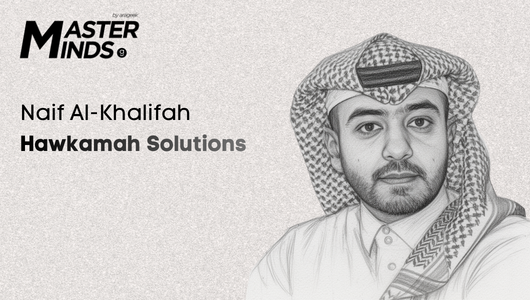
Naif Al-Khalifah does not talk about governance as a back-office function. He talks about it as infrastructure, the kind that determines whether institutions can scale with trust or simply grow more fragile. That framing runs through his account of building Hawkamah Solutions, a Saudi firm that has tried to close a stubborn gap: the distance between formal governance frameworks and the speed of digital change.
For Al-Khalifah, the point was never just to build another advisory business. The more consequential ambition was to make governance usable, measurable and relevant to organisations operating under the wider pressure and opportunity of Saudi Vision 2030. He sees the firm’s strongest achievement in those terms, not simply in revenue or market standing, but in helping local organisations build stronger habits of transparency and accountability. In his telling, the real milestone is that Hawkamah’s methods have begun to serve as a benchmark for national entities. Profit matters, but professional legacy and national impact matter more.
Why governance had to become operational
When asked about Hawkamah’s position in the market, Al-Khalifah is clear on what separated it from firms that remained easier to admire than to use.
Too much of the governance industry, he suggests, still sells theory. The pitch may sound sophisticated, but if it leaves clients with more paperwork rather than better decisions, it has missed the point. Hawkamah’s edge came from combining technical consultancy with working technology, especially through its AI-led systems such as Edama Tech. The distinction matters. He is not claiming that software replaces judgement. He is arguing that governance becomes credible when it is embedded in daily operations rather than left sitting in policy binders.
That approach also depended on a dual fluency many competitors lacked. Hawkamah was rooted in the Saudi market, with a close understanding of local regulation, institutional expectations and business culture. At the same time, it worked against global standards. For Al-Khalifah, that combination of local specificity and international discipline proved more useful than either one on its own. Traditional firms, he argues, were often too burdened by legacy models to adapt quickly. Hawkamah moved faster because it treated AI not as a branding layer, but as an operating decision.
What he learned when a good product failed to land
Pressed on what had gone wrong, Al-Khalifah does not reach for a dramatic failure story. Instead, he points to a more instructive one: a major client was slow to adopt a new digital governance tool, even though the product itself was technically strong.
The cost was immediate. The team had to spend far more time than expected on manual support, and the company’s plans to scale that quarter stalled. But the lesson was sharper than a delayed rollout. “Technology alone does not build trust,” he says, in effect. User empowerment does.
He realised the business had underweighted change management. Governance tools, especially in audit and risk environments, can easily be experienced as surveillance or disruption if people are not brought into the logic of the system. So he changed the delivery model. Hawkamah added intensive stakeholder workshops and developed a more intuitive AI-assisted interface, including the Adam assistant, to make users feel supported rather than displaced.
That shift now sits at the centre of his thinking. What began as a setback became a stronger commercial argument: user-centric governance is not a softer add-on to technical excellence. It is part of the product.
How he keeps a compliance business from becoming a compliance culture
When the conversation turns to leadership, Al-Khalifah’s instinct is to challenge the vocabulary of the sector itself.
He leads, he says, by reframing compliance as empowerment. That is not just a motivational slogan for staff. It is a deliberate attempt to stop governance work collapsing into checklist behaviour. In his view, teams in audit and internal control lose energy when they are taught to think of themselves as enforcers of process. They gain it back when they understand themselves as protecting organisational integrity and enabling long-term stability.
This is also how he links day-to-day work to a wider mission. He wants his team to see governance not as a technical service but as part of the machinery that helps the Saudi economy mature. AI plays a role here too. By building tools such as Edama Tech, he argues, the company is not simply modernising its own operations. It is helping redefine a field that has often been slow, manual and reactive.
The larger point is that mission, in his model, comes from connecting detail to consequence. If an auditor only sees forms, the job narrows. If they see trust, resilience and economic value, the work changes shape.
What he hires for when polished answers are easy
Asked to reflect on hiring, Al-Khalifah starts where many founders finish: technical competence is the baseline, not the differentiator.
What he looks for is “intellectual curiosity and ethical courage”. In a governance business, that means more than knowing standards or passing certification. It means being willing to challenge assumptions and understand risk in context, not as an abstract category. His biggest red flag is the candidate who can explain process in immaculate detail but cannot explain purpose. If someone is fixated on the how and blind to the why, he sees that as a serious weakness.
His way of testing judgement is practical. Rather than rewarding polished interview performances, he puts candidates into high-pressure scenarios where no answer is clean. He asks them to weigh business growth against governance risk and studies how they reason through the trade-off. The ideal response is neither rigid nor permissive. He wants people who can support commercial progress while holding a clear line on integrity.
That standard says a lot about how he views the discipline itself. Governance, in his account, is not the art of saying no. It is the work of making better decisions under pressure.
Why the real career bet was on digital governance
On the question of the best decision he has made, Al-Khalifah does not hesitate. It was the move into digital governance and AI integration.
The easier path, he says, would have been to remain a traditional consultancy. There was already a market for that, and it carried fewer technical and capital demands. But he believed internal audit was moving towards automation and intelligent data, and he committed accordingly. That meant investing heavily in Edama Tech and the Adam AI assistant before the shift felt obvious.
He describes it as a leap of faith, but not a blind one. The logic was that governance firms built around billable hours would eventually hit a ceiling. Intelligent systems, by contrast, could scale beyond human limitations and generate a different kind of value. The company’s proposition changed from selling manpower to providing decision-support tools with embedded expertise.
That choice, he argues, became foundational to Hawkamah’s growth and investment success. It also positioned the company well in a market increasingly serious about AI. More importantly, it forced a change in identity. Once governance becomes a technology-enabled service rather than a purely advisory one, the organisation has to think differently about product, adoption, delivery and trust.
The founder mistake that slowed everything down
When asked about the worst decision of his career, Al-Khalifah is unusually direct. He tried to micro-manage too much, across too many ventures.
At the time, he believed close involvement guaranteed quality. In practice, it created a bottleneck. Decisions slowed. Innovation slowed with them. The problem was not effort but concentration of control. By trying to sit inside every important detail, he made it harder for the businesses to move at the speed they needed.
He now sees that period as the point where he had to shift from doer to leader. If he were making the choice again, he says, he would empower leadership teams much earlier. That is more than a generic lesson about delegation. Coming from someone who builds governance structures for other organisations, it carries a sharper implication: founders also need governance. Their own overreach can become an operational risk.
The change in his operating style followed from that recognition. Today he focuses on strategy and on building structures inside his companies that allow them to function effectively without his constant intervention. For a founder in multiple ventures, that is not detachment. It is discipline.
How he handles conflict when trust is at stake
When the conversation moves to his audit committee role, Al-Khalifah offers a view that is both calm and revealing: conflict is often evidence that the system is working.
He does not treat disagreement as a breakdown in trust, but as a sign that different risks are being surfaced properly. His method is to anchor difficult conversations in data and shared goals rather than personality. Tough feedback, in his account, has to be direct, but also clearly tied to the organisation’s safety and long-term sustainability.
He describes the approach as radical transparency with respect. The common enemy is risk, not the colleague on the other side of the table. That framing matters because it preserves professional trust without diluting the seriousness of the issue. People can absorb difficult truths more easily when they are not being cast as the problem themselves.
It is a governance answer, but also a leadership one. He is trying to remove ego from hard conversations without removing accountability.
What newcomers misunderstand about governance
Asked what people should focus on if they want to enter the field, Al-Khalifah pushes against a common misconception.
Most newcomers, he says, treat governance as a static collection of rules, policies and qualifications. They approach it like a library. But the real work is more human and more strategic than that. Governance is about influence, culture and decision-making. Technical standards matter, and he advises mastering them, especially frameworks such as the IIA standards. But that is only the starting point.
The bigger move is to understand how business value is created. If a governance professional cannot explain how a framework helps a company grow, save money or avoid material risk, they will remain peripheral. His advice is blunt: do not just be an auditor. Be a strategic partner who understands the business as well as the chief executive does.
That view is consistent with everything else he says. In his world, governance earns its seat at the table by improving judgement, not by reciting rules.
The habits that keep him effective across multiple ventures
Asked to reflect on how he stays effective week to week, Al-Khalifah reduces it to three principles: prioritisation, digital integration and continuous learning.
The first is straightforward but strict. He runs his week with a governance-first logic, handling the most critical risk-related work when his attention is strongest. The second is operational. He uses the same tools his companies build, relying on AI and automation to maintain visibility across Hawkamah, ESIT and Aeqan without drowning in manual reporting. That is not just efficiency. It is a form of managerial design, using systems to preserve oversight without reverting to the micro-management he now rejects.
The third principle is writing. Each week, he makes time to write, whether for a newspaper article or a book chapter. The habit matters because it forces clarity. Writing, for him, is not separate from leadership. It is how he sharpens his thinking, tests his assumptions and stays ahead of changes in the field.

Taken together, the routine makes sense of the wider pattern in his career. Al-Khalifah’s work sits at the junction of governance, technology and institutional change. His argument is that none of those areas can be led well through control alone. They require structure, adaptation and the willingness to rethink what trust looks like when systems become digital.
That is the thread running through Hawkamah’s story as he tells it. Governance is not there to slow ambition down. It is there to make ambition durable.