 Ai Everything
 LEAP26
 AI
AI Saudi Arabia
 UAE
UAE Egypt
EgyptI am Tareq Khaleel. I stopped building technology and started owning its conditions.

7 min
Owning the Conditions of Technology, Not Just Its Outcomes
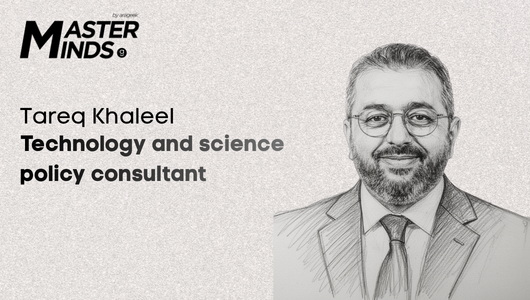
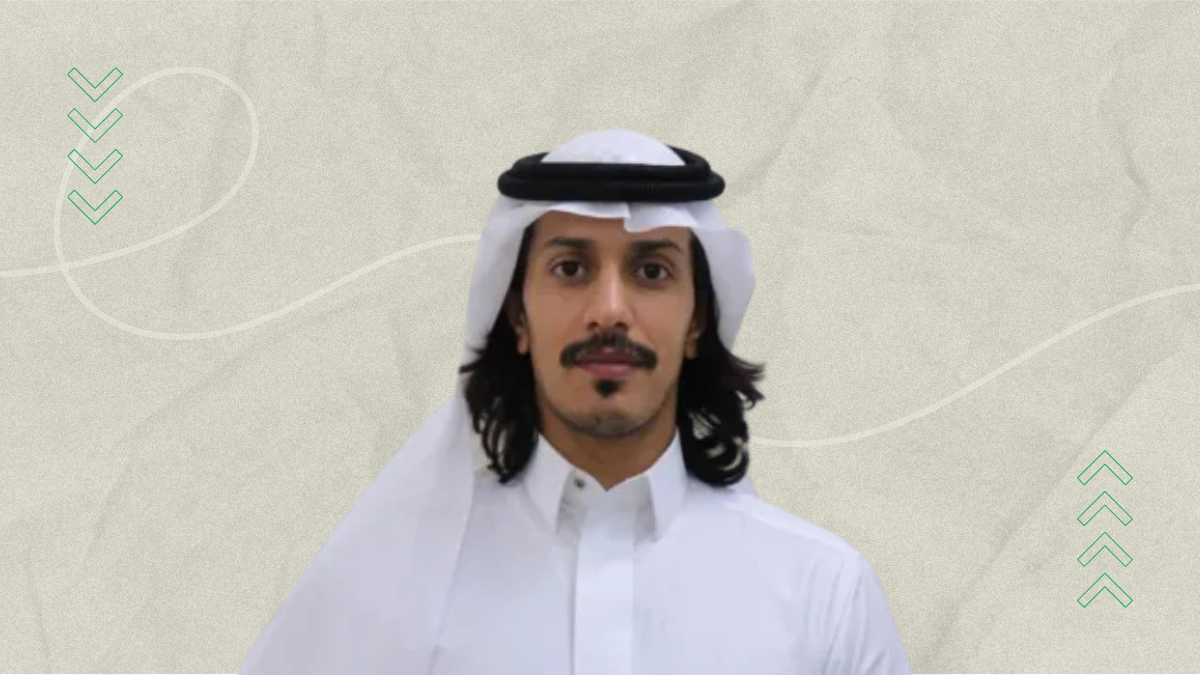
Tareq Khaleel has spent enough time inside advanced laboratories to know that technical excellence alone rarely decides what succeeds in the world. Photonics, quantum imaging, artificial intelligence, even language itself, are not just scientific domains to him. They are sites of power, negotiation, and long-term consequence. When the conversation ranges from light particles to legal clauses, it does so with a single throughline: technology fails or succeeds less because of physics than because of who controls its conditions.
Explaining light without equations
When asked to simplify photonics and quantum imaging for a non-specialist, Khaleel does not reach for metaphors about magic or futurism. He starts with a comparison engineers recognise immediately. Electronics processes information through electrons moving in metal wires, treating the electron primarily as a particle with mass. Photonics replaces the electron with the photon, a particle of light travelling through waveguides. Light propagates as a wave and is processed as a particle only at detection.
That distinction, he explains, is not cosmetic. It produces concrete advantages: extraordinary speed, no mass, and no thermal dissipation. In quantum imaging, those properties are pushed further by using quantum mechanics to extract information that conventional imaging cannot, particularly in sensing and medical contexts. Precision, not spectacle, is the point.
Why the lab was not enough
Pressed on his shift from technical research to policy and governance, Khaleel is blunt about disillusionment. Years of experience convinced him that innovation does not end at publication or prototype. Many technologies fail not because they are weak, but because the surrounding mechanisms do not exist or are hostile to them.
Reviewing technical contracts for Arab governments sharpened this realisation. He saw repeated patterns of unfair attribution and distorted ownership. The gap between theoretical excellence and real-world application felt structural. Studying law became a practical response, not a career detour. Technology, he concluded, is often strangled by funding models, supply chains, standards, contracts, and intellectual property frameworks long before it reaches users.
The question that began to dominate his thinking shifted accordingly. Not how technology is built, but who sets the conditions of its entry, and who bears its political and economic consequences.
Against intellectual silos
When the discussion turns to interdisciplinarity, Khaleel speaks with something close to irritation at the way education enforces separations between science, language, and art. He does not argue for intellectual chaos, but for depth in more than one field. Nature itself, he notes, does not distinguish between chemistry and physics. Those categories exist to organise human understanding, not to constrain it.
Language occupies a special place in his thinking. He describes it as the greatest divine gift, citing the Qur’anic reference to البيان as a mark of greatness. A lifelong reader, much of his knowledge comes from self-directed study. For him, language is not decoration for ideas. It is the medium through which ideas become possible.
Why photonics matters now
Asked why photonics has become central to the future of computing and artificial intelligence, Khaleel points to a quiet but decisive shift. Moore’s Law, which once guaranteed regular miniaturisation of electronic circuits, has effectively stalled. That slowdown undermines the economic and technical model that sustained the electronics industry for decades.
Photons now sit at the centre of the next transition. They offer new properties at a moment when electronic scaling is reaching its physical limits. Beyond raw performance, photonics promises energy efficiency and a way to extend architectures that would otherwise be exhausted.
Optical speed versus electronic control
On the distinction between optical and electronic processing, Khaleel is careful not to frame it as replacement. Electronics remains dominant in logic and general control. But at high speeds, it runs into familiar problems: heat, interference, and limits on interconnection.
Optical processing excels precisely where those problems accumulate. Multiple channels can travel through the same fibre or waveguide using wavelength division multiplexing. The result is speed and parallelism, making optics increasingly important in communications, data centres, and specialised computational acceleration, particularly for matrix-style operations.
The military phase of quantum imaging
When asked about everyday applications of quantum imaging, Khaleel resists optimistic timelines. By current technology adoption standards, he sees it firmly in the early adopters phase. Governments and militaries dominate usage because they recognise its strategic value in surveillance and tracking.
Medicine may follow, but later. The market is larger and slower to absorb risk. For now, quantum imaging remains a technology of state advantage rather than consumer benefit.
Money as the real constraint
On the question of limits, Khaleel rejects the idea that physics is the primary bottleneck in contemporary technology. The real constraint, he argues, is money. Modern science aims not only to describe and explain, but to predict and control. Technology is the apex of that control.
Today, control over science often lies with capital rather than scientists. Investors shape research towards profitable forms, not necessarily humane ones. This condition, sometimes described as science alienation, determines what is built far more than what is possible.
Language as an architectural choice
When the conversation turns to language and computing, Khaleel’s claims become deliberately provocative. Arabic, he argues, is a deeply generative language, rich in derivation in ways that English is not. English, which underpins most computational logic, is largely analytical and has shed many intrinsic inflectional features.
He believes that building computational logic on sound Arabic could bypass constraints imposed by English-based models. An Arabic mode of thinking, even Arabic processors, might unlock capabilities that appear unreachable today. The limitation, he insists, is not the language itself, but the intellectual frameworks applied to it.
Beyond a single world model
Asked whether artificial intelligence can reflect diverse linguistic and cultural perspectives, Khaleel treats this as inevitable rather than aspirational. AI is not simply about language models, but about world models. A system trained on a single culture reproduces its biases by default.
Future intelligence systems, in his view, must switch lenses. Linguistic, legal, social. Intelligence that cannot do this will remain provincial, no matter how powerful it appears.
Irreversibility and industrial traps
On irreversibility, Khaleel defines it as the point at which industrial decisions become prohibitively expensive to undo. Kodak is his preferred example. Despite inventing the digital camera internally, the company failed to abandon its chemical photography model. Once the idea escaped, it destroyed the very business that had suppressed it.
States face similar traps. Digital identity systems tied to single vendors, or communication networks built on standards they do not control, lock countries into paths dictated by others. Escaping requires political will, money, and strategy. Fate has little to do with it.
Contracts as instruments of power
When asked how contracts and intellectual property evolve from regulation into domination, Khaleel does not soften the language. Contracts are constraints by design. Intellectual property can prohibit use, modification, or learning, especially when paired with closed standards and supply conditions.
Over time, this produces submission rather than partnership. Law becomes a form of engineering, shaping dependency across decades.
The developing world’s disadvantage
On whether developing countries enter the technology race constrained from the start, Khaleel answers without hesitation. Deals are often judged by purchase price, not by the cost of dependency over ten years. The failure is not in contracting itself, but in weak negotiation: insufficient knowledge transfer, lack of modification rights, poor data protection, and enforced vendor lock-in.
Buying surfaces, not systems
When asked about common investment mistakes, particularly by governments and sovereign funds, Khaleel points to a fixation on interfaces. Buildings, platforms, and acquisitions are easy to announce. Skills, supply chains, testing infrastructure, standards, and operating models are harder to build.
Advanced technology, he insists, is not a deal. It is a system of learning and sustained operation, too often undermined by overreliance on foreign experts who structurally disadvantage local partners.
Owning the conditions


Asked for a single piece of advice to Arab decision-makers on AI and deep technology, Khaleel condenses his position into one line. Do not buy artificial intelligence, own its conditions.
He defines those conditions precisely: sovereignty over data before algorithms, open standards to avoid lock-in, and contracts designed as tools of empowerment. The right to localise, to audit, to learn, and ultimately, to exit.