 GITEX Dubai
 Ai Everything
 LEAP26
 AI
AI Saudi Arabia
 UAE
UAE Egypt
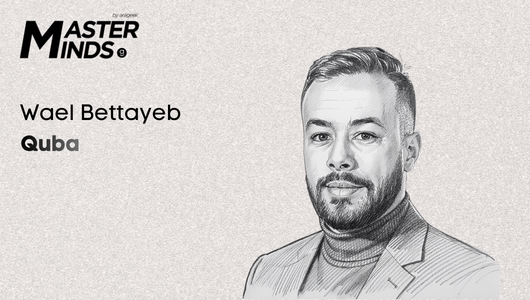
EgyptI am Wael Bettayeb. I built privacy to unlock AI adoption!

12 min
Wael Bettayeb has spent much of his career deliberately walking into industries he did not yet understand.
Startups, open source, consulting, high-frequency trading, aerospace, e-commerce and now AI privacy might look like an unusually scattered path. Bettayeb sees almost the opposite. Each move has been another test of how quickly he can become useful in an unfamiliar system, and of how much of what people call a limit is simply a boundary they have learned to accept.
That habit of starting again has shaped more than his career. It runs through how he thinks about products, engineering and the current AI boom. Build only what matters. Design reliability into the system rather than checking for it afterwards. Do not mistake faster development for better judgement. And as AI makes execution cheaper, place a higher premium on the human ability to connect ideas across disciplines.
Those principles now sit behind Quba, where Bettayeb is working on a problem he believes enterprises can no longer avoid: how to embrace AI without losing control of the sensitive data moving through it.
What changing industries taught him about limits
Asked what keeps drawing him into such different environments, Bettayeb comes back to a deceptively simple conclusion: “Most limits are self-imposed.”
The industries changed, but the test remained similar. He would enter a field without the comfort of deep prior familiarity, learn its constraints and eventually reach a level where he could perform within them.
“The only real ceiling is the one you accept,” he says.
There is an important distinction in that answer. Bettayeb is not arguing that expertise comes instantly, or that domain knowledge does not matter. His career suggests the opposite. Moving between demanding fields requires accepting a period in which you are not yet fluent, then doing the work required to become so.
What he appears unwilling to accept is the assumption that previous experience should permanently define the problems someone is capable of solving.
That willingness to restart becomes important later in his argument about AI, because for Bettayeb, repeatedly becoming a beginner is part of how broader judgement is built.
How he decides what is worth building
Asked to reflect on his early founder experiences, including Fenome and Soug, Bettayeb focuses less on individual mistakes than on a recurring product trap.
At the beginning, building is difficult. Progress feels uncertain and every working piece matters. Then the product starts taking shape. Development accelerates, the team becomes more capable, and shipping itself begins to feel like progress.
That, in Bettayeb’s view, is exactly when discipline becomes more important.
“A product should be crafted around what users actually need,” he says. The danger is that teams become comfortable producing features and gradually lose sight of the more uncomfortable question: does this solve a problem somebody genuinely values enough to pay for?
AI has made that tension sharper. Agents and coding tools can dramatically increase how quickly teams turn ideas into software, but Bettayeb does not equate faster output with better product decisions. Greater development capacity can simply allow a team to travel further in the wrong direction before reality catches up.
By the time early customers reveal that they do not need most of what has been built, correcting course can be harder than starting again. Existing assumptions, architecture and product decisions become constraints of their own.
Bettayeb does not pretend there is a clean formula for knowing exactly when a product is ready to launch. His working rule is narrower and more demanding: “Invest only in what you are certain about, otherwise just don’t.”
It is less a philosophy of caution than one of focus. Speed matters, but only after the team has earned enough conviction about where it is going.
Why generalism matters more when AI can build faster
When the conversation turns to his belief that the future belongs to small teams of “obsessed generalists”, Bettayeb starts by defining the opposite.
A specialist develops deep knowledge in one field. With enough experience, that person learns to solve variations of the same class of problem across changing situations and constraints.
A generalist, in Bettayeb’s definition, begins in much the same way. The difference comes afterwards. They develop real depth, then deliberately enter another discipline and accept being inexperienced again.
Then they repeat the process.
It is slower and less comfortable than remaining inside a single area of expertise. But over time, Bettayeb argues, something changes. Patterns that were once confined to individual domains begin to resemble one another. Knowledge becomes transferable.
That cross-domain pattern recognition is where he sees much of the generalist’s value.
A problem that looks familiar to a specialist can look fundamentally different to somebody who has encountered related structures in engineering, business, design or another discipline. The advantage is not knowing a little about everything. It is having gone deep enough in several places to understand which ideas can travel between them.
AI makes that more consequential.
Bettayeb sees current AI systems as exceptionally fast and inexpensive problem solvers that can reproduce and combine patterns drawn from vast bodies of specialist knowledge. What he believes they still struggle to do reliably is form genuinely original connections across fields.
The result, in his view, is visible in the convergence of AI-generated work. Different people using similar systems frequently arrive at outputs with familiar structures, language and ideas. It is the phenomenon often dismissed as “AI slop”.
For Bettayeb, that changes what becomes scarce. If producing an implementation is becoming cheaper, judgement, taste and the ability to recognise an unusual connection become more valuable.
AI can accelerate execution. The harder question is still deciding what deserves to exist.
What high-stakes systems taught him about quality
Pressed on how high-frequency trading and aerospace changed his engineering instincts, Bettayeb distils both experiences into one rule: “Reliability is designed, not inspected.”
The consequences of mistakes in those environments sharpened different parts of the same discipline.
Trading made him “obsessive about performance and correctness”, where seemingly small technical decisions can carry disproportionate consequences. Manufacturing reinforced the importance of putting quality into the process from the beginning rather than treating it as a final checkpoint.
That distinction has stayed with him.
Testing can expose failures, but Bettayeb’s approach is to reduce the conditions in which those failures can emerge in the first place. Reliability becomes an architectural concern and a process concern, not simply a quality assurance task performed once a system appears complete.
He says he now carries that mindset into every system he builds.
It also provides a useful bridge into the problem Quba is trying to solve. As AI moves deeper into organisations, questions about data protection become difficult to address if privacy is treated as something that can be inspected into a system after deployment.
Where enterprise AI adoption loses control
Asked what working on AI at Salla revealed about enterprise adoption, Bettayeb points to a widening gap between ambition and control.
Companies are under pressure to move quickly. Executives want the productivity and intelligence AI promises. Investors expect companies to have an AI strategy. Employees, meanwhile, do not necessarily wait for formal programmes. They begin using the tools available to them.
The problem is that sensitive information can then move across applications, models, accounts and vendors faster than security teams can follow it.
“Everyone wants AI’s value, but data flows across tools, models and vendors faster than security can follow,” Bettayeb says.
That is where his thinking about Shadow AI departs from a straightforward restriction-first approach.
Banning AI appears to solve the governance problem by removing the technology. Bettayeb argues that in practice it can simply turn one visible problem into an invisible one.
If employees obey the ban, an organisation gives up the speed and capability that made the tools attractive in the first place. If employees continue using them through personal accounts or unsanctioned applications, the organisation loses visibility into where information is going.
“Banning AI forces a bad choice,” he says.
His preferred model is what he calls a “controlled yes”. Employees and systems can use AI, but sensitive information is protected through a privacy layer before it moves beyond the organisation’s trusted environment.
The objective is not merely to preserve security. It is to preserve speed, utility and visibility at the same time.
How Quba puts privacy into the path of data
Asked how that idea translates into Quba itself, Bettayeb describes a model in which protection happens before sensitive information reaches an external AI system.
An enterprise first defines what counts as sensitive within its own context and how different categories of information should be handled. Those decisions become a common policy rather than a collection of rules recreated independently for each AI tool.
The same policy can then follow data across different routes.
For employees using AI through a browser, protection can be applied through Quba Teams. For autonomous systems and agents, Quba Agents carries those controls into machine-driven workflows. Quba API provides the same underlying model for applications and other systems.
The significant point is where the intervention happens. Sensitive information is protected before it leaves the trusted environment, rather than relying on every external model or vendor to handle the original information according to the organisation’s expectations.
That architecture reflects Bettayeb’s earlier lesson from high-stakes engineering. Privacy, like reliability, becomes part of the system’s design rather than something inspected after data has already moved.
Why AI agents change the privacy problem
On the question of what happens as AI agents gain more autonomy, Bettayeb argues that the nature of enterprise data itself begins to change.
Historically, much of the privacy conversation has centred on information people can access, read or share. Agents introduce another dimension. They do not simply consume information. Increasingly, they can use it to make decisions and take actions across other systems.
“As agents gain autonomy, enterprise data shifts from something people read to something machines act on,” Bettayeb says.
That makes the moment of action more important.
In his view, organisations will need tightly scoped access, anonymisation before information leaves protected environments, and clear audit trails showing what systems accessed and acted on.
It also changes the relationship between privacy and AI adoption.
Privacy is often framed as a constraint, a layer of governance that slows deployment or limits what a system can do. Bettayeb sees the relationship moving in the opposite direction. Companies will only be willing to grant more capable AI systems meaningful access to their operations if they can control the data those systems encounter.
“Intelligence will move to the data,” he says, “and privacy will become what unlocks AI adoption rather than what slows it.”
In that framing, stronger controls do not reduce what an enterprise can do with AI. They create the conditions under which it can safely do more.
What Ai Everything Abu Dhabi means for Quba
Asked what Ai Everything Abu Dhabi represents for Quba at this stage, Bettayeb sees it as more than a chance to demonstrate the product. It puts the company in the middle of the conversations that will determine how AI is actually adopted inside large organisations.
The challenge, as he sees it, is no longer convincing companies that AI matters. Most already understand the opportunity. The harder questions are about implementation: which systems should have access to sensitive information, how that information moves between models and applications, and how organisations can maintain control as AI becomes embedded in everyday work.
That is the conversation Quba wants to bring to Ai Everything.
For Bettayeb, the event creates an opportunity to speak directly with the people approaching the same problem from different sides. Enterprises are trying to adopt AI without creating new security gaps. AI companies are building increasingly capable products that depend on access to organisational data. Governments and regulators are thinking about sovereignty, accountability and responsible deployment.
Quba sits between those interests.
“You don’t have to trade AI adoption for data sovereignty,” Bettayeb says.
That principle is particularly important as companies move beyond isolated AI tools towards agents and applications that can interact with internal systems more autonomously. The more access those systems receive, the less practical it becomes to rely on employees manually deciding what information is safe to share. Bettayeb believes privacy controls will increasingly need to operate automatically and consistently across the organisation.
Ai Everything also gives Quba an opportunity to make a broader point about where this infrastructure can be built. Bettayeb wants to show that a company addressing a global problem around AI privacy and enterprise data can emerge from Abu Dhabi, with an understanding of the region’s priorities around control, sovereignty and adoption.
For Quba, the most valuable outcome is therefore not simply visibility. It is the opportunity to build relationships with the enterprises adopting AI, the companies developing it and the institutions shaping the rules around it.


When the conversation turns to the partnerships he hopes the event will unlock, Bettayeb keeps the invitation deliberately open: “Whether you adopt, build or govern AI, we’d love to meet.”
The common ground is control. Quba’s argument at Ai Everything is that organisations should not have to choose between taking advantage of increasingly capable AI systems and protecting the information that makes those systems useful in the first place.