 Ai Everything
 LEAP26
 AI
AI Saudi Arabia
 UAE
UAE Egypt
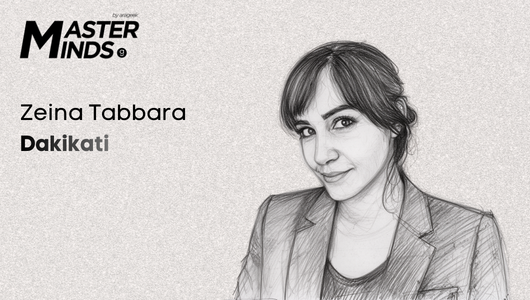
EgyptI am Zeina Tabbara. I chose taste over scale, and built Dakikati differently

4 min
The bet behind Dakikati, and the work she refused to take
When asked about what Dakikati actually exists to solve, Zeina Tabbara is clear that it is not another content shop chasing volume. She describes Dakikati as a brand, content strategy and trends company built around one organising belief: in a world where everyone publishes, sounding like yourself is the hardest thing to do well. The shift from big, episodic campaigns to constant, distributed content means every brand and individual now needs a point of view, not just output. That is the gap Dakikati stepped into. Just as important is what she chose not to do. From day one, she avoided generic agency work and production-for-hire. No content farms, no empty execution. The focus stayed on thinking, positioning and voice, a decision that now extends into building Dakikati Media with original formats and podcasts in development.
What told her this was working
Pressed on the first real signal of traction, Tabbara points to curiosity rather than revenue. People kept asking how she curates information across tech, media, culture, beauty and fashion. They wanted to understand how dots were being connected. That pattern revealed something important: clients were not only buying services, they were buying perspective and taste. The response was strategic, not cosmetic. Dakikati doubled down on curation and commentary as a product in its own right, not just a layer on top of client work.
The trade-off that shows up every week
On the question of what feels hardest right now, the answer is not ideological but operational. Founders have to do everything at once, from legal and finance to hiring and delivery, while still protecting quality. For Tabbara, the real tension is quality versus speed. Shipping fast matters, but so does taste. She felt this most acutely while balancing consulting work with the less visible task of building operations and creative pipelines underneath it. Both are essential, and neither can be rushed without consequence.
Building repeatable audio without killing intimacy
When the conversation turns to her time at Asharq News, Tabbara does not pretend there is a formula for audio. In fact, she argues the opposite. Audio remains intimate precisely because it resists over-engineering. In the MENA region, podcasts are still early, which creates room to experiment. The discipline comes from building systems for repeatability, preparation, scripting, quality control and publishing, while protecting voice and emotion. Scale without soul, she says plainly, kills the format.
The decision that mattered at Amazon
Asked to reflect on her work on Arabic Alexa, Tabbara describes a rare setup where a global company operated like a startup. The most consequential decision was prioritising dialect and cultural nuance over shipping features quickly. Voice technology lives or dies by how people actually speak at home. Accents, humour and context mattered more than technical completeness. Focusing on linguistic authenticity proved to be the right call.
Why curiosity keeps paying off
On the subject of success, Tabbara does not point to a single milestone. She frames curiosity itself as the advantage. Multiple career shifts were driven by it, and the payoff is compound interest. Curiosity makes you early to trends and sharpens pattern recognition across industries. The unglamorous side is relentless upkeep. Reading, watching, researching and maintaining routines is work. There is no shortcut and no luck involved.
The failure that repeats if unchecked
Asked about failure, she avoids drama and names a quieter cost: overthinking. Early on, and especially when starting out on her own, planning too much meant losing time and momentum. The lesson she still applies weekly is simple and uncomfortable. Start. Write it, launch it, test it. Momentum beats perfection every time.
Seeing shifts before they are obvious
When pressed on the best decision of her career, Tabbara returns again to curiosity. She moved early into video and podcasts when both were niche in the region, and now sees a similar shift toward essay-style editorial content and direct communication. What others missed is audience fatigue with polished ads. People want thoughtful, personal and transparent voices, especially from brands that claim to stand for something.

Who she works with, and how she handles friction
On hiring and partnerships, Tabbara is blunt about non-negotiables. She needs clarity, alignment and ownership. Waiting to be told what to do is a deal-breaker. Red flags show up as vague expectations and blurry lines. Her approach to conflict is preventative rather than reactive. Define roles, deliverables, timelines and boundaries early. Most problems, she believes, are born because things were never said out loud.