 GITEX Dubai
 Ai Everything
 LEAP26
 AI
 Saudi Arabia
 UAE
 Egypt
AI Everything Kicks Off Today in Abu Dhabi with Leading AI Pioneers in Attendance

7 min
Abu Dhabi wants AI beyond “glossy demos” and into real deployment across key sectors.
AI Everything Abu Dhabi will gather 400 organisations, 150 startups and 200 investors.
The focus is scaling AI safely, efficiently and with real value in services.
Healthcare, government platforms like TAMM, and “agentic AI” are major talking points.
Success will mean turning talks into deals, contracts and systems used every day.
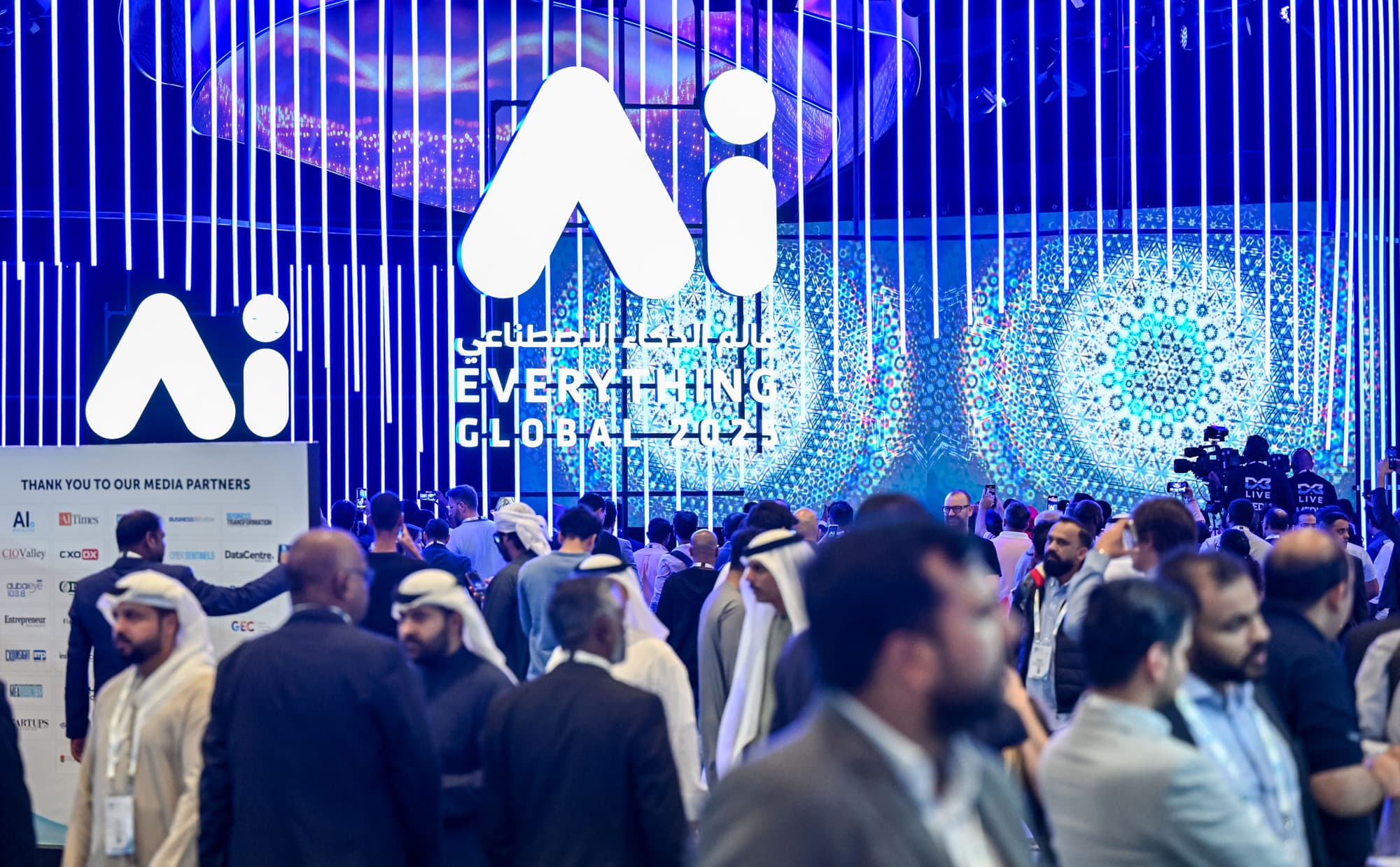
Abu Dhabi is trying to push the AI conversation past the glossy demos and into something far more practical: real deployment. That is the big idea behind AI Everything Abu Dhabi, set for 6 and 7 October 2026 at ADNEC, where more than 400 companies and organisations from 60 countries are expected to gather, alongside over 150 startups and 200 investors.
The mood around AI has shifted, and quite fast too. Not long ago, most of the buzz was about what the technology could do in theory. Now the harder question is how to run it at scale, safely, efficiently and in a way that actually delivers value in government, healthcare, finance, transport, energy and industry. In other words, the race is no longer just about clever models. It is about who can make them work in the real world, and keep them running without it becoming a bit of a faff.
That shift sits at the centre of Abu Dhabi’s pitch. The emirate is not treating AI as some separate tech niche, but more like a core layer for the future economy and public services. For readers at Arageek, that feels like an important detail, because in the startup world across MENA, we keep hearing the same thing: pilots are easy to celebrate, but scaling is where the real bruises come. I have seen founders get chuffed to bits over a proof of concept, only to hit a wall when it comes to regulation, data access or infrastructure.
The event is organised by in5, with the Department of Government Enablement as host partner and Solutions+, a Mubadala company, as global partner. The broader ecosystem includes Abu Dhabi players such as the Advanced Technology Research Council, First Abu Dhabi Bank and Hub71, as well as international names including AWS, Alibaba Cloud, Mistral AI and ASUS. That mix matters. It suggests this is not only a showcase for software, but a meeting point for capital, policy, infrastructure and enterprise demand.
Healthcare looks set to be one of the headline sectors. The summit will spotlight applications ranging from AI-designed drugs and Arabic-first clinical systems to digital health tools tied to the wider digitisation of care. Abu Dhabi already has some foundations here. Published figures indicate that an AI-powered patient safety system now links all hospitals in the emirate and serves more than 60,000 users. Add its work in genomics and precision medicine, and you can see why healthcare keeps coming up as one of the strongest use cases. It is not just hype, well... I mean, there is actual system-level groundwork.
There is also a research angle. One conference session will look at autonomous AI in science, focusing on how systems are moving beyond helping researchers analyse data and towards taking a more active role in experimentation itself. On paper, that sounds ambitious. On the flip side, it also raises awkward but necessary questions about oversight, trust and where human judgement should still sit.
The line-up of speakers reflects the event’s global ambitions. Among the names expected are Arthur Mensch, co-founder and chief executive of Mistral AI, and Marc Raibert, founder of Boston Dynamics, joined by government officials and leaders from the technology and investment worlds. Big names alone do not guarantee impact, of course. I reckon the more interesting test is what happens after the stage lights are off.
That is really the heart of this story. Abu Dhabi appears to be asking a simple but weighty question: how many of these tools can move from presentations into public services, factories, hospitals and company workflows? The focus of the AI 360 Conference under the wider event is expected to centre on exactly that jump, from early experiments to large-scale use across sectors from retail and manufacturing to government and energy.
A good example often cited in Abu Dhabi’s own AI push is TAMM, described as an AI-powered government platform connecting more than 1,200 government and private-sector services for millions of users. The idea is to stop people bouncing between dozens of entities and forms, and instead let a system understand the need, pull the right data and deliver the service more directly. If it works smoothly, that is spot on. It turns AI from a background assistant into part of the infrastructure of government itself.
Other applications due to be presented at the event point in the same direction. According to event information, these include a digital worker said to generate roughly $3 million in yearly savings and AI tools designed to support around 35,000 government employees, alongside systems for infrastructure and scientific research. This is where the labour conversation gets more serious. The framing is less humans versus machines and more about who knows how to work with these systems and who does not. For startups, especially in MENA, that may become one of the biggest talent divides of the next few years.
And believe it or not, one of the less glamorous but most decisive themes is energy. Every serious AI deployment depends on data centres, compute power, networks, cooling and steady electricity. That is why AI Everything Abu Dhabi is also leaning into smart infrastructure and data centres, not only flashy applications. The global contest is increasingly about operating capacity as much as invention. Who has the GPUs, the reliable power, the secure systems and the investment muscle? It is not a sexy question, but it is probably the right one.
That links neatly to another theme on the agenda: agentic AI. Unlike a chatbot that simply answers a prompt, an AI agent can, within set permissions, plan and carry out a sequence of actions across systems to complete a goal. If generative AI was the first wave, this next one could be more disruptive because it edges closer to execution, not just assistance. I am not a fan of the breathless language that often surrounds this stuff, but the shift is definatly worth watching.
Money, naturally, is part of the picture. The event will host more than 200 global investors with the aim of connecting startups to funding, partnerships and routes to growth. For Abu Dhabi, this is strategic. AI competition is no longer one race, but several happening at once: talent, intellectual property, compute, capital and regulation. Any city trying to become a serious hub has to keep up on all fronts.
So the bigger measure of success will not be how full the exhibition halls are at ADNEC, or how many polished panels are streamed online. It will be whether the event helps turn conversations into deals, experiments into contracts, and startup demos into systems used every day. That, more than anything, is the challenge outside the conference walls.
Abu Dhabi’s message seems clear enough: the next chapter of AI will belong not to those who talk about the future most loudly, but to those who can build it, fund it, power it and deploy it at scale. For the MENA startup scene, that is a message worth paying attention to.
🚀 Got exciting news to share?
If you're a startup founder, VC, or PR agency with big updates—funding rounds, product launches 📢, or company milestones 🎉 — AraGeek English wants to hear from you!
✉️ Send Us Your Story 👇