 LEAP26
 AI
AI Saudi Arabia
 UAE
UAE Egypt
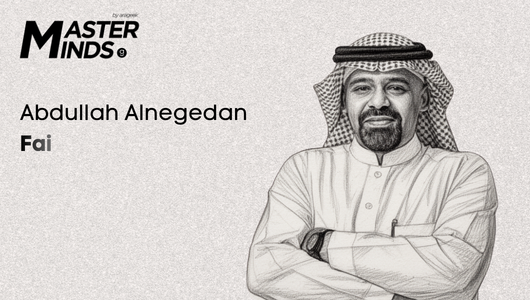
EgyptI am Abdullah Alnegedan. I built systems over heroics, and scaled without burnout

10 min
An operator by instinct, a builder by choice
When asked to describe his professional arc, Abdullah Alnegedan frames it less as a climb and more as a deliberate crossing between worlds. He is, by his own definition, a Saudi operator by nature and a builder by choice. His career has moved between global organisations obsessed with discipline and repeatability, and early-stage startups where speed and customer obsession dominate daily decisions.
What ties those environments together is a consistent preoccupation with how work actually gets done. Today, that focus has narrowed into a clear mission: helping founders and leaders in the MENA region run operations that scale, rather than operations that simply keep people busy. Over the past year, he has also stepped into public thinking, sharing practical frameworks on LinkedIn and hosting longer conversations on YouTube, driven by a belief that operational knowledge in the region is too often trapped inside companies instead of shared.
How global organisations shaped his view of leadership
On the question of what Amazon, Uber and PwC taught him, Alnegedan does not talk about prestige or brand value. He talks about clarity. At Amazon, he learned that simplifying communication is one of the most powerful productivity levers available to leaders. The organisation’s insistence on structured writing, limited meetings and ruthless prioritisation showed him that precision accelerates execution. Fewer slides and fewer opinions create more ownership, not less.
Uber, by contrast, forced a very different kind of learning. Leading customer experience across MENA during COVID meant navigating collapsing demand in some markets, explosive growth in others, regulatory uncertainty and genuine human fear at the same time. It was leadership under sustained ambiguity, where incomplete data was the norm and judgment mattered as much as process. That period reshaped his understanding of pressure. Systems matter, but trust and calm decision-making matter more when those systems are under stress.
At PwC, the lesson was structure in high-stakes environments. Governance, risk management and translating complex realities into language executives and regulators could act on taught him the value of credibility and precision. Together, these experiences formed a philosophy he still applies: simplify communication, design systems that do not rely on heroes, and lead calmly when conditions are at their worst.
Learning leadership the hard way, early
Asked to reflect on the most challenging chapter of his early career, Alnegedan points to becoming a manager at a very young age. Technically, he was ready. Culturally, he was not. Managing people older and more experienced exposed a gap that many early leaders underestimate: organisations run on trust, history and unspoken rules, not just org charts.
That mismatch created friction and forced rapid growth. He had to abandon the idea that authority comes from title and replace it with a harder truth. Leadership is earned through listening, humility and consistency. That period taught him how to manage conflict, ask rather than instruct, and build credibility without ego. It was uncomfortable, but formative, and it shaped a leadership style that values emotional intelligence as much as execution.
What large-scale operations taught him about reality
When the conversation turns to Toyota and Saudi Binladin Group, Alnegedan’s respect for real operations becomes clear. Toyota taught him that excellence is not about working harder but about reducing variation. Standard work, root-cause problem solving and continuous improvement matter because inefficiencies multiply at scale.
Saudi Binladin Group showed him what scale looks like outside dashboards. Logistics, safety and multi-stakeholder execution leave little room for abstraction. Problems are visible on the ground. Those experiences made him obsessive about building repeatable systems for people, processes and customers, because at scale, improvisation becomes risk.
Choosing startups for impact and ownership
Pressed on why he moved from global corporations to startups, his answer is straightforward: impact and ownership. In large organisations, you can build something excellent, but it remains one component of a vast machine. In startups, every decision shapes the company’s fate, from culture to execution rhythm.
There was also timing. Saudi Arabia’s transformation is creating new markets in real time. Alnegedan wanted to be close to that creation, not just optimising what already existed. Startups offered the chance to build operating systems from scratch in an environment where those systems matter deeply.
The phone call that became Fai
When asked about the origin of Fai, Alnegedan does not start with a pitch deck. He starts with a phone call. While driving home one evening, his future co-founder called. The forty-minute conversation was not about valuations or titles, but about a problem both were seeing across the market. By the time he arrived home, he had said yes.
Saudi Arabia’s introduction of VAT had pushed many SMEs into formal taxation and compliance for the first time. The intent was right, but the reality was confusion, manual work and fear of penalties. Business owners were spending more time trying to understand compliance than running their companies.
Fai was born from a sense of responsibility as much as opportunity. The goal was not to offer traditional bookkeeping, but to build a technology-driven operating layer that embeds compliance into daily workflows. Finance, in this model, becomes continuous and trusted rather than reactive and end-of-month. Saying yes to Fai was about reshaping how an entire segment experiences financial operations in a transforming economy.
Why Fai is not a traditional service provider
On the question of differentiation, Alnegedan is blunt. Traditional providers operate like service counters. You send documents, you wait, you receive outputs. Fai aims to keep finance continuously clean, not fixed later. That means system-first design rather than people dependence, real-time visibility instead of surprises, automation with controls so quality holds at scale, and a product mindset where experience matters as much as outcome.
The ambition is not to produce reports, but to help businesses build finance operations they can trust.
Scaling while building a market
Asked about scaling challenges, Alnegedan emphasises that Fai was not just scaling a company but building a market. Many clients were encountering VAT and structured bookkeeping for the first time. There was no shared understanding of what good looked like.
The first challenge was standardisation in an immature market. Clients arrived with wildly different levels of readiness. The solution was a clear service blueprint with non-negotiable standards, combined with flexibility at the edges. The second challenge was resisting hero dependence. Instead of relying on exceptional individuals, Fai invested early in documentation, quality controls and clean handoffs.
The third challenge was balancing speed with education and trust. In a new market, consistency compounds faster than features. The guiding question was not how to grow faster, but how to grow correctly in a space where mistakes are costly and trust is everything.
Balancing technology, experience and compliance
When asked how he balances technology, customer experience and compliance as a COO, Alnegedan treats them as one triangle. Over-invest in one corner and the business breaks. Technology without experience becomes an internal project. Experience without compliance becomes a future crisis. Compliance without usability leads to abandonment.
The operating model therefore integrates clear process ownership, measurable SLAs, customer feedback loops and compliance checkpoints directly into workflows. The goal is not to choose between priorities, but to design systems where they reinforce each other.
Automation as trust, not efficiency
On automation, his framing is deliberately unfashionable. Automation is not about saving time. It is about reducing risk and increasing trust. Manual finance work is inconsistent and people-dependent. Automation creates predictable timelines, audit-ready trails and fewer handoffs. It turns finance from firefighting into a function that supports growth.
How he builds high-performing teams
Asked about team building across startups and large organisations, Alnegedan argues the principles are the same, even if the intensity differs. Clarity around priorities and roles, execution cadence through weekly rhythms and metrics, capability through training and tools, and a culture of ownership and truth-telling.
One belief is non-negotiable. Performance is a system outcome, not a personality trait.
Making cross-functional work actually work
When the discussion turns to cross-functional collaboration, he identifies misaligned incentives as the usual failure point. His approach focuses on shared metrics, explicit handoffs, decision clarity and pre-mortems that ask what will break at scale. When teams agree on outcomes and rules of engagement, collaboration becomes execution rather than meetings.
A decision that scaled people as well as performance
Asked for a concrete strategic decision, Alnegedan points to cross-utilising teams across borders based on operational needs rather than fixed geography. By designing talent pools around capability, availability and demand cycles, the organisation improved utilisation and responsiveness without adding unnecessary headcount.
The impact was cultural as well as operational. Teams shifted from thinking in terms of my market to our system. High performers gained exposure and growth, linking responsibility to real progression. The decision reinforced a belief he still holds: smart operating models scale people, not just companies.
The trends that matter in fintech and SaaS
On future trends, Alnegedan highlights three. Embedded compliance that lives inside workflows rather than paperwork. AI that reduces operational load through forecasting, anomaly detection and triage rather than novelty. And operational transparency as a product feature, where customers know what is happening, what comes next and why. Together, these trends push SaaS from tools toward trust infrastructure.
What comes next, and why it feels different
Looking ahead, his ambition for Fai remains focused. He wants it to be quiet infrastructure that helps businesses in Saudi Arabia run finance operations with confidence, fast where speed matters and rigorous where compliance demands it.
Beyond Fai, his interests are widening. Alongside technology, he is drawn to physical products and humanised experiences where craftsmanship and emotional connection matter. In a world racing toward automation, he believes differentiation will come from what remains deeply human. Writing and content have become central, not as marketing, but as tools for thinking. Sharing frameworks is a way to help others find their own management language.
The mistake leaders keep repeating
When asked about the most common operational mistake, Alnegedan does not hesitate. Leaders build companies on effort instead of systems. Early on, heroics work. As teams grow, heroics become a tax. Burnout rises, quality drops and escalation becomes constant.
Busy often means unclear priorities, unclear ownership, centralised decisions and activity measured instead of outcomes. His advice is uncomfortable but simple. Stop rewarding speed and start rewarding repeatability. Progress is not shipping once. It is being able to ship again next week with the same quality and less stress.
Advice for overwhelmed leaders in Saudi Arabia
Pressed to give one piece of advice to fast-scaling leaders, Alnegedan urges them to pause long enough to design their operating system. Saudi Arabia’s pace tempts leaders to run faster, but speed without structure creates confusion and fatigue.
Most overwhelmed teams are not short on talent or ambition. They have outgrown their communication style, centralised decisions without noticing, and lost clarity on what good looks like. His prescription starts with fundamentals: a short list of priorities, clear ownership with one accountable person per outcome, and a weekly execution rhythm that forces clarity.
The message is clear. Do not ask people to work harder. Ask the company to work cleaner.
A quieter definition of success
Asked to define success today, Alnegedan’s answer is measured. Earlier, success meant titles and pace. Now it means building work with integrity that does not rely on hype or break people. It is about systems over anxiety, value that lasts longer than a quarter, and sharing knowledge in ways that help others develop their own style.
If his companies and content help founders build more thoughtful, humane and sustainable businesses, that, for him, is real success.