 LEAP26
 AI
AI Saudi Arabia
 UAE
UAE Egypt
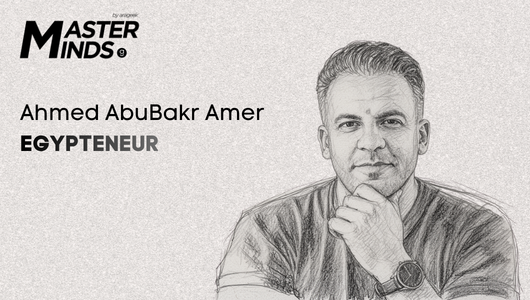
EgyptI am Ahmed AbuBakr Amer. I left corporate to build fintech ecosystems

6 min
The operator who moved from campaigns to systems
When asked about the arc of his career, Ahmed AbuBakr Amer does not describe a linear climb. He frames it as a shift in how he thinks about value. Early years in telecom marketing built reach and visibility, but the real inflection came when he moved closer to product and growth. That shift, he suggests, changed the question from “How do we promote?” to “How do we make adoption inevitable?”
Across more than 17 years, working in Egypt and markets such as Iraq and Afghanistan, he built a reputation for linking marketing to measurable outcomes. The move into fintech, particularly during the early stages of mobile wallet adoption, forced a deeper level of thinking. It was no longer about messaging. It was about behaviour.
How emerging markets reshape judgement
On the question of operating across difficult environments, he is direct. Constraints, he says, are not limitations, they are design inputs. Exposure to underbanked and unbanked populations sharpened his understanding of what actually drives usage. Convenience alone is not enough. Trust, clarity, and immediate value matter more.
Working in places like Kurdistan Iraq required faster decisions and a tolerance for ambiguity. It also removed any illusion that a single marketing playbook could travel unchanged. Local context is not a layer added at the end. It is the starting point.
That experience, he argues, builds a different kind of operator. More data-driven, but also more culturally aware. More disciplined, but also more willing to act without perfect information.
Why his campaigns focused on behaviour, not awareness
When the conversation turns to his time leading marketing for Orange Egypt’s mobile wallet, he points to a simple principle. Campaigns should not chase attention. They should remove friction.
This thinking led to initiatives such as 100 per cent cashback offers. The intention was not noise. It was to eliminate hesitation at the point of first use. If the barrier is risk, remove it completely. If the product delivers, usage will follow.
He describes campaigns as products in their own right. Designed, tested, and optimised against clear KPIs such as activation, usage, and retention. The creative element matters, but only insofar as it serves a financial outcome.
The discipline behind creativity
Pressed on how he balances bold ideas with commercial reality, his answer is blunt. Creativity that does not move the P and L is indulgence.
Every initiative begins with a financial objective. From there, frameworks are built to connect marketing spend to revenue impact. Testing is constant. Scaling is conditional. Optimisation never stops.
This requires alignment beyond the marketing team. Product, finance, and growth must operate as one system. Without that, even the most compelling campaign risks becoming disconnected from the business.
What difficult markets taught him about growth
Asked to reflect on the hardest lessons, he returns to fundamentals. Growth does not come from pushing products. It comes from solving real problems. In many cases, that means redefining the product itself.
Speed, he says, consistently outperforms perfection. In volatile environments, waiting for ideal conditions is a losing strategy. Teams need ownership, clarity, and the ability to execute with limited resources.
Trust emerges again as a central theme. Brand awareness can be bought. Trust must be earned through consistent value.
The idea of a “strategic storytelling marketer”
When asked how he defines his approach, he uses a phrase that captures his philosophy: strategic storytelling marketer.
For him, storytelling is not decoration. It is a mechanism for changing perception and behaviour. A product becomes meaningful when it is framed correctly. In the case of mobile wallets, that meant shifting the narrative from a simple payment tool to a broader financial lifestyle.
The effectiveness comes from combining data, emotion, and timing. When those elements align, storytelling does not just capture demand. It creates it.
Why he left corporate to build
On the question of moving into entrepreneurship, the motivation is clear. Execution inside large organisations provided scale and exposure, but it also imposed limits. He wanted ownership of both the problem and the solution.
Through Egypteneur, he is building a venture studio focused on fintech and digital ecosystems. The aim is not to launch isolated products, but to create interconnected platforms that address fragmentation in digital services and financial inclusion.
He sees a gap between ideas and execution in Egypt. His approach is to fill that gap with structured building, not just ideation.
Lessons that shaped his approach to building
Asked what entrepreneurship changed in his thinking, he prioritises execution over everything else. Ideas are abundant. Delivery is scarce.
Timing, he notes, is often underestimated. A strong concept launched too early or too late can fail regardless of quality. Partnerships also play a decisive role. The right ones accelerate growth. The wrong ones can stall it entirely.
Cash flow discipline is non-negotiable. Validation must come before scale. These are not abstract principles. They are operational constraints that define survival.
Learning to sell vision internally
When the conversation turns to failure, he does not point to external setbacks first. He highlights internal resistance. Many of his more unconventional ideas were initially rejected or misunderstood.
This forced him to develop a different skill. Selling the vision inside the organisation before taking it to the market. It required patience, persistence, and the ability to translate bold ideas into credible business cases.
The lesson, he says, is a balance between conviction and flexibility. Holding the core idea while adapting the path to get it approved and executed.
What he is building now, and what comes next
Asked about his priorities, he returns to scale. The ambition for Egypteneur is to become a leading venture studio in the region, launching multiple fintech products and building strong partnerships with banks and telecom operators.


At a broader level, he sees his role in Egypt’s digital transformation as enabling adoption. Not just through products, but through ecosystems that make cashless behaviour natural.
For younger professionals, his advice reflects his own path. Do not chase titles. Chase exposure. Learn how businesses work, not just your function within them. Take risks early, because the compounding effect is real.