 LEAP26
 AI
AI Saudi Arabia
 UAE
UAE Egypt
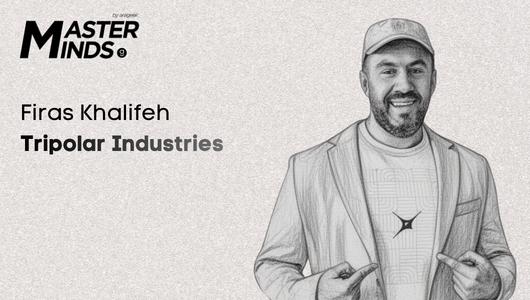
EgyptI am Firas Khalifeh. I drive real-world autonomy through Physical AI and deep tech

7 min
Firas Khalifeh does not describe his career as a sequence of companies. He describes it as a series of deliberate escalations, each one closer to the metal.
He began in software and electronics, moved into advanced materials, then into manufacturing at scale. Now he is building what he calls Physical AI, an attempt to push artificial intelligence out of screens and into factories. Along the way there have been exits, patents, relocations across three continents, and a decision to invest time and reputation into rebuilding Syria’s technology ecosystem.
What ties it together is not geography or sector. It is a conviction that hard problems are worth pursuing, even when the room resists you.
How he moved from software into deep hardware
When asked to walk through his journey, Khalifeh starts in Syria, studying computer engineering and working while still at university. The Syrian revolution forced a relocation to the UAE, where he founded a group of companies and achieved several exits.
But it was electronics that held his attention.
That pull led him to found Carbon Mobile in Germany, with a bold objective: build the world’s lightest carbon fibre smartphone. It was not an incremental software play. It was materials science, manufacturing and industrial design combined.
He moved to Berlin, then to China to oversee large scale production, remaining there for three years to embed himself in industrial reality. After the pandemic, he returned to Germany and established an in-house manufacturing facility. Later, he relocated to San Francisco. By that stage, he had executed a successful exit from Carbon Mobile and secured a patent for his materials technology.
The pattern is consistent. He moves towards complexity rather than away from it.
Why carbon fibre became the obsession
On the question of what drew him into material science, Khalifeh’s answer is simple: he wanted to redefine how devices are manufactured.
Carbon fibre has obvious advantages, lightweight, strong, durable. But for two decades it had remained largely incompatible with consumer electronics because of signal interference. Major technology companies had attempted to solve the problem without success.
The patented HyRECM technology changed that. It enabled carbon fibre to be integrated into electronic devices without compromising signal performance. In practice, that opened design and durability possibilities for smartphones, laptops and other hardware categories.
Khalifeh speaks about the breakthrough with controlled satisfaction rather than bravado. The point is not novelty for its own sake. It is that a material constraint had quietly limited an entire category, and someone needed to solve it properly.
Carbon olso won the JEC Composites Innovation Award in the electronics category, competing against and beating entries from BMW and Bayer. It's the leading award in advanced composites globally and speaks directly to the materials credibility thread running through the piece.
The harder challenge was belief, not engineering
Pressed on the most difficult part of the journey, he does not mention technical bottlenecks first. He speaks about self-belief.
Operating in Germany as a Syrian founder, he encountered discrimination, particularly in investor conversations. That friction could have been paralysing. Instead, he treated conviction as a discipline. Staying committed to the idea, even when external validation was scarce, became the central test.
In deep tech, he suggests, the emotional resilience required often exceeds the technical challenge. Engineering problems can be solved with expertise. Doubt, especially in rooms where capital is controlled by others, is more corrosive.
What it actually takes to scale deep tech across borders
When the conversation turns to international scaling, Khalifeh is pragmatic. Deep tech cannot be built in isolation.
He travelled repeatedly to Taiwan and China to work with teams possessing decades of industrial knowledge. Manufacturing, he argues, is a community effort. You assemble experts, partners and operators who understand the physics and the process as deeply as you do.
He is clear that the Middle East needs specialised deep tech hubs, structured environments where industrial expertise is concentrated and supported. Some countries have begun investing in this direction, but he believes more deliberate effort is required if the region is to compete globally.
It is not about ambition. It is about infrastructure and density of knowledge.
Why he is now building “Autonomous Facilities”
Asked about his current focus at Tripolar Industries, Khalifeh shifts from materials to systems.
After nearly a decade in manufacturing, he began asking a straightforward question: why does artificial intelligence still sit behind screens while factories remain only partially automated?
Tripolar Industries operates in what he calls Physical AI. The ambition is to build fully autonomous industrial facilities, sometimes described as autonomous facilities, where robots operate through integrated AI systems without continuous administrative intervention.
Tripolar Industries is a San Francisco-based company with offices in the Gulf, targeting the region as its primary growth market.
Why rebuilding Syria’s tech ecosystem matters
When asked about his involvement in the SYNC 25 initiative, his tone changes. He describes it as one of the most impactful missions of his career.
SYNC is an NGO connecting Silicon Valley and Syria, bridging diaspora expertise with local talent and working toward large-scale tech employment in Syria. Khalifeh helped lead the Syrian edition, facilitating dialogue between entrepreneurs, technologists and investors. The goal is not symbolic engagement. It is practical bridge-building.
He believes Syria’s greatest asset is its people, both inside the country and across the diaspora. The challenge lies in infrastructure, regulation and investment frameworks. Without those, talent cannot compound.
He speaks about ecosystem design the way he speaks about hardware. It requires structure, incentives and alignment.
On balancing commercial success with long-term impact
Asked to reflect on the intersection of climate, hardware and frontier technologies, Khalifeh rejects the idea that profit and impact are in tension.
Clarity of vision matters. So does choosing partners carefully and investing in capable talent. If the product is genuinely differentiated and delivers real value, commercial success and long-term impact can reinforce each other.
For him, the dividing line is execution discipline. Impact without commercial viability is unsustainable. Commercial gain without substance is fragile.
The failure that changed his perspective
When asked about meaningful setbacks, Khalifeh does not cite a collapsed product. He speaks about emotional attachment.
He learned to ask for help. Mentors and community, he says, are not optional in deep tech. Founders often over-identify with their companies. That can turn entrepreneurship into constant pressure rather than purposeful challenge.
Sometimes the mature decision is to step away from a company if it has lost direction or personal conviction. Reassessment is not failure. It is clarity.
That perspective is hard won.
His advice to the next generation of deep-tech founders
On the question of guidance for young founders in the Middle East, he is direct.
Deep tech is more accessible today than at any point in the past. Resources and global case studies are widely available. The opportunity lies in understanding regional markets deeply, especially in agriculture and industry, then improving upon global models rather than copying them.
Study what exists. Identify the gap. Build something better.


It is advice consistent with his own career. He did not invent carbon fibre. He removed the constraint that prevented it from being used properly in electronics.
And now he is trying to remove the constraint that keeps AI confined to screens.