 LEAP26
 AI
AI Saudi Arabia
 UAE
UAE Egypt
EgyptI am Joumana Karam. I protected brand equity while retailers demanded instant sales.

7 min
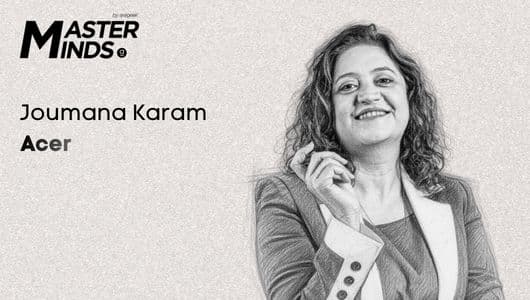
Joumana Karam on the Constant Negotiation Between Brand, Retail, and Reality
Marketing a global technology brand across the Middle East and Africa is less about grand campaigns and more about judgement under pressure. Budgets tighten, retailers demand sell-through, headquarters pushes strategy, and every market behaves differently.
For Joumana Karam, Head of Marketing for Acer Middle East and Africa, the work is a constant balancing act between protecting brand equity and delivering immediate commercial results. The decisions are rarely theoretical. They show up in budget allocations, campaign structures, team structure, and sometimes in the difficult recalibration of global ideas to local realities.
What emerges from the conversation is not a marketer chasing visibility, but an operator managing trade-offs.
The permanent tension between brand equity and quarterly targets
When asked about the hardest trade-off in her role, Karam does not hesitate. The pressure between brand building and immediate sales is constant.
In the current hardware market across the region, budgets are tightening and the instinct across organisations is to channel every available dollar into high-intent conversion activity. Retail promotions, discount campaigns, and direct “buy now” advertising promise immediate movement of inventory.
But Karam sees the risk clearly. A brand that lives only in promotions slowly erodes its own long-term value.
The practical challenge, she explains, is finding ways to embed brand storytelling inside promotional activity. If the campaign is purely transactional, it may move stock today but it damages the brand tomorrow. The discipline is to ensure that even tactical campaigns carry a sense of aspiration and brand identity.
In other words, sales campaigns cannot be allowed to flatten the brand.
Why gaming works across cultures
When the conversation turns to cross-market messaging, Karam points to one area that consistently travels well across the region: gaming.
Marketing across MEA usually requires careful localisation. Language, cultural context, and influencer ecosystems vary widely from market to market.
Gaming, however, behaves differently.
Campaigns built around Acer’s Predator gaming portfolio have shown surprising consistency across markets. The execution still requires localisation, but the emotional trigger is broadly universal.
Players are motivated by performance and by belonging to a community. Those two drivers translate across borders far more easily than traditional product messaging.
The insight reinforced a lesson she has seen repeatedly. Marketing formats may differ by country, but certain emotional drivers remain remarkably stable.
What she refuses to outsource
Since 2018, Karam has overseen agencies, PR teams, influencer programmes, social media operations, and digital campaigns across the region. That breadth forces clarity on what must stay inside the company and what can be delegated.
When asked where she draws the line, the answer is firm.
Strategy, performance data, and copy-editing remain in-house.
The reason is simple. Strategy defines the direction of the brand and must remain aligned with global headquarters. Data informs every major decision and cannot sit outside the organisation. Copy-editing, meanwhile, protects the brand’s voice.
A campaign can appear in many formats, from a short Instagram caption to an influencer brief or a full press release. Keeping editorial oversight internally ensures tone consistency across languages, particularly across English and Arabic.
Execution is a different story.
Content production, community management, social media operations, and specialised media buying are frequently outsourced. Agencies bring platform expertise, particularly when navigating fast-changing algorithms or local PR dynamics across dozens of markets.
The result is a lean internal team focused on strategic thinking, market intelligence, and partner relationships.
Marketing outside the PC category
Acer’s expansion into categories beyond traditional PCs, including areas such as e-mobility, forced a shift in marketing thinking.
Asked about the biggest adjustment, Karam describes it as a move from specifications to lifestyle.
In traditional IT marketing, communication is logical and product-led. Messaging focuses on performance metrics and the purchasing cycle is predictable, often driven by device replacement.
In emerging categories, the dynamic is different.
The centre of gravity shifts from the product to the user experience. Emotional resonance becomes more important, and purchasing behaviour often follows hype cycles rather than predictable upgrade patterns.
For a marketer trained in product-driven categories, that requires a deliberate change in mindset.
When local data challenges the global playbook
As part of the regional executive team, Karam regularly navigates the tension between global strategy and local market realities.
Pressed on a decision she reversed after reviewing the data, she points to the ongoing debate between digital-first strategies and physical retail experiences.
Global headquarters typically advocates a digital-heavy marketing mix. But feedback from distributors and retailers across several MEA markets told a different story.
In many places, the “touch and feel” experience of a physical showroom remains a primary driver of conversion.
The response was not to reject digital strategy, but to rebalance the mix. Marketing budgets were adjusted to better support retail partners while maintaining digital investment.
The internal conversation, she explains, relied on one principle: acknowledge the data and respond to it.
Steering through the supply chain crisis
Looking back over more than three decades in the technology sector, Karam identifies a different kind of achievement as her personal highlight.
When asked to reflect on the moment that mattered most, she points to the 2020 to 2022 period, when global supply chains and demand patterns were thrown into extreme volatility.
The challenge was not simply marketing. It was maintaining brand relevance while navigating product shortages, shifting demand, and strained partner relationships.
Keeping the business and brand stable during that period required resilience, coordination, and strong relationships across the regional ecosystem.
For Karam, successfully guiding the MEA marketing and business strategy through that environment stands out as a defining moment.
The achievement she values most
When the conversation turns to success, Karam does not point to a campaign or product launch.
Instead, she talks about people.
The achievement she values most is building a long-tenure, multicultural team in an industry known for high turnover. Maintaining a consistent group of marketers who understand the complexity of the region is rare in technology companies.
The difference, she believes, comes from empowerment and investment in local talent.
A stable team creates institutional memory, cultural understanding, and operational consistency across a diverse region.
Learning to localise global campaigns
Not every campaign works equally well across markets.
Asked about a failure that carried real consequences, Karam describes moments when global creative assets proved too universal in tone and failed to resonate with specific MEA audiences.
In those cases, campaigns could feel disconnected from local realities, sometimes weakening partner confidence and wasting marketing spend.
The adjustment was pragmatic.
Global creative assets remain the foundation, but the regional team now applies deliberate cultural adaptation layers before deployment. The goal is to retain global consistency while ensuring local relevance.
The decision that changed her career
When asked about the most important decision she made, Karam returns to a moment earlier in her career.
Accepting an internal role relocation from Lebanon to a Middle East headquarters in Dubai was not an obvious or comfortable move. It meant relocating without family support and stepping into broader responsibilities across marketing and sales.
In hindsight, the move changed the trajectory of her career.
It shifted her focus from managing product lifecycles to shaping the strategic narrative of a global brand across a complex regional landscape.
Why she does not believe in “wrong decisions”
Finally, asked about the worst decision she has made, Karam reframes the premise.
She does not describe her career in terms of mistakes or wrong turns. Instead, she sees difficult periods as catalysts for adjustment.

Challenges force a different kind of thinking. They require listening more carefully, adapting faster, and adjusting strategies when necessary.
Over time, that habit of learning, listening, and recalibrating has become what she describes as her personal formula for maintaining a growth mindset.