 Ai Everything
 LEAP26
 AI
AI Saudi Arabia
 UAE
UAE Egypt
EgyptI am Mohamed Salah Helmy. I measure campaigns by business outcomes, not impressions

8 min
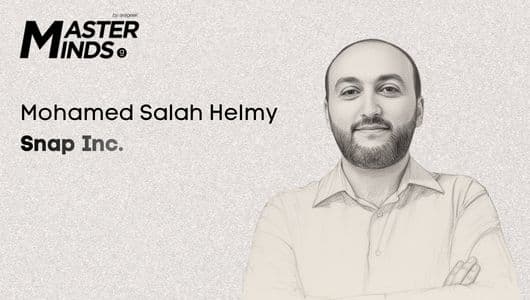
Mohamed Salah Helmy on Strategy, Measurement, and the Reality of Digital Advertising
Digital marketing often gets described in terms of tools, platforms, and trends. Mohamed Salah Helmy approaches it differently. For him, the discipline is fundamentally about turning media channels into reliable growth engines, guided by strategy, data, and constant optimisation.
With more than sixteen years in the industry across MENA and EMEA markets, Helmy has worked with global brands while helping organisations rethink how advertising performance should actually be measured. Now a Senior Account Manager at Snap Inc., he focuses on building strategic partnerships with advertisers and helping brands translate platform capabilities into measurable business outcomes.
Why digital marketing appealed to him in the first place
When asked about how he entered the industry, Helmy traces the decision back to the intersection of three forces: technology, data, and business growth.
His academic background in Business Administration gave him a framework for understanding how companies scale. Digital marketing, he realised early, offered a way to connect that commercial logic with performance-driven advertising strategies.
What makes the field distinctive, in his view, is the speed and precision of feedback. Campaign performance can be tracked in real time, which means strategy does not end once a campaign launches. Instead, it evolves continuously as new data appears.
For Helmy, that immediacy makes digital marketing less about broadcasting messages and more about managing an ongoing system of optimisation.
How marketing strategies differ between MENA and EMEA
When the conversation turns to regional differences, Helmy points first to consumer behaviour.
In the MENA region, marketing strategies are heavily shaped by a mobile-first audience. Platforms such as Snapchat and TikTok hold substantial influence over purchasing decisions, which pushes brands to prioritise social and mobile-driven experiences.
Across EMEA markets, however, the media mix tends to be more balanced. Search, email marketing, and programmatic channels often play a larger role alongside social platforms.
Regulation also plays a major role. European markets operate under stricter data privacy frameworks, which directly affects how advertisers collect and use customer data for targeting and measurement. For marketers operating across regions, adapting strategy to these constraints is not optional.
What his role at Snap Inc. actually involves
Asked about the reality of his day-to-day work, Helmy describes a role that sits somewhere between strategist, advisor, and operator.
As a Senior Account Manager, he focuses on developing and growing relationships with major clients and advertising agencies. That work ranges from presenting product updates to guiding brands on how to structure campaigns that produce meaningful return on investment.
A significant part of the role involves working alongside account executives during campaign planning and pitch stages, helping brands design digital campaigns that are both creative and measurable.
He also contributes to broader internal initiatives, from mentoring newer account managers to collaborating with product and data science teams on large-scale projects. The goal across all of it is simple: help advertisers unlock stronger performance from the platform while building long-term strategic partnerships.
The campaigns he remembers most clearly
Pressed on highlights from his earlier career, Helmy points to his time as Media Strategy Director at Jellyfish.
One of the most significant milestones was winning and managing the digital media account for GMG Group, which included major retail brands such as Sun & Sand Sports, Dropkick, and Nike.
The campaigns demanded constant optimisation. Teams monitored performance daily, analysing campaign data and adjusting strategy to maintain strong return on ad spend targets across multiple sports brands.
For Helmy, the experience reinforced a lesson that has followed him throughout his career: high-performing campaigns are rarely static. They are the result of continuous measurement and refinement.
Working with global brands and high expectations
When asked how he handles demanding clients such as Samsung, NEOM, and Virgin Mobile, Helmy returns to the idea of measurement.
Large organisations require more than creative ideas or media plans. They require a clear framework that links marketing activity to business performance.
For Helmy, that framework must align with the brand’s core objectives from the outset. Once established, transparency becomes critical. Clients need to understand how campaigns are performing and why certain decisions are being made.
Without that shared measurement system, even strong campaigns can struggle to prove their value.
What large platforms really look for in talent
Asked how someone might join a company like Snap Inc., Helmy emphasises that technical ability alone is rarely enough.
Major platforms are not simply hiring campaign managers. They want people who can operate as strategic advisors to their clients.
During his time at Snapchat, Helmy has worked directly with more than fifty advertisers at once. Managing that level of responsibility requires strong prioritisation, disciplined time management, and the ability to operate under constant deadlines.
His advice to candidates is straightforward: stay deeply informed about the broader platform ecosystem. Understanding what competing platforms are building allows marketers to deliver integrated solutions rather than isolated campaign tactics.
The skill that matters more than platform knowledge
When the conversation shifts to essential skills for modern marketers, Helmy highlights something often overlooked: understanding the client’s business model.
Different industries behave very differently. An e-commerce brand operates under entirely different pressures than an FMCG company or a real estate developer.
Marketers who fail to understand these distinctions risk optimising for superficial metrics such as impressions or website visits rather than genuine business outcomes.
The real skill, he argues, is connecting digital media strategy to the commercial realities of the business itself.
His advice for startups chasing rapid growth
When asked about startups, Helmy’s first recommendation is not creative experimentation but measurement discipline.
Young companies often spend aggressively across channels without a clear attribution framework. Without that structure, it becomes impossible to understand which platforms are actually driving revenue or customer acquisition.
Before scaling paid media budgets, startups need systems that map advertising investment to business outcomes. Only then does spending become strategic rather than speculative.
How he evaluates campaign success
Pressed on the metrics he tracks most closely, Helmy emphasises business outcomes rather than surface-level engagement metrics.
Key indicators include year-on-year efficiency improvements, new-to-business customer acquisition, and direct return on ad spend.
Ultimately, however, the most important metric is the health of the company itself. Advertising success should be visible in business performance, not just in marketing dashboards.
The two challenges reshaping the industry
Asked about the most significant challenges he has faced, Helmy points to two forces currently reshaping digital advertising.
The first is the growing wave of privacy regulation, which has made traditional audience tracking and measurement more complex. His response has been to lean more heavily on first-party data owned by brands, alongside server-side measurement solutions such as CAPI.
The second challenge is artificial intelligence.
Helmy’s view is blunt: AI will not replace everyone, but people who use AI will replace those who do not. For that reason, he integrates AI tools into his daily workflow to improve efficiency and decision-making.
Where digital advertising is heading next
When the discussion turns to the future, Helmy sees two clear directions.
The first is the continued expansion of AI-driven marketing systems, which will increasingly automate campaign optimisation and audience targeting.
The second is the rise of immersive experiences, particularly augmented reality. Platforms like Snapchat are already heavily invested in AR experiences that allow users to interact with products before purchasing.
He also believes Retail Media Networks will become a defining force in the advertising ecosystem, allowing brands to place advertising much closer to the moment of purchase.
If he were starting again today
Asked to imagine beginning his career again, Helmy does not hesitate.
He would focus early on data analytics and advanced reporting dashboards. These tools, he argues, form the backbone of effective marketing decision-making.
Without clear reporting systems, strategy becomes guesswork.
The principle that has shaped his career
When asked to summarise the most important lesson from sixteen years in the industry, Helmy returns to a simple but often misunderstood idea.
Advertising performance is not determined by the size of the budget.
It is determined by the quality of the strategy and the discipline of continuous optimisation. Even weaker channels can become powerful profit drivers when managed with the right approach.
His personal formula for long-term success
Asked about the mindset that has sustained his career, Helmy emphasises continuous learning.
Certifications and formal study matter, but they are only part of the picture. Staying ahead in digital marketing requires constant exposure to new ideas, industry analysis, and platform updates.
He regularly reads specialised blogs, listens to industry experts, and studies new tools entering the market.


That commitment to learning also explains why he pursued advanced fellowships from British marketing institutions later in his career.
In a field that changes as quickly as digital advertising, curiosity remains the most valuable professional habit.