 Ai Everything
 LEAP26
 AI
AI Saudi Arabia
 UAE
UAE Egypt
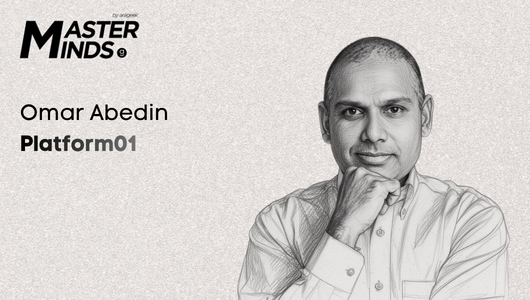
EgyptI am Omar Abedin. I learned that strategy is deciding early, not explaining later

6 min
Omar Abedin has spent three decades inside organisations where decisions carried real consequence. What emerges from his account is a consistent belief that strategy is not theory, it is the discipline of choosing early, clearly, and with conviction.
Learning strategy where pressure is real
When asked about his professional formation, Abedin traces it to environments where brand, regulation, and execution collide. His early years at Reckitt Benckiser, Johnson & Johnson, and Novartis were not abstract training grounds but places where value was tested daily under commercial and regulatory pressure. Being part of the team that established Johnson & Johnson in Jeddah in 2001 grounded him early in market entry, governance, and institutional building, lessons that would resurface repeatedly later.
That grounding became sharper during his time at Novartis in North America. Asked to reflect on moments that shaped his leadership, he returns to the Triaminic Thin Strips launch, a global first in drug delivery. When the US pseudoephedrine ban threatened a $100M franchise in 2005 and 2006, the choice to remove PSE from formulations was not popular but it was decisive. Protecting long-term brand value meant confronting reality early rather than defending legacy positions. That experience, he says, defined how he thinks about leadership under pressure.
Operating across markets and scales
When the conversation turns to the breadth of his operating roles, a pattern emerges rather than a catalogue of achievements. From scaling London Dairy in the GCC from SAR 20M to SAR 100M in three years, to building Careem into Pakistan’s most downloaded app with 300,000 rides per day, to leading Starcom as CEO with 150 people across three offices, Abedin consistently found himself working at inflection points.
Pressed on what connects these experiences, he points to the primacy of decisions over functions. At Graana, a $1B real estate conglomerate where he served as Group CMO, the task was not marketing polish but helping design a ten-year growth strategy. Titles and sectors changed, but the work remained focused on direction, trade-offs, and execution under constraint.
Why strategy became the focus
Asked why he moved from operating roles into advisory work, Abedin is direct. Operating roles taught him that most business problems are not functional but directional. Whether responding to regulatory disruption in healthcare or managing hypergrowth in a platform business, outcomes were shaped by a small number of high-quality decisions.
Strategy and advisory work, he argues, create space for leadership teams to slow down just enough to make those decisions deliberately. The value is not in contemplation but in enabling decisive movement once direction is clear.
What stands out in Saudi Arabia today
On the question of his recent work in Saudi Arabia, where he has led more than 70 engagements, Abedin highlights the seriousness of intent. This is not transformation as theatre or incremental change. CEOs and boards are wrestling with capital allocation, governance, operating models, and long-term competitiveness at a depth he rarely sees elsewhere.
What he finds most rewarding is helping leaders replace complexity with clarity, then watching that clarity translate into action. The ambition is evident, but so is a growing discipline about how that ambition is executed.
A structural reset with real stakes
When asked why Saudi Arabia’s transformation feels different from a CEO perspective, Abedin frames it as a structural reset. Regulation, capital, talent, and ambition are moving in the same direction, a rare alignment that creates both opportunity and risk.
For leaders, the central question is no longer whether change is coming. It is whether their organisations are designed to absorb it and benefit from it. Moving fast without a strategic spine, he cautions, can be as dangerous as standing still.
The work behind the title
As the conversation turns to his role as Country Manager for Platform01 Consulting in Saudi Arabia, Abedin outlines three responsibilities. First, delivering measurable outcomes across growth strategy, turnaround, and restructuring. Second, building long-term, trust-based relationships with CEOs and boards. Third, ensuring global capabilities are applied with deep local context.
He is explicit about what this work is not. Platform01 is not in the business of presentations. It is in the business of decisions and results.
How complexity is reduced to decisions
Asked how Platform01 helps leaders unlock growth, Abedin returns to diagnosis. The work starts with rigorous understanding rather than assumptions. From there, strategies are designed to be executable, financially grounded, and aligned with leadership reality.
This approach reflects his lived experience, whether protecting a $100M healthcare brand under regulatory threat or prioritising customer acquisition over optics during Careem’s hypergrowth, a focus that contributed to a $3.1B exit.
Focus as the real constraint
On the question of today’s CEO challenges in Saudi Arabia, Abedin argues that speed is not the issue. Focus is. Leaders face unprecedented opportunity, advice, and pressure at the same time. Without clarity, this abundance turns into confusion, fragmented execution, and organisational fatigue.
His role, he says, is to help CEOs prioritise, align their organisations, and make trade-offs explicit rather than implicit.
Choosing the right intervention
Asked how he determines whether a business needs growth, turnaround, or restructuring, Abedin stresses diagnosis over ambition. Growth strategies work when the core is sound. Turnarounds make sense when performance has dipped but fundamentals remain strong. Restructuring becomes unavoidable when financial, operational, or governance issues have been deferred too long.
Choosing the wrong approach, he notes, can be as damaging as choosing none at all.
Strategy as disciplined aspiration
When pressed on how he evaluates long-term strategic options, Abedin returns to four questions. Where is value shifting in the market. What can the organisation realistically win at. Which capabilities are real and which are assumed. And what does success look like five to ten years out.
Strategy, in his framing, is discipline with aspiration rather than optimism with slides.
Brand at the centre of leadership decisions
On the role of brand at board and CEO level, Abedin is unequivocal. Brand is strategy made visible. When brand, operations, and capital allocation are aligned, growth accelerates. When they are not, value leaks.
This principle sits at the heart of his writing and teaching, including Building Brand YOU, and underpins much of his advisory work.
Judgement over certainty
Asked what advice he gives CEOs navigating uncertainty, Abedin resists platitudes. Leaders do not need perfect information. That is rarely available. What they need is sound judgement, the courage to make trade-offs, and the ability to communicate direction clearly.
Clarity, he insists, beats most things.
Personal discipline and credibility

When the conversation turns inward, Abedin points to habits rather than hacks. He writes regularly because it forces clarity. He reads widely outside his sector. And he stays close to operators and founders, not just boardrooms.
A principle from Building Brand YOU guides him: long-term credibility is built by consistently choosing truth over comfort. Trust, he adds, is an everyday effort that has to be earned daily.